Department of Medical Oncology, Jiangsu Cancer Hospital & Jiangsu Institute of Cancer Research & The Affiliated Cancer Hospital of Nanjing Medical University, Nanjing, 210009, China.
BMC Cancer. 2020 Apr 28;20(1):354. doi: 10.1186/s12885-020-06803-7.
Tumor recurrence and metastasis occur at a high rate in patients with colon cancer. Identification of effective strategies for the treatment of colon cancer is critical. Recently, poly (lactic-co-glycolic acid) (PLGA) has been shown to have potential as a broad therapeutic drug delivery system. We designed a dual-loaded nanoparticle drug delivery system to overcome the limitations of chemotherapeutic drugs used to treat colon cancer.
We developed epidermal growth factor (EGF) functionalized PLGA nanoparticles (NPs) co-loaded with 5-fluorouracil (5Fu) and perfluorocarbon (PFC) (EGF-PLGA@5Fu/PFC) for targeted treatment of colon cancer. CCK-8 assay, Hoechst33342 staining and flow cytometry were performed to investigate the functions of EGF-PLGA@5Fu/PFC NPs in SW620 cells. Beside, animal experiment, histological analysis and immunofluorescence staining were adopted to further confirm the role of EGF-PLGA@5Fu/PFC NPs in vivo.
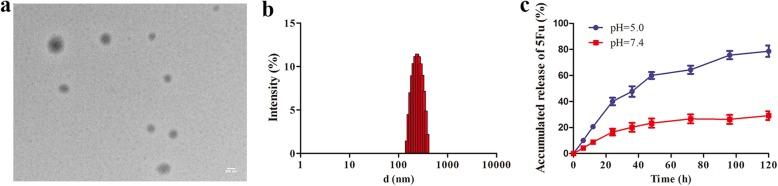
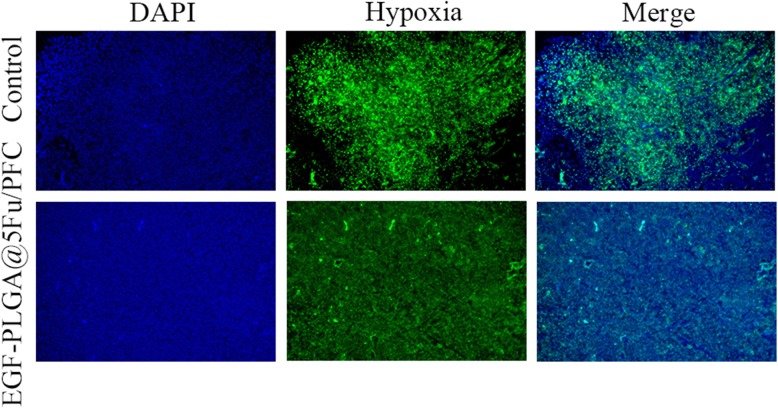
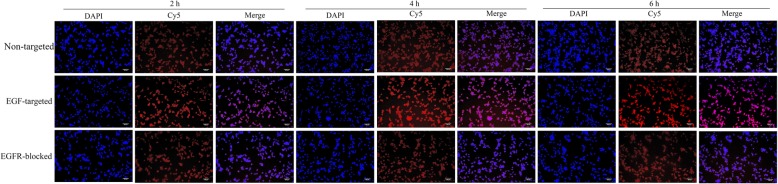
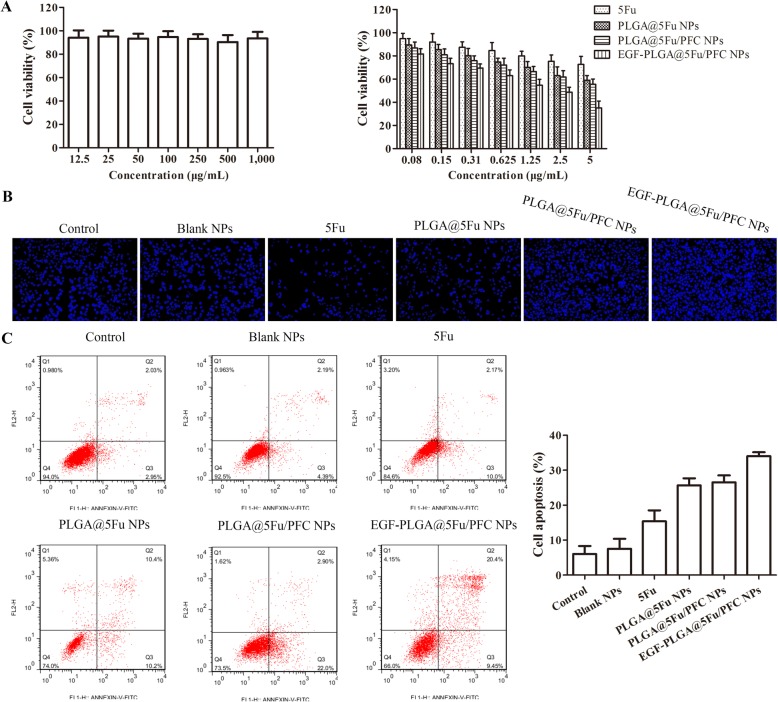
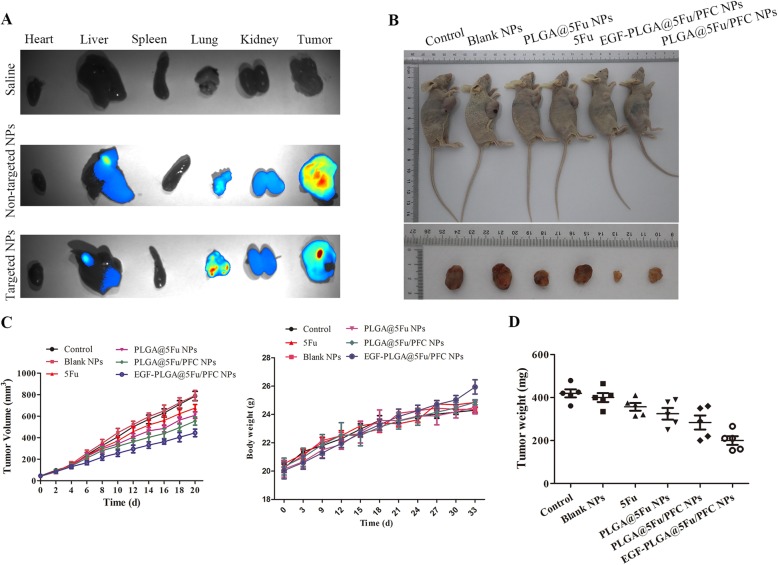
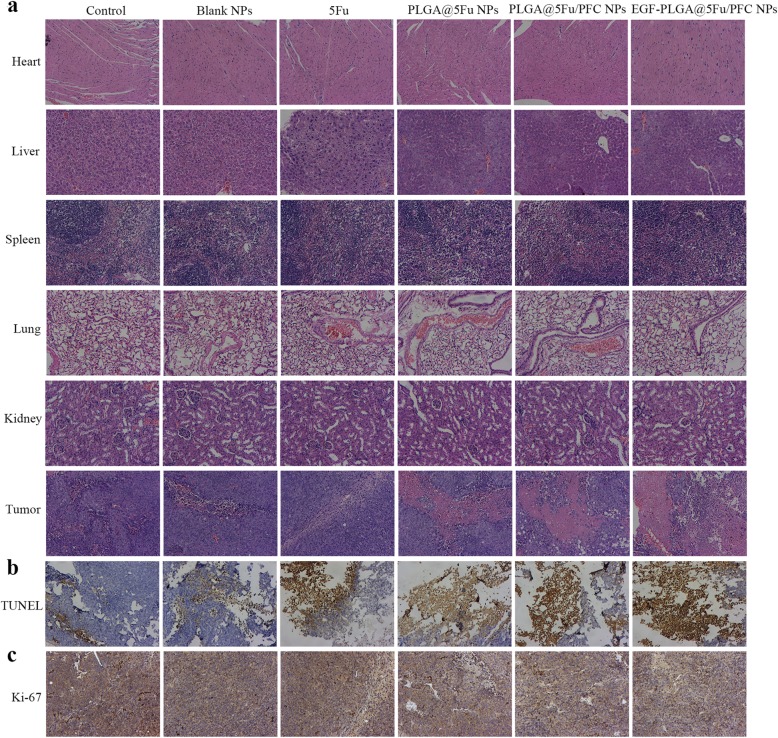
The findings showed that EGF-PLGA@5Fu /PFC NPs had an average size 200 nm and a 5Fu-loading efficiency of 7.29%. Furthermore, in vitro release was pH-sensitive. Targeted EGF-PLGA@5Fu/PFC NPs exhibited higher cellular uptake than non-targeted NPs into colon cancer cells. In addition, EGF-PLGA@5Fu/PFC NPs suppressed cell viability and induced apoptosis in SW620 cells to a greater extent than non-targeted NPs. In tumor xenografted mice, EGF-PLGA@5Fu/PFC NPs suppressed tumor growth more effectively than 5Fu, PLGA@5Fu or PLGA@5Fu/PFC NPs. Histopathological analysis further demonstrated that EGF-targeted NPs inhibited tumor growth to a greater extent than non-targeted or non-NP treatments. The improved therapeutic outcomes observed in this study were due to relief of tumor hypoxia by transport of oxygen by PFC to the tumors.
We constructed a biocompatible nanodrug delivery system based on functionalized nanoparticles that provided a novel strategy for selective delivery of chemotherapy drugs to tumors.
结肠癌患者肿瘤复发和转移的发生率很高。寻找有效的结肠癌治疗策略至关重要。聚(乳酸-共-乙醇酸)(PLGA)最近被证明具有作为广泛的治疗性药物递送系统的潜力。我们设计了一种双重载药纳米粒药物递送系统,以克服用于治疗结肠癌的化疗药物的局限性。
我们开发了表皮生长因子(EGF)功能化的 PLGA 纳米粒(NPs),共同负载 5-氟尿嘧啶(5Fu)和全氟碳(PFC)(EGF-PLGA@5Fu/PFC),用于结肠癌的靶向治疗。CCK-8 检测、Hoechst33342 染色和流式细胞术用于研究 EGF-PLGA@5Fu/PFC NPs 在 SW620 细胞中的作用。此外,动物实验、组织学分析和免疫荧光染色进一步证实了 EGF-PLGA@5Fu/PFC NPs 在体内的作用。
结果表明,EGF-PLGA@5Fu/PFC NPs 的平均粒径为 200nm,5Fu 载药效率为 7.29%。此外,体外释放具有 pH 敏感性。与非靶向 NPs 相比,靶向 EGF-PLGA@5Fu/PFC NPs 进入结肠癌细胞的细胞摄取更高。此外,EGF-PLGA@5Fu/PFC NPs 比非靶向 NPs 更能抑制 SW620 细胞的活力并诱导其凋亡。在肿瘤异种移植小鼠中,EGF-PLGA@5Fu/PFC NPs 比 5Fu、PLGA@5Fu 或 PLGA@5Fu/PFC NPs 更有效地抑制肿瘤生长。组织病理学分析进一步表明,与非靶向或非 NP 处理相比,EGF 靶向 NPs 更能抑制肿瘤生长。本研究中观察到的改善的治疗效果归因于 PFC 将氧气输送到肿瘤中缓解肿瘤缺氧。
我们构建了一种基于功能化纳米粒的生物相容性纳米药物递送系统,为化疗药物的肿瘤选择性递送提供了一种新策略。