Department of Life Science and Technology, Tokyo Institute of Technology, 4259 Nagatsuta, Midori-ku, Yokohama, 226-8501, Japan.
NODAI Genome Research Center, Tokyo University of Agriculture, 1-1-1 Sakuragaoka, Setagaya-ku, Tokyo, 156-8502, Japan.
Sci Rep. 2020 Apr 28;10(1):7128. doi: 10.1038/s41598-020-63981-x.
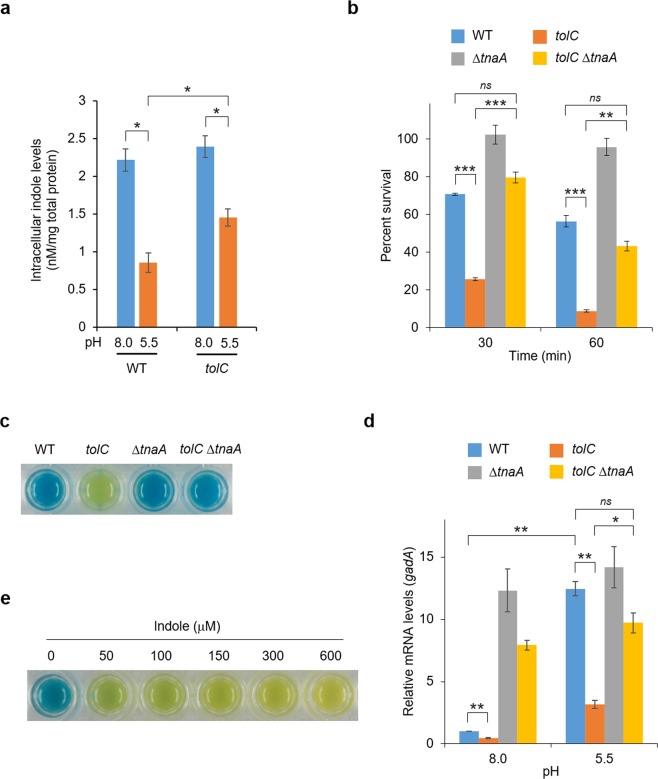
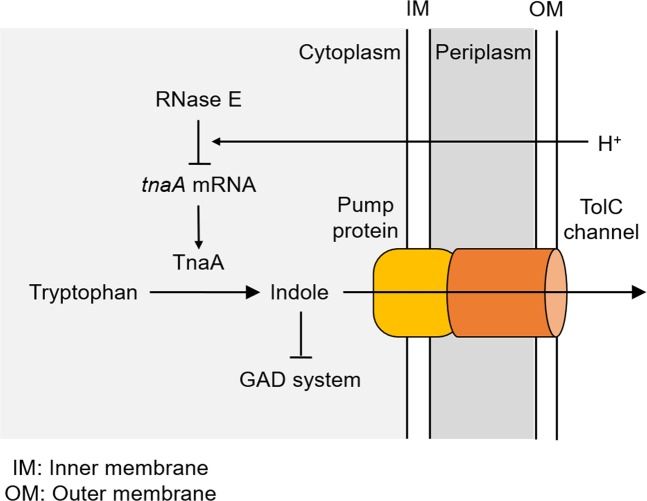
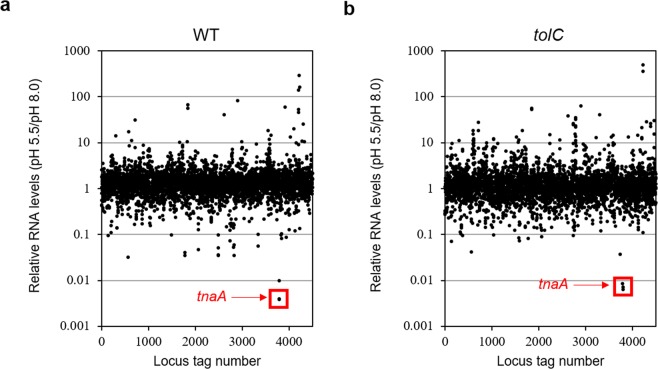
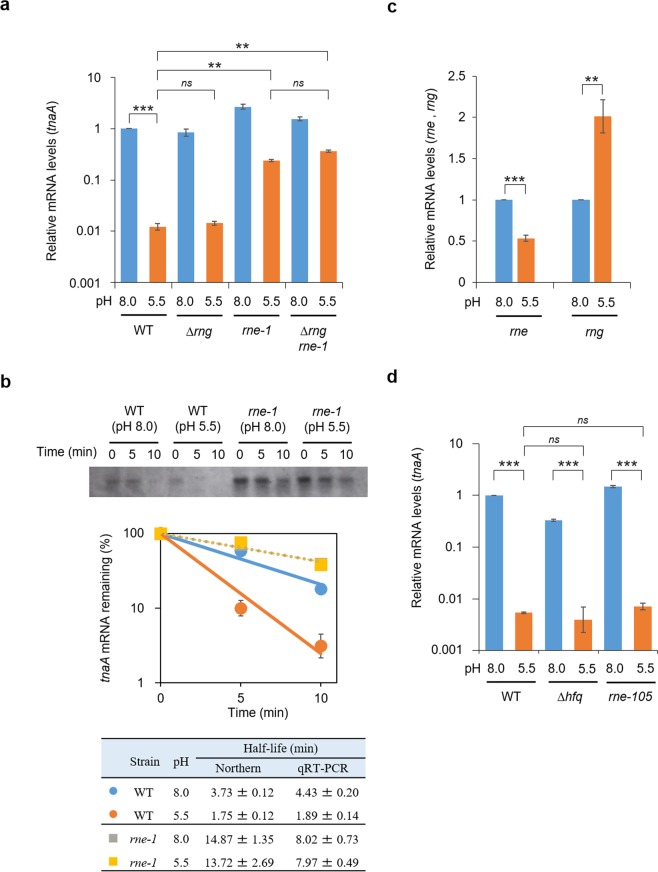
Acid-resistance systems are essential for pathogenic Escherichia coli to survive in the strongly acidic environment of the human stomach (pH < 2.5). Among these, the glutamic acid decarboxylase (GAD) system is the most effective. However, the precise mechanism of GAD induction is unknown. We previously reported that a tolC mutant lacking the TolC outer membrane channel was defective in GAD induction. Here, we show that indole, a substrate of TolC-dependent efflux pumps and produced by the tryptophanase encoded by the tnaA gene, negatively regulates GAD expression. GAD expression was restored by deleting tnaA in the tolC mutant; in wild-type E. coli, it was suppressed by adding indole to the growth medium. RNA-sequencing revealed that tnaA mRNA levels drastically decreased upon exposure to moderately acidic conditions (pH 5.5). This decrease was suppressed by RNase E deficiency. Collectively, our results demonstrate that the RNase E-dependent degradation of tnaA mRNA is accelerated upon acid exposure, which decreases intracellular indole concentrations and triggers GAD induction.
酸抗性系统对于致病性大肠杆菌在人类胃部的强酸性环境(pH 值<2.5)中生存至关重要。在这些系统中,谷氨酸脱羧酶(GAD)系统最为有效。然而,GAD 诱导的确切机制尚不清楚。我们之前曾报道,缺乏 TolC 外膜通道的 tolC 突变体在 GAD 诱导方面存在缺陷。在这里,我们表明色氨酸酶编码的色氨酸酶基因 tnaA 产生的色氨酸,作为 TolC 依赖性外排泵的底物,负调控 GAD 的表达。在 tolC 突变体中删除 tnaA 可恢复 GAD 的表达;在野生型大肠杆菌中,向生长培养基中添加色氨酸会抑制 GAD 的表达。RNA 测序显示,tnaA mRNA 水平在接触中度酸性条件(pH 5.5)时大幅下降。这种下降受到 RNase E 缺乏的抑制。总之,我们的结果表明,RNase E 依赖性 tnaA mRNA 的降解在酸暴露时加速,这降低了细胞内色氨酸的浓度并触发 GAD 诱导。