Department of Biological Sciences, University of Alabama in Huntsvillegrid.265893.3, Huntsville, Alabama, USA.
Department of Microbiology-Immunology, Northwestern University Feinberg School of Medicine, Chicago, Illinois, USA.
Microbiol Spectr. 2022 Apr 27;10(2):e0226121. doi: 10.1128/spectrum.02261-21. Epub 2022 Mar 21.
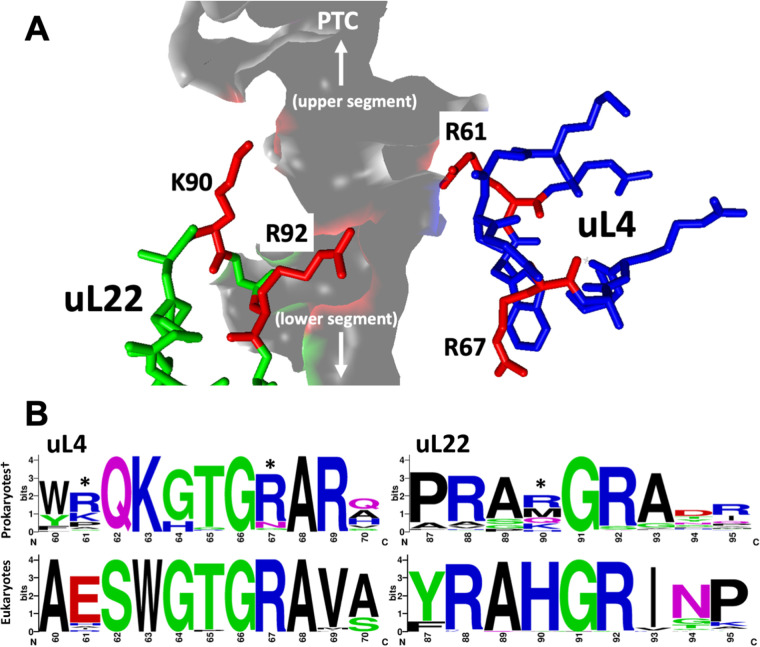
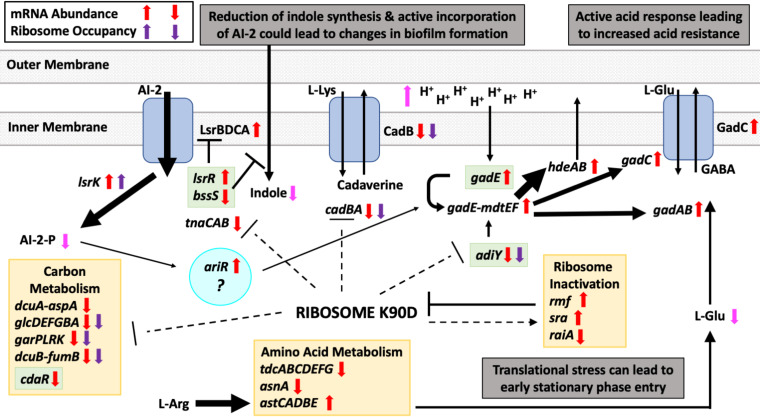
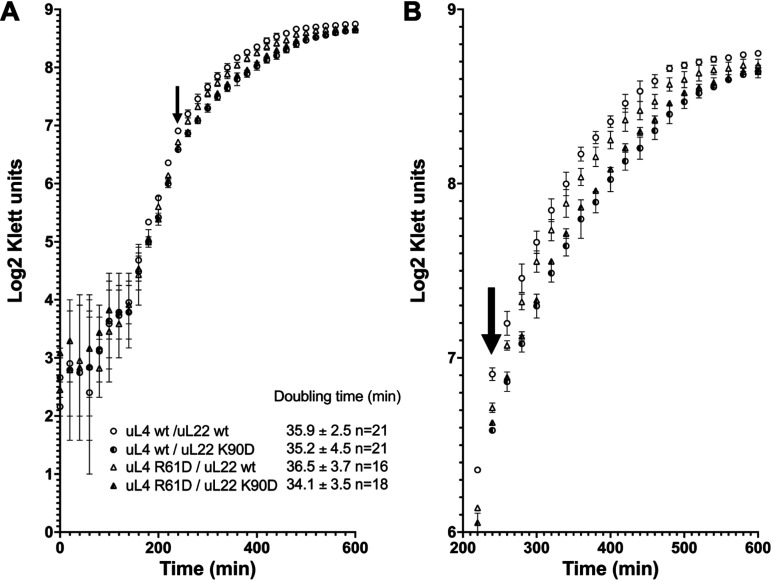
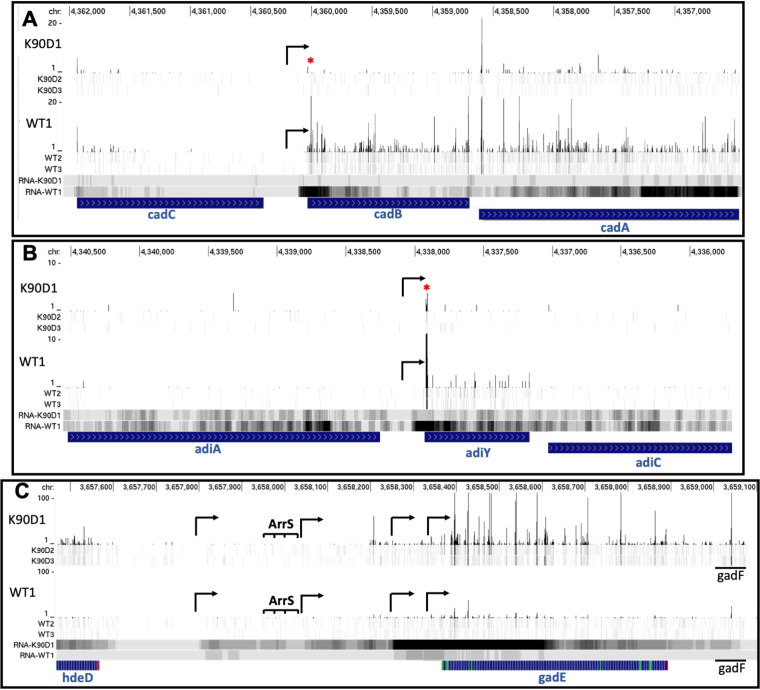
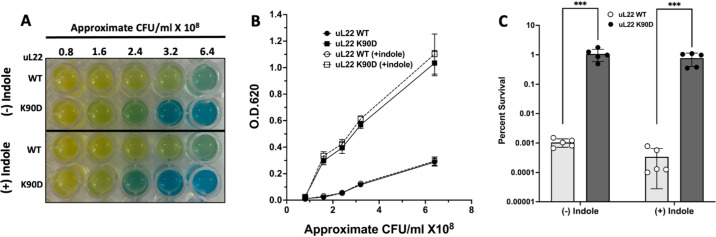
Mutational changes in bacterial ribosomes often affect gene expression and consequently cellular fitness. Understanding how mutant ribosomes disrupt global gene expression is critical to determining key genetic factors that affect bacterial survival. Here, we describe gene expression and phenotypic changes presented in Escherichia coli cells carrying an uL22(K90D) mutant ribosomal protein, which displayed alterations during growth. Ribosome profiling analyses revealed reduced expression of operons involved in catabolism, indole production, and lysine-dependent acid resistance. In general, translation initiation of proximal genes in several of these affected operons was substantially reduced. These reductions in expression were accompanied by increases in the expression of acid-induced membrane proteins and chaperones, the glutamate-decarboxylase regulon, and the autoinducer-2 metabolic regulon. In agreement with these changes, uL22(K90D) mutant cells had higher glutamate decarboxylase activity, survived better in extremely acidic conditions, and generated more biofilm in static cultures compared to their parental strain. Our work demonstrates that a single mutation in a non-conserved residue of a ribosomal protein affects a substantial number of genes to alter pH resistance and the formation of biofilms. All newly synthesized proteins must pass through a channel in the ribosome named the exit tunnel before emerging into the cytoplasm, membrane, and other compartments. The structural characteristics of the tunnel could govern protein folding and gene expression in a species-specific manner but how the identity of tunnel elements influences gene expression is less well-understood. Our global transcriptomics and translatome profiling demonstrate that a single substitution in a non-conserved amino acid of the E. coli tunnel protein uL22 has a profound impact on catabolism, cellular signaling, and acid resistance systems. Consequently, cells bearing the uL22 mutant ribosomes had an increased ability to survive acidic conditions and form biofilms. This work reveals a previously unrecognized link between tunnel identity and bacterial stress adaptation involving pH response and biofilm formation.
细菌核糖体的突变变化经常影响基因表达,从而影响细胞适应性。了解突变核糖体如何破坏全局基因表达对于确定影响细菌生存的关键遗传因素至关重要。在这里,我们描述了携带 uL22(K90D)突变核糖体蛋白的大肠杆菌细胞中呈现的基因表达和表型变化,该蛋白在生长过程中发生了改变。核糖体谱分析显示,参与分解代谢、吲哚产生和赖氨酸依赖性酸抗性的操纵子的表达降低。一般来说,这些受影响的操纵子中近端基因的翻译起始明显减少。这些表达的减少伴随着酸诱导的膜蛋白和伴侣、谷氨酸脱羧酶调控子和自动诱导物-2 代谢调控子的表达增加。与这些变化一致,uL22(K90D)突变细胞的谷氨酸脱羧酶活性更高,在极端酸性条件下的生存能力更好,并且在静态培养物中产生更多的生物膜,与它们的亲本菌株相比。我们的工作表明,核糖体蛋白中一个非保守残基的单个突变会影响大量基因,从而改变 pH 抗性和生物膜的形成。所有新合成的蛋白质都必须通过核糖体中的一个通道,称为出口隧道,然后才能进入细胞质、膜和其他隔室。隧道的结构特征可以以物种特异性的方式控制蛋白质折叠和基因表达,但隧道元素的身份如何影响基因表达则知之甚少。我们的全局转录组学和翻译组学分析表明,大肠杆菌隧道蛋白 uL22 中一个非保守氨基酸的单个取代对分解代谢、细胞信号转导和酸抗性系统有深远影响。因此,携带 uL22 突变核糖体的细胞具有更强的在酸性条件下生存和形成生物膜的能力。这项工作揭示了隧道身份与涉及 pH 反应和生物膜形成的细菌应激适应之间以前未被认识到的联系。