Department of Orthopedics, Shanghai Changhai Hospital, Second Military Medical University, Shanghai, China.
China-South Korea Bioengineering Center, Shanghai, China.
J Cell Mol Med. 2020 Jun;24(11):6149-6161. doi: 10.1111/jcmm.15229. Epub 2020 Apr 28.
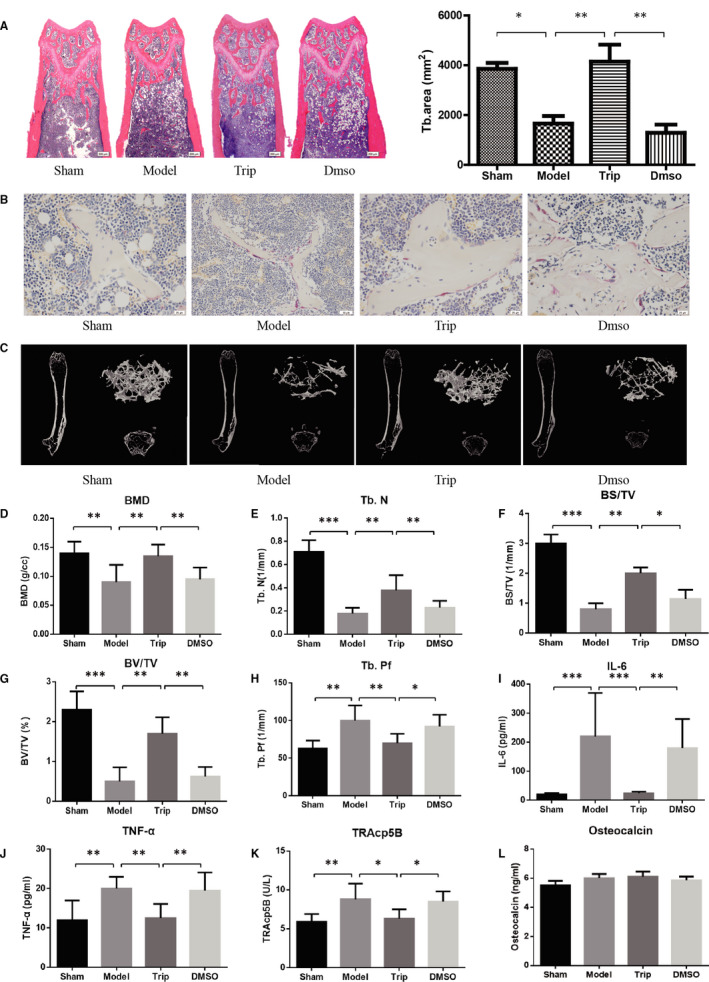
Bone loss (osteopenia) is a common complication in human solid tumour. In addition, after surgical treatment of gynaecological tumour, osteoporosis often occurs due to the withdrawal of oestrogen. The major characteristic of osteoporosis is the low bone mass with micro-architectural deteriorated bone tissue. And the main cause is the overactivation of osteoclastogenesis, which is one of the most important therapeutic targets. Inflammation could induce the interaction of RANKL/RANK, which is the promoter of osteoclastogenesis. Triptolide is derived from the traditional Chinese herb lei gong teng, presented multiple biological effects, including anti-cancer, anti-inflammation and immunosuppression. We hypothesized that triptolide could inhibits osteoclastogenesis by suppressing inflammation activation. In this study, we confirmed that triptolide could suppress RANKL-induced osteoclastogenesis in bone marrow mononuclear cells (BMMCs) and RAW264.7 cells and inhibited the osteoclast bone resorption functions. PI3K-AKT-NFATc1 pathway is one of the most important downstream pathways of RANKL-induced osteogenesis. The experiments in vitro indicated that triptolide suppresses the activation of PI3K-AKT-NFATc1 pathway and the target point located at the upstream of AKT because both NFATc1 overexpression and AKT phosphorylation could ameliorate the triptolide suppression effects. The expression of MDM2 was elevated, which demonstrated the MDM-p53-induced cell death might contribute to the osteoclastogenesis suppression. Ovariectomy-induced bone loss and inflammation activation were also found to be ameliorated in the experiments in vivo. In summary, the new effect of anti-cancer drug triptolide was demonstrated to be anti-osteoclastogenesis, and we demonstrated triptolide might be a promising therapy for bone loss caused by tumour.
骨丢失(骨质疏松症)是人类实体瘤的常见并发症。此外,妇科肿瘤手术后,由于雌激素的撤出,常发生骨质疏松症。骨质疏松症的主要特征是骨量低,骨组织微观结构恶化。主要原因是破骨细胞生成过度激活,这是最重要的治疗靶点之一。炎症可诱导 RANKL/RANK 的相互作用,这是破骨细胞生成的促进剂。雷公藤红素来源于传统中药雷公藤,具有多种生物学作用,包括抗癌、抗炎和免疫抑制作用。我们假设雷公藤红素可以通过抑制炎症激活来抑制破骨细胞生成。在这项研究中,我们证实雷公藤红素可以抑制骨髓单核细胞(BMMCs)和 RAW264.7 细胞中 RANKL 诱导的破骨细胞生成,并抑制破骨细胞的骨吸收功能。PI3K-AKT-NFATc1 通路是 RANKL 诱导成骨作用的最重要下游通路之一。体外实验表明,雷公藤红素抑制 PI3K-AKT-NFATc1 通路的激活,作用点位于 AKT 的上游,因为 NFATc1 过表达和 AKT 磷酸化都可以改善雷公藤红素的抑制作用。MDM2 的表达升高,表明 MDM-p53 诱导的细胞死亡可能有助于抑制破骨细胞生成。体内实验也发现卵巢切除术诱导的骨丢失和炎症激活得到改善。综上所述,抗癌药物雷公藤红素的新作用被证明是抗破骨细胞生成,我们证明雷公藤红素可能是治疗肿瘤引起的骨丢失的一种有前途的疗法。