Center for Gene Research, Nagoya University, Chikusa-ku, Nagoya, Japan.
Institute of Transformative Bio-Molecules (WPI-ITbM), Nagoya University, Chikusa-ku, Nagoya, Japan.
PLoS One. 2020 Apr 29;15(4):e0232366. doi: 10.1371/journal.pone.0232366. eCollection 2020.
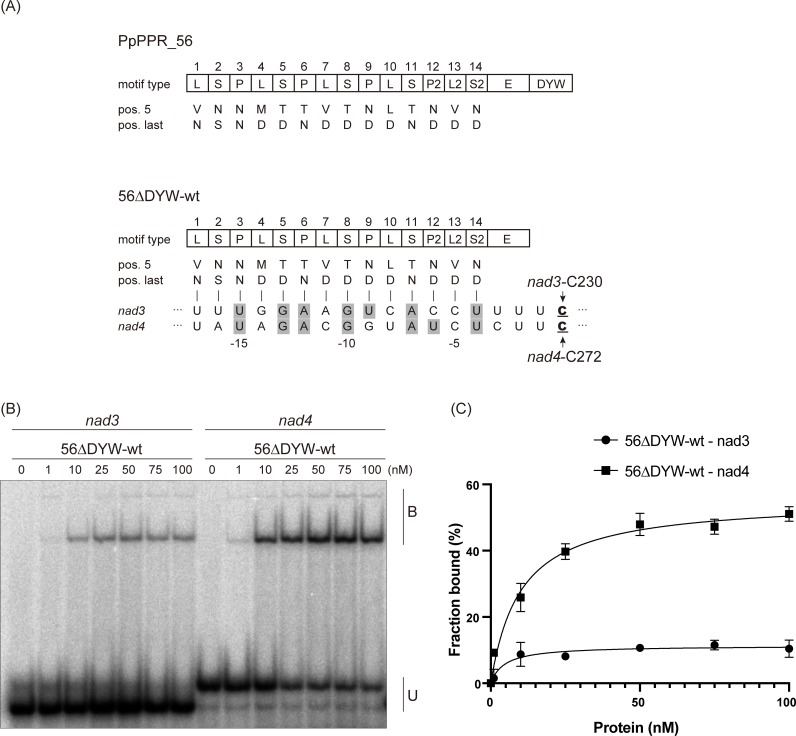
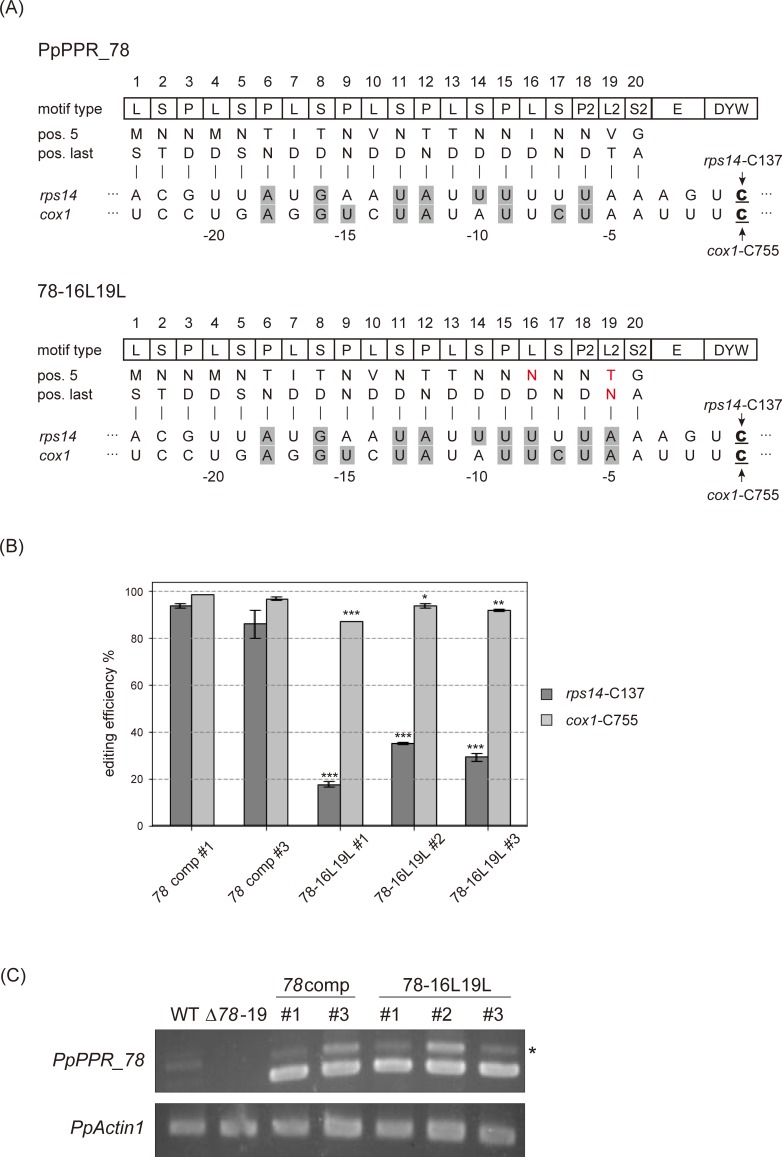
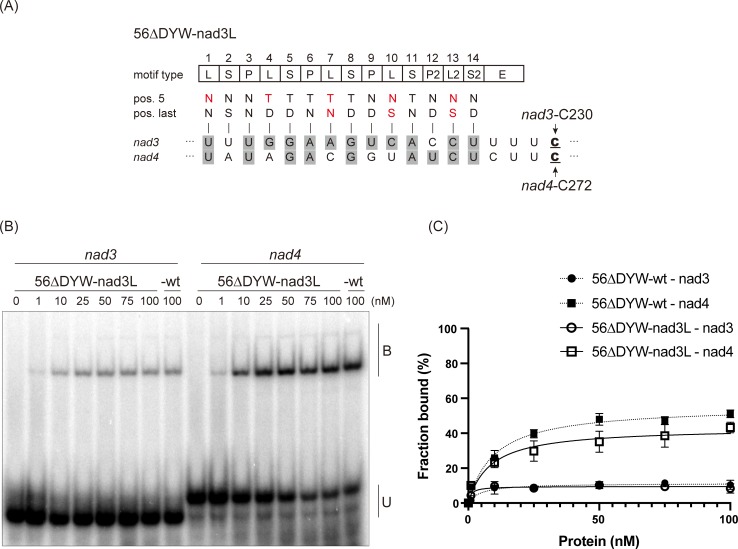
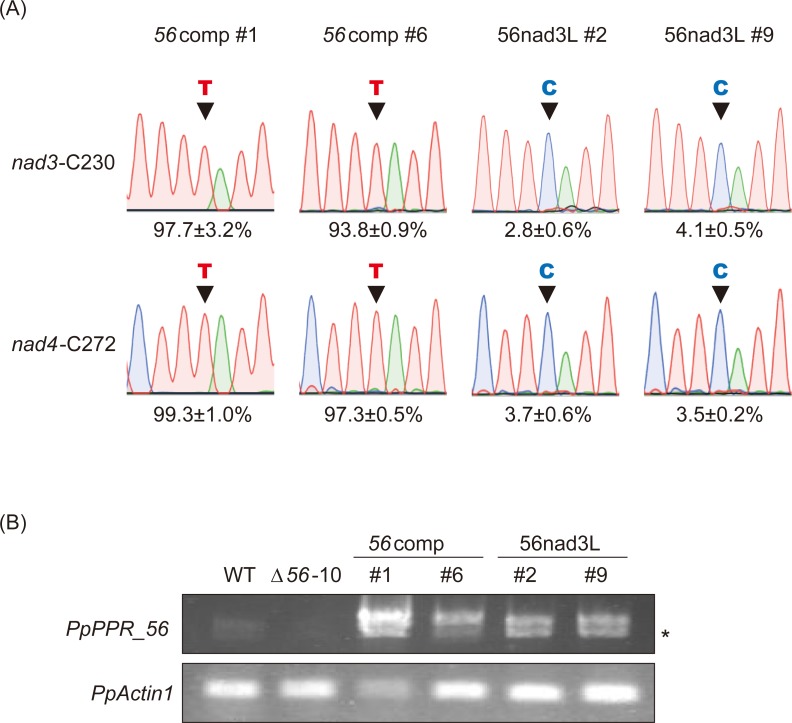
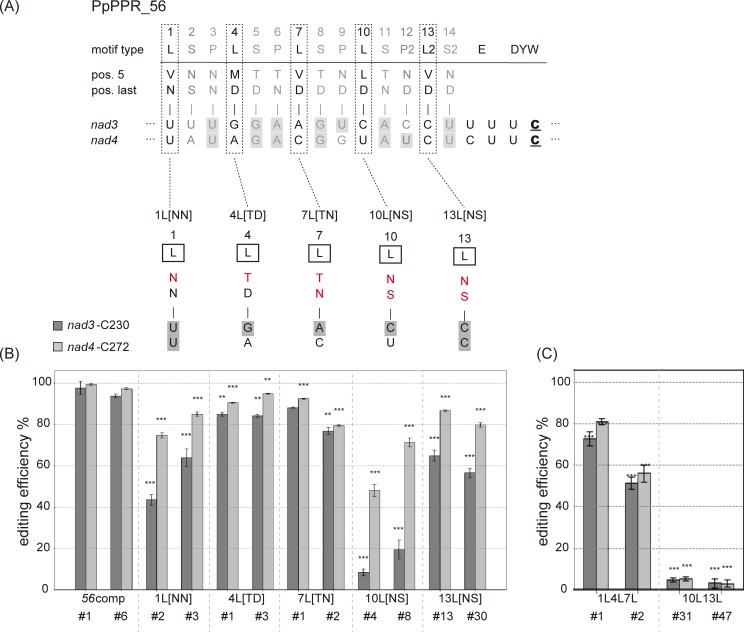
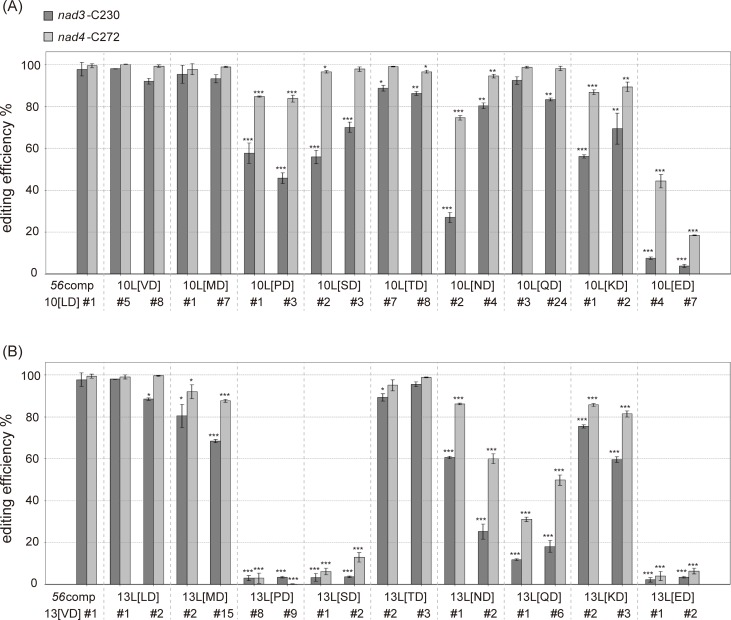
Pentatricopeptide repeat (PPR) proteins, composed of PPR motifs repeated in tandem, are sequence-specific RNA binding proteins. Recent bioinformatic studies have shown that the combination of polar amino acids at positions 5 and last in each PPR motif recognizes RNA bases, and an RNA recognition code for PPR proteins has been proposed. Subsequent studies confirmed that the P (canonical length) and S (short) motifs bind to specific nucleotides according to this code. However, the contribution of L (long) motifs to RNA recognition is mostly controversial, owing to the presence of a nonpolar amino acid at position 5. The PLS-class PPR protein PpPPR_56 is a mitochondrial RNA editing factor in the moss Physcomitrella patens. Here, we performed in vitro RNA binding and in vivo complementation assays with PpPPR_56 and its variants containing mutated L motifs to investigate their contributions to RNA recognition. In vitro RNA binding assay showed that the original combination of amino acids at positions 5 and last in the L motifs of PpPPR_56 is not required for RNA recognition. In addition, an in vivo complementation assay with RNA editing factors PpPPR_56 and PpPPR_78 revealed the importance of nonpolar amino acids at position 5 of C-terminal L motifs for efficient RNA editing. Our findings suggest that L motifs function as non-binding spacers, not as RNA-binding motifs, to facilitate the formation of a complex between PLS-class PPR protein and RNA. As a result, the DYW domain, a putative catalytic deaminase responsible for C-to-U RNA editing, is correctly placed in proximity to C, which is to be edited.
五肽重复(PPR)蛋白由串联重复的 PPR 基序组成,是序列特异性的 RNA 结合蛋白。最近的生物信息学研究表明,每个 PPR 基序中第 5 位和最后一位的极性氨基酸组合识别 RNA 碱基,并提出了 PPR 蛋白的 RNA 识别密码。随后的研究证实,根据该密码,P(典型长度)和 S(短)基序结合到特定的核苷酸。然而,由于第 5 位存在非极性氨基酸,L(长)基序对 RNA 识别的贡献在很大程度上存在争议。PPR 蛋白 PpPPR_56 是苔藓Physcomitrella patens 中的线粒体 RNA 编辑因子。在这里,我们用 PpPPR_56 及其含有突变 L 基序的变体进行了体外 RNA 结合和体内互补测定,以研究它们对 RNA 识别的贡献。体外 RNA 结合测定表明,PpPPR_56 L 基序第 5 位和最后一位的原始氨基酸组合不是 RNA 识别所必需的。此外,用 RNA 编辑因子 PpPPR_56 和 PpPPR_78 进行的体内互补测定揭示了 C 端 L 基序第 5 位非极性氨基酸对有效 RNA 编辑的重要性。我们的研究结果表明,L 基序作为非结合间隔物发挥作用,而不是 RNA 结合基序,以促进 PLS 类 PPR 蛋白与 RNA 之间复合物的形成。结果,DYW 结构域,一个负责 C 到 U RNA 编辑的假定催化脱氨酶,正确地放置在要编辑的 C 附近。