Department of Nephrology, School of Medicine, University of Dicle, Diyarbakır, Turkey.
Department of Internal Medicine, School of Medicine, University of Dicle, Diyarbakır, Turkey.
Rev Soc Bras Med Trop. 2020;53:e20200016. doi: 10.1590/0037-8682-0016-2020. Epub 2020 Apr 27.
Sepsis is an important cause of mortality and morbidity, and inflammatory response and oxidative stress play major roles underlying its pathophysiology. Here, we evaluated the effect of intraperitoneal etanercept administration on oxidative stress and inflammation indicators in the kidney and blood of experimental sepsis-induced rats.
Twenty-eight adult Sprague Dawley rats were classified into Control (Group 1), Sepsis (Group 2), Sepsis+Cefazolin (Group 3), and Sepsis+Cefazolin+Etanercept (Group 4) groups. Kidney tissue and serum samples were obtained for biochemical and histopathological investigations and examined for the C reactive protein (CRP), tumor necrosis factor-alpha (TNF-α), triggering receptor expressed on myeloid cells (TREM), and malondialdehyde (MDA) levels.
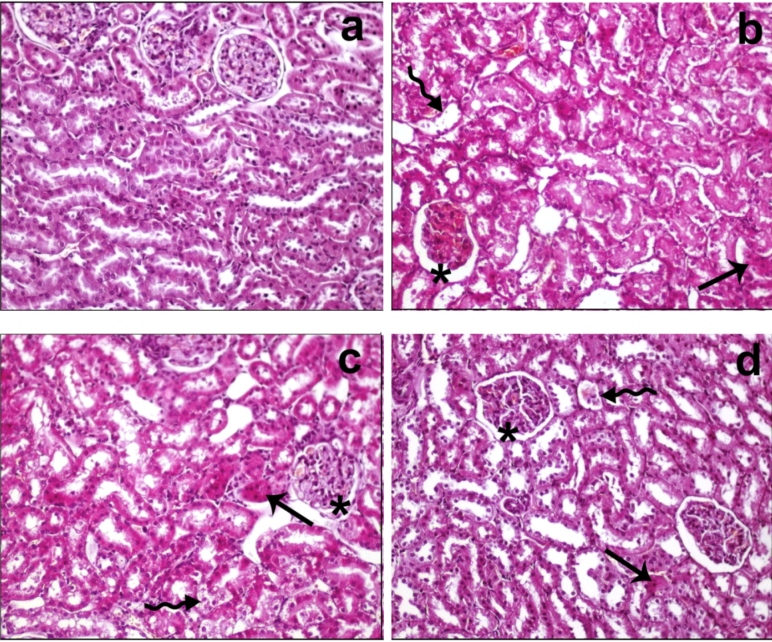
The levels of TNF-α, TREM, and MDA in serum and kidney samples were significantly higher in rats from sepsis group than in rats from control group (p < 0.05). Group 3 showed a significant reduction in serum levels of TNF-α, CRP, and TREM as compared with Group 2 (p < 0.05). Serum TNF-α, CRP, TREM, and MDA levels and kidney TNF-α and TREM levels were significantly lower in Group 4 than in Group 2 (p < 0.05). Serum TNF-α and TREM levels in Group 4 were significantly lower than those in Group 3, and histopathological scores were significantly lower in Group 3 and Group 4 than in Group 2 (p < 0.05). Histopathological scores of Group 4 were significantly lower than those of Group 3 (p < 0.05).
Etanercept, a TNF-α inhibitor, may ameliorate sepsis-induced oxidative stress, inflammation, and histopathological damage.
败血症是导致死亡率和发病率的重要原因,炎症反应和氧化应激在其病理生理学中起主要作用。在这里,我们评估了腹腔内给予依那西普对实验性败血症诱导大鼠肾脏和血液中氧化应激和炎症指标的影响。
将 28 只成年 Sprague Dawley 大鼠分为对照组(第 1 组)、败血症组(第 2 组)、败血症+头孢唑林组(第 3 组)和败血症+头孢唑林+依那西普组(第 4 组)。采集肾脏组织和血清样本进行生化和组织病理学检查,并检测 C 反应蛋白(CRP)、肿瘤坏死因子-α(TNF-α)、髓样细胞触发受体(TREM)和丙二醛(MDA)水平。
与对照组相比,败血症组大鼠血清和肾脏样本中 TNF-α、TREM 和 MDA 水平显著升高(p < 0.05)。与第 2 组相比,第 3 组大鼠血清中 TNF-α、CRP 和 TREM 水平显著降低(p < 0.05)。与第 2 组相比,第 4 组大鼠血清中 TNF-α、CRP、TREM 和 MDA 水平以及肾脏中 TNF-α和 TREM 水平均显著降低(p < 0.05)。与第 3 组相比,第 4 组大鼠血清中 TNF-α和 TREM 水平显著降低,第 3 组和第 4 组大鼠的组织病理学评分均显著低于第 2 组(p < 0.05)。与第 3 组相比,第 4 组大鼠的组织病理学评分显著降低(p < 0.05)。
TNF-α 抑制剂依那西普可改善败血症引起的氧化应激、炎症和组织病理学损伤。