Centre for Mechanochemical Cell Biology, University of Warwick, Coventry, UK; Division of Biomedical Sciences, Warwick Medical School, University of Warwick, Coventry, UK.
Centre for Mechanochemical Cell Biology, University of Warwick, Coventry, UK; Mathematics Institute, University of Warwick, Coventry, UK.
Cell Rep. 2020 Apr 28;31(4):107535. doi: 10.1016/j.celrep.2020.107535.
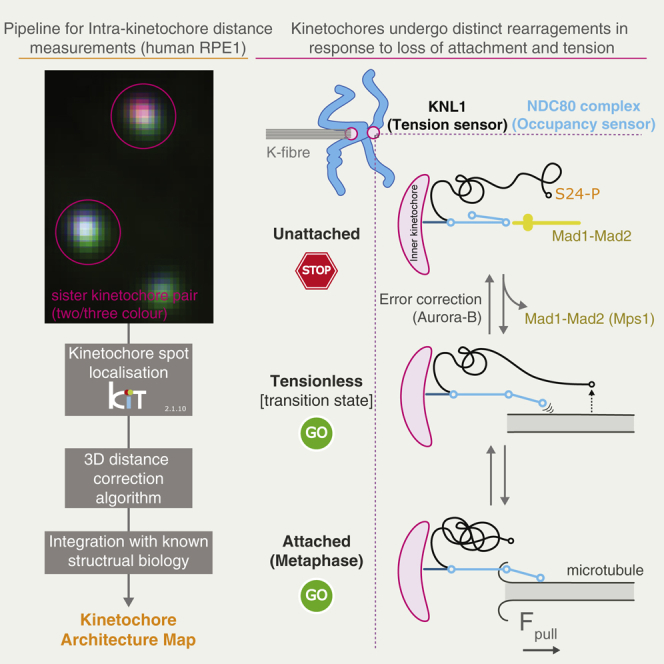
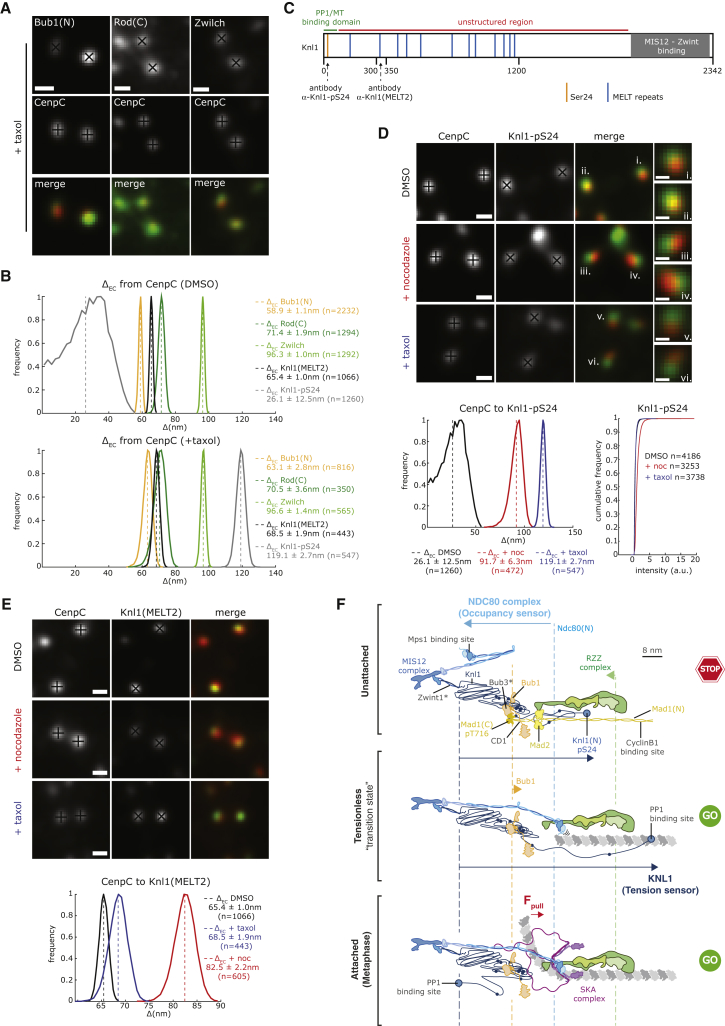
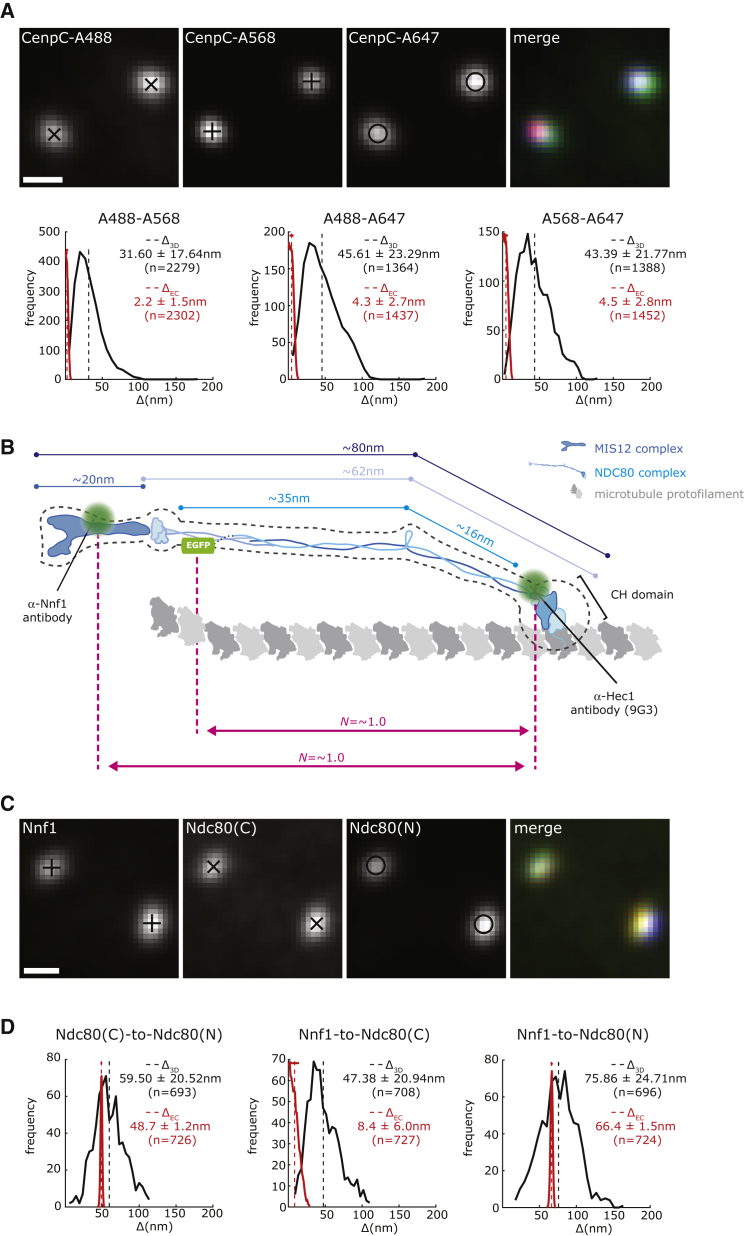
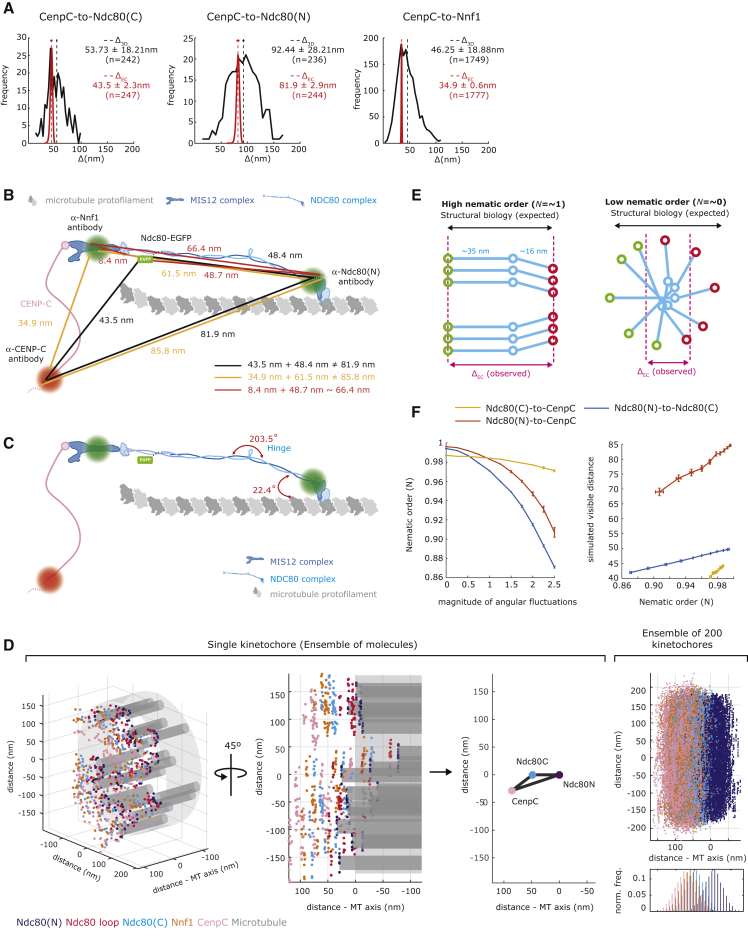
Kinetochores are multi-protein machines that form dynamic attachments to microtubules and control chromosome segregation. High fidelity is ensured because kinetochores can monitor attachment status and tension, using this information to activate checkpoints and error-correction mechanisms. To explore how kinetochores achieve this, we used two- and three-color subpixel fluorescence localization to define how proteins from six major complexes (CCAN, MIS12, NDC80, KNL1, RZZ, and SKA) and the checkpoint proteins Bub1, Mad1, and Mad2 are organized in the human kinetochore. This reveals how the outer kinetochore has a high nematic order and is largely invariant to the loss of attachment or tension, except for two mechanical sensors. First, Knl1 unravels to relay tension, and second, NDC80 undergoes jackknifing and loss of nematic order under microtubule detachment, with only the latter wired up to the checkpoint signaling system. This provides insight into how kinetochores integrate mechanical signals to promote error-free chromosome segregation.
着丝粒是一种多蛋白机器,能够与微管形成动态连接,并控制染色体分离。由于着丝粒可以监测连接状态和张力,并利用这些信息激活检查点和纠错机制,因此能够确保高度的保真度。为了探究着丝粒如何实现这一点,我们使用双色和三色亚像素荧光定位来定义来自六个主要复合物(CCAN、MIS12、NDC80、KNL1、RZZ 和 SKA)以及检查点蛋白 Bub1、Mad1 和 Mad2 的蛋白质在人类着丝粒中的组织方式。这揭示了外着丝粒具有较高的向列有序性,并且在很大程度上不受连接或张力丧失的影响,除了两个机械传感器。首先,Knl1 解开以传递张力,其次,NDC80 在微管脱离时经历了折刀式运动和向列有序性的丧失,只有后者与检查点信号系统相连。这为了解着丝粒如何整合机械信号以促进无错误的染色体分离提供了线索。