ZHAW Zurich University of Applied Sciences, School of Health Professions, Institute of Health Sciences, Technikumstrasse 71, 8401, Winterthur, Switzerland.
University of Basel, Medical Faculty, Department of Public Health, Institute of Nursing Science, Bernoullistrasse 28, 4056, Basel, Switzerland.
BMC Health Serv Res. 2020 Apr 29;20(1):366. doi: 10.1186/s12913-020-05238-x.
One way of measuring the quality of home care are quality indicators (QIs) derived from data collected with the Resident Assessment Instrument-Home Care (RAI-HC). In order to produce meaningful results for quality improvement and quality comparisons across home care organizations (HCOs) and over time, RAI-HC QIs must be valid and reliable. The aim of this systematic review was to identify currently existing RAI-HC QIs and to summarize the scientific knowledge on the validity and reliability of these QIs.
A systematic review was performed using the electronic databases PubMed, CINAHL, Embase, PsycINFO and Cochrane Library. Studies describing the development process or the psychometric characteristics of RAI-HC QIs were eligible. The data extraction involved a general description of the included studies as well as the identified RAI-HC QIs and information on validity and reliability. The methodological quality of the identified RAI-HC QI sets was assessed using the Appraisal of Indicators through Research and Evaluation (AIRE) instrument.
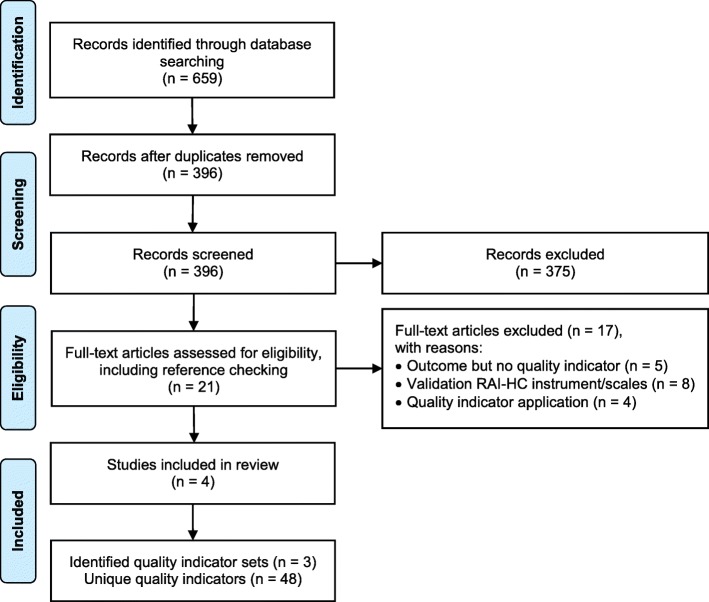
Four studies out of 659 initial hits met the inclusion criteria. The included studies described the development and validation process of three RAI-HC QI sets comprising 48 unique RAI-HC QIs, which predominantly refer to outcome of care. Overall, the validity and reliability of the identified RAI-HC QIs were not sufficiently tested. The methodological quality of the three identified RAI-HC QI sets varied across the four AIRE instrument domains. None of the QI sets reached high methodological quality, defined as scores of 50% and higher in all four AIRE instrument domains.
This is the first review that systematically summarized and appraised the available scientific evidence on the validity and reliability of RAI-HC QIs. It identified insufficient reporting of RAI-HC QIs validation processes and reliability as well as missing state-of-the-art methodologies. The review provides guidance as to what additional validity and reliability testing are needed to strengthen the scientific soundness of RAI-HC QIs. Considering that RAI-HC QIs are already implemented and used to measure and compare quality of home care, further investigations on RAI-HC QIs reliability and validity is recommended.
衡量家庭护理质量的一种方法是使用居民评估工具-家庭护理(RAI-HC)收集的数据得出的质量指标(QIs)。为了为家庭护理组织(HCO)之间和随时间推移的质量改进和质量比较产生有意义的结果,RAI-HC QIs 必须是有效的和可靠的。本系统评价的目的是确定当前现有的 RAI-HC QIs,并总结这些 QIs 的有效性和可靠性的科学知识。
使用电子数据库 PubMed、CINAHL、Embase、PsycINFO 和 Cochrane Library 进行系统评价。有资格描述 RAI-HC QIs 的开发过程或心理测量特征的研究。数据提取包括对纳入研究的一般描述以及确定的 RAI-HC QIs 和有效性和可靠性信息。使用评估指标的研究和评价(AIRE)工具评估确定的 RAI-HC QI 集的方法学质量。
从 659 个初始结果中,有 4 项研究符合纳入标准。纳入的研究描述了三个 RAI-HC QI 集的开发和验证过程,其中包含 48 个独特的 RAI-HC QIs,主要涉及护理结果。总体而言,确定的 RAI-HC QIs 的有效性和可靠性没有得到充分检验。三个确定的 RAI-HC QI 集的方法学质量在四个 AIRE 仪器领域各不相同。没有一个 QI 集达到高方法学质量,即所有四个 AIRE 仪器领域的分数都在 50%及以上。
这是第一个系统地总结和评估 RAI-HC QIs 的有效性和可靠性的现有科学证据的综述。它确定了 RAI-HC QIs 验证过程和可靠性报告不足以及缺乏最新方法。该综述为加强 RAI-HC QIs 的科学合理性需要进行哪些额外的有效性和可靠性测试提供了指导。考虑到 RAI-HC QIs 已经实施并用于衡量和比较家庭护理质量,建议对 RAI-HC QIs 的可靠性和有效性进行进一步研究。