School of Public Health and Health Systems, University of Waterloo, 200 University Ave W, Waterloo, ON, N2L 3G1, Canada.
BMC Med Inform Decis Mak. 2017 Oct 30;17(1):150. doi: 10.1186/s12911-017-0547-9.
The aim of this project is to describe the quality of assessment data regularly collected in home and community, with techniques adapted from an evaluation of the quality of long-term care data in Canada.
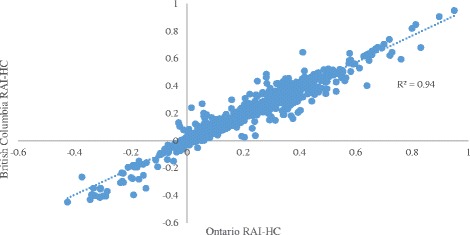
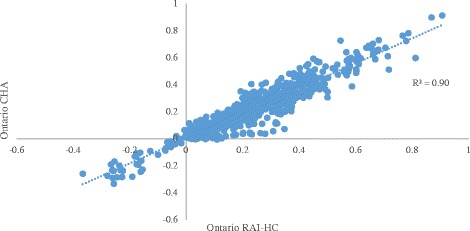
Data collected using the Resident Assessment Instrument - Home Care (RAI-HC) in Ontario and British Columbia (BC) as well as the interRAI Community Health Assessment (CHA) in Ontario were analyzed using descriptive statistics, Pearson's r correlation, and Cronbach's alpha in order to assess trends in population characteristics, convergent validity, and scale reliability.
Results indicate that RAI-HC data from Ontario and BC behave in a consistent manner, with stable trends in internal consistency providing evidence of good reliability (alpha values range from 0.72-0.94, depending on the scale and province). The associations between various scales, such as those reflecting functional status and cognition, were found to be as expected and stable over time within each setting (r values range from 0.42-0.45 in Ontario and 0.41-0.43 in BC). These trends in convergent validity demonstrate that constructs in the data behave as they should, providing evidence of good data quality. In most cases, CHA data quality matches that of RAI-HC data quality and shows evidence of good validity and reliability. The findings are comparable to the findings observed in the evaluation of data from the long-term care sector.
Despite an increasingly complex client population in the home and community care sectors, the results from this work indicate that data collected using the RAI-HC and the CHA are of an overall quality that may be trusted when used to inform decision-making at the organizational- or policy-level. High quality data and information are vital when used to inform steps taken to improve quality of care and enhance quality of life. This work also provides evidence that a method used to evaluate the quality of data obtained in the long-term care setting may be used to evaluate the quality of data obtained through community-based measures.
本项目旨在描述在家庭和社区中定期收集的评估数据的质量,采用的技术来自于对加拿大长期护理数据质量的评估。
使用安大略省和不列颠哥伦比亚省(BC)的居民评估工具-家庭护理(RAI-HC)以及安大略省的 interRAI 社区健康评估(CHA)收集的数据,采用描述性统计、皮尔逊 r 相关和克朗巴赫 alpha 进行分析,以评估人口特征的趋势、收敛效度和量表信度。
结果表明,安大略省和 BC 的 RAI-HC 数据表现一致,内部一致性的稳定趋势表明具有良好的可靠性(alpha 值范围为 0.72-0.94,取决于量表和省份)。各种量表之间的关联,如反映功能状态和认知的量表,在每个环境中均表现出预期的稳定趋势(安大略省 r 值范围为 0.42-0.45,BC 为 0.41-0.43)。这些收敛效度的趋势表明,数据中的结构表现如预期,证明数据质量良好。在大多数情况下,CHA 数据质量与 RAI-HC 数据质量相匹配,具有良好的有效性和可靠性。这些发现与对长期护理部门数据评估中观察到的发现相当。
尽管家庭和社区护理部门的客户群体日益复杂,但这项工作的结果表明,使用 RAI-HC 和 CHA 收集的数据总体质量良好,可在组织或政策层面用于决策时信任。高质量的数据和信息对于改善护理质量和提高生活质量所采取的步骤至关重要。这项工作还提供了证据,即用于评估长期护理环境中获得的数据质量的方法也可用于评估通过基于社区的措施获得的数据质量。