Max Planck Institute of Animal Behavior, Department of Migration, Am Obstberg 1, Radolfzell, 78315, Germany.
University of Konstanz, Department of Biology, Universitätsstraße 10, Konstanz, 78464, Germany.
Sci Rep. 2020 Apr 29;10(1):7220. doi: 10.1038/s41598-020-63312-0.
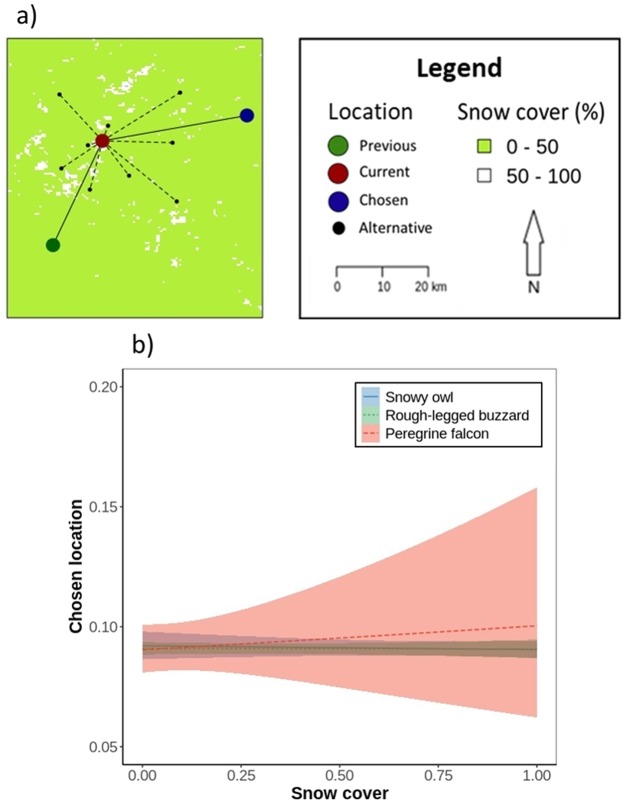
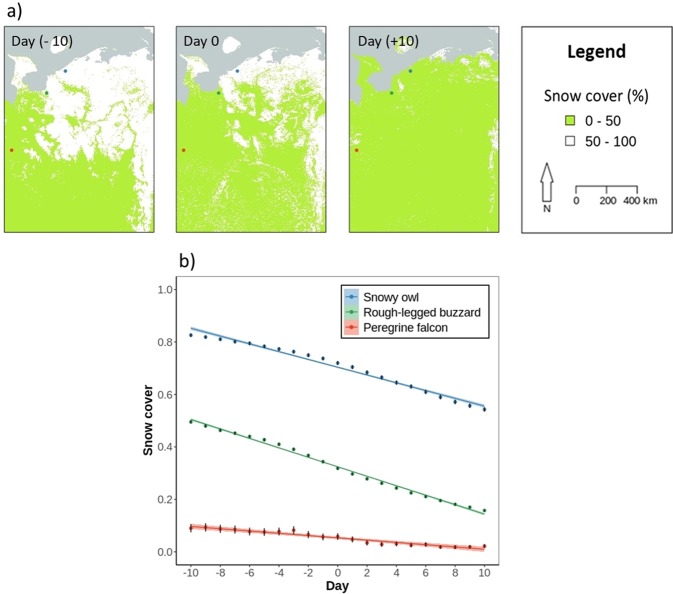
Migratory species display a range of migration patterns between irruptive (facultative) to regular (obligate), as a response to different predictability of resources. In the Arctic, snow directly influences resource availability. The causes and consequences of different migration patterns of migratory species as a response to the snow conditions remains however unexplored. Birds migrating to the Arctic are expected to follow the spring snowmelt to optimise their arrival time and select for snow-free areas to maximise prey encounter en-route. Based on large-scale movement data, we compared the migration patterns of three top predator species of the tundra in relation to the spatio-temporal dynamics of snow cover. The snowy owl, an irruptive migrant, the rough-legged buzzard, with an intermediary migration pattern, and the peregrine falcon as a regular migrant, all followed, as expected, the spring snowmelt during their migrations. However, the owl stayed ahead, the buzzard stayed on, and the falcon stayed behind the spatio-temporal peak in snowmelt. Although none of the species avoided snow-covered areas, they presumably used snow presence as a cue to time their arrival at their breeding grounds. We show the importance of environmental cues for species with different migration patterns.
迁徙物种表现出从爆发性(随意)到规律性(强制)的一系列迁徙模式,这是对资源可预测性的不同反应。在北极,雪直接影响资源的可利用性。然而,迁徙物种为应对雪情而表现出不同迁徙模式的原因和后果仍未得到探索。预计迁徙到北极的鸟类将跟随春季融雪,以优化它们的到达时间,并选择无雪地区,以最大限度地提高沿途捕食的机会。基于大规模的运动数据,我们比较了三种苔原顶级捕食者物种的迁徙模式与雪盖时空动态之间的关系。雪鸮是一种爆发性迁徙物种,粗腿秃鹫是一种中间迁徙模式,而游隼则是一种规律性迁徙物种,它们都在迁徙期间按照预期跟随春季融雪。然而,雪鸮领先,秃鹫停留,游隼则落后于融雪的时空高峰。尽管这些物种都没有避开积雪地区,但它们可能利用积雪的存在作为到达繁殖地的时间提示。我们展示了不同迁徙模式物种对环境提示的重要性。