V.I. Vernadsky Crimean Federal University, Simferopol, Russia.
Inflamm Res. 2020 Jul;69(7):635-640. doi: 10.1007/s00011-020-01352-y. Epub 2020 Apr 30.
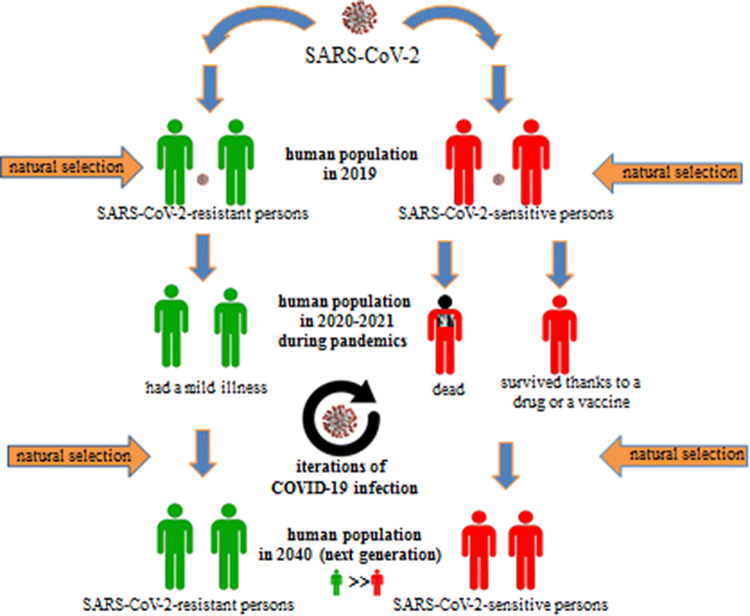
At the population level, the virus-host relationship is not set up to end with the complete elimination of either or both. Pathogen-resistant individuals will always remain in the host population. In turn, the virus can never completely eliminate the host population, because evolutionarily such an event is a dead end for the virus as an obligate intracellular parasite. A certain existential balance exists in the virus-host relationship. Against this backdrop, viral epidemics and pandemics only become manifest and egregious to human beings when tens and hundreds of thousands of people die and the question emerges what caused the high mortality peaks on the death chart. The answer seems clear; the emerging strain of the virus is new to the host population, and new mutations of the virus and natural selection will lead to a survival of only genetically resistant individuals in a host population. The dangers inherent to a novel virus are due to new features generally inthe molecular structure of proteins, which enable the virus to infect the cells of the host organism more intensively, dramatically challenging host immunity, and thus be transmitted more readily in the host population. In this article, we will concentrate on the facts currently available about severe acute respiratory syndrome coronavirus 2 (SARS-CoV-2), which has caused COVID-19 (coronavirus disease 2019) pandemic and try to predict its development and consequences based on the virus-host relationship. In fact, only two scenarios will occur simultaneously in the very near future: people who are genetically resistant to the virus will get sick, recover, and develop immunity, while people who are sensitive to the virus will need drugs and vaccines, which will have to be researched and developed if they are to recover. If the pandemic does not stop, in a few decades it is anticipated that SARS-CoV-2 will become as safe as the four non-severe acute respiratory syndrome human coronaviruses (HCoV-NL63, HCoV-HKU1, HCoV-OC43, and HCoV-229E) currently circulating but causing low mortality in the human population.
从群体水平看,病毒与宿主之间的关系不会以一方或双方的完全消灭而告终。具有病原体抗性的个体将始终存在于宿主群体中。反过来,病毒也永远无法完全消灭宿主群体,因为从进化角度来看,对于作为专性细胞内寄生虫的病毒来说,这种情况是死胡同。病毒与宿主之间存在某种生存平衡。在这种背景下,只有当数以万计的人死亡,并且出现了导致死亡图表上高死亡率峰值的原因这个问题时,病毒的流行和大流行才会对人类产生明显和严重的影响。答案似乎很明确;宿主群体中出现的新病毒株对宿主是全新的,病毒的新突变和自然选择将导致宿主群体中只有具有遗传抗性的个体存活下来。新型病毒所带来的危险源于蛋白质分子结构中的新特征,这些特征使病毒能够更强烈地感染宿主细胞,对宿主免疫产生巨大挑战,从而更容易在宿主群体中传播。在本文中,我们将集中讨论目前关于严重急性呼吸综合征冠状病毒 2(SARS-CoV-2)的事实,该病毒引发了 COVID-19(2019 年冠状病毒病)大流行,并试图根据病毒与宿主的关系预测其发展和后果。事实上,在不久的将来,只有两种情况会同时发生:具有病毒遗传抗性的人会生病、康复并产生免疫力,而对病毒敏感的人则需要药物和疫苗,如果要康复,就必须研究和开发这些药物和疫苗。如果大流行不停止,预计在几十年内,SARS-CoV-2 将变得像目前在人群中传播但死亡率较低的四种非严重急性呼吸综合征人类冠状病毒(HCoV-NL63、HCoV-HKU1、HCoV-OC43 和 HCoV-229E)一样安全。