Department of Nutrition and Food Sciences, Faculty of Agricultural and Food Sciences, American University of Beirut, Beirut, Lebanon.
Department of Biomedical Sciences, Lebanese International University, Beirut, Lebanon.
PLoS One. 2020 Apr 30;15(4):e0232199. doi: 10.1371/journal.pone.0232199. eCollection 2020.
Energy drinks (ED) are caffeine- and sugar-rich beverages with other ingredients that are marketed for their energy-boosting and performance-enhancing effects. The consumption of these drinks, with and without alcohol, is dramatically increasing worldwide, despite the reported side effects and potential harms to consumers. Few studies, to date, have explored the perceptions and experiences of young adults towards these beverages.
The present study aimed to explore the consumption patterns and correlates of ED consumption, as well as the perceptions and experiences of university students in Lebanon towards these beverages.
A sequential explanatory mixed-methods approach was adopted. Data collection was conducted in two private universities in Beirut, Lebanon. A self-administered 36-item quantitative survey was first used to explore the prevalence and correlates of ED consumption among a convenience sample of university students (n = 226). The survey included questions related to socio-demographic characteristics, anthropometric measurements, and other lifestyle behaviors, including physical activity of university students. The subsequent qualitative phase consisted of focus group discussions (FGD) conducted to further examine the perceptions and experiences of university students towards ED. Descriptive statistics and logistic regression analyses were conducted using survey data, whereas the transcribed FGD were analyzed thematically.
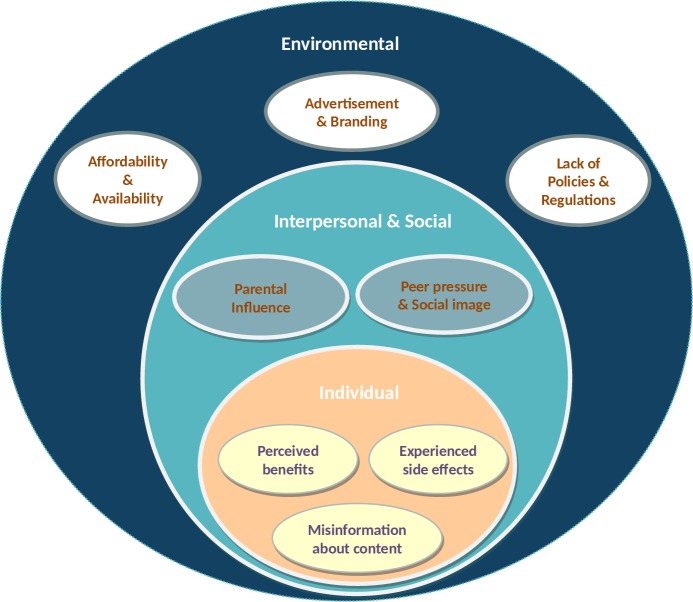
A total of 226 university students completed the survey. Results showed that 45% of survey respondents consumed ED at least once in their life (ever consumers), among which 30% reported consumption of ED mixed with alcohol (AmED). Adjusting for socio-demographic and anthropometric characteristics, coffee and sports drinks consumption were significantly associated with ED (OR = 2.45, 95% CI = 1.20, 5.00, and OR = 4.88, 95%CI = 2.41, 9.88, respectively). In addition, physically active participants were 1.89 times (95%CI = 1.01, 3.51) more likely to consume ED compared to their inactive counterparts. During the qualitative phase, a total of six FGD were conducted with 29 university students, who reported consuming ED at least once per month. Three main themes were derived reflecting individual-, interpersonal/social- and environmental-level factors affecting ED consumption among university students. These themes were further supported by eight subthemes, including: perceived benefits of ED, experienced side effects, misinformation about content of ED, peer pressure and social image, as well as affordability and accessibility of ED.
Findings highlight the need for public health policies and programs to curb the growing public health phenomenon of ED consumption amongst university students. Such programs should consider the multi-level factors affecting ED consumption at the individual, interpersonal/social, and environmental levels, including educational campaigns on ED potential harms, regulating ED content and labeling, as well as restricting sales and marketing of these beverages, especially among young consumers.
能量饮料(ED)是一种含有咖啡因和糖分的饮料,还含有其他成分,以其提神醒脑和提高表现的功效而销售。尽管有报道称这些饮料会产生副作用,对消费者造成潜在危害,但目前全球饮用这些饮料的情况正在急剧增加,包括含酒精和不含酒精的饮料。迄今为止,很少有研究探讨年轻人对这些饮料的看法和体验。
本研究旨在探讨大学生对这些饮料的消费模式和相关因素,以及他们的看法和体验。
采用序贯解释性混合方法。数据收集在黎巴嫩贝鲁特的两所私立大学进行。首先,对一个方便样本的大学生(n=226)使用一份 36 项的自我管理定量调查来探讨 ED 消费的流行程度和相关因素。该调查包括与社会人口特征、人体测量学测量以及包括大学生体育活动在内的其他生活方式行为有关的问题。随后的定性阶段包括焦点小组讨论(FGD),以进一步探讨大学生对 ED 的看法和体验。使用调查数据进行描述性统计和逻辑回归分析,对转录的 FGD 进行主题分析。
共有 226 名大学生完成了调查。结果显示,45%的调查对象一生中至少饮用过一次 ED(曾饮用者),其中 30%报告饮用过 ED 与酒精混合(AmED)。调整社会人口学和人体测量特征后,咖啡和运动饮料的消费与 ED 显著相关(OR=2.45,95%CI=1.20,5.00 和 OR=4.88,95%CI=2.41,9.88)。此外,与不活跃的参与者相比,积极运动的参与者更有可能消费 ED(95%CI=1.01,3.51)。在定性阶段,共进行了六次 FGD,有 29 名大学生参加,他们报告每月至少饮用一次 ED。得出了三个反映影响大学生 ED 消费的个体、人际/社会和环境层面因素的主题。这些主题进一步得到了八个子主题的支持,包括:ED 的感知益处、经历的副作用、ED 内容的错误信息、同伴压力和社会形象,以及 ED 的可负担性和可获得性。
研究结果强调需要制定公共卫生政策和计划,以遏制大学生中日益严重的 ED 消费这一公共卫生现象。这些计划应考虑到影响 ED 消费的个体、人际/社会和环境层面的多层次因素,包括有关 ED 潜在危害的教育活动、规范 ED 成分和标签,以及限制这些饮料的销售和营销,特别是针对年轻消费者。
