Mollel Edson W, Todd Jim, Mahande Michael J, Msuya Sia E
1Institute of Public Health, Department of Epidemiology and Biostatistics, Kilimanjaro Christian Medical University College (KCMUCo), Moshi, Tanzania.
Northern Zone Blood Transfusion Centre, P.O.BOX 823 Kilimanjaro, Tanzania.
Trop Med Health. 2020 Apr 27;48:26. doi: 10.1186/s41182-020-00212-z. eCollection 2020.
TB and HIV are public health problems, which have a synergistic effect to each other. Despite the decreasing burden of these two diseases they still make a significant contribution to mortality. Tanzania is among the 30 high TB and HIV burden countries.
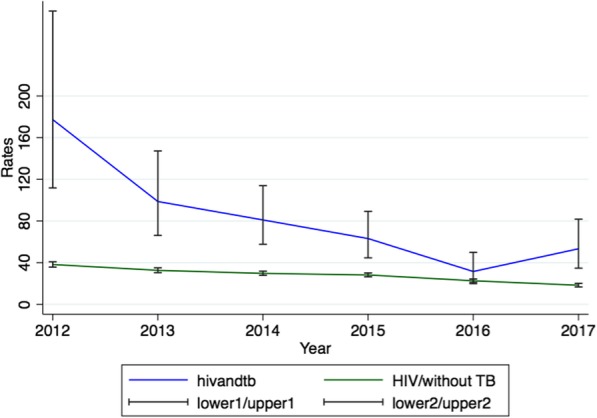
Routine data over 6 years from people living with HIV (PLHIV) attending health facilities in three regions of Northern Tanzania were analyzed, showing mortality trends from 2012 to 2017 for HIV and HIV/TB subpopulations. Poisson regression with frailty model adjusting for clustering at health facility level was used to analyze the data to determine mortality rate ratios (RR) and 95% confidence intervals (95%CI).
Among all PLHIV the overall mortality rate was 28.4 (95% CI 27.6-29.2) deaths per 1000 person-years. For PLHIV with no evidence of TB the mortality rates was 26.2 (95% CI 25.4-27.0) per 1000 person-years, and for those with HIV/TB co-infection 57.8 (95% CI 55.6-62.3) per 1000 person-years. After adjusting for age, sex, residence, WHO stage, and bodyweight, PLHIV with TB co-infection had 40% higher mortality than those without TB (RR 1.4; 95% CI 1.24-1.67).
Over the 6-year period mortality rates for HIV/TB patients were consistently higher than for PLHIV who have no TB. More efforts should be directed into improving nutritional status among HIV patients, as it has destructive interaction with TB for mortality. This will improve patients' body weight and CD4 counts which are protective against mortality. Among PLHIV attention should be given to those who are in WHO HIV stage 3 or 4 and having TB co-infection.
结核病和艾滋病是公共卫生问题,二者相互具有协同作用。尽管这两种疾病的负担在减轻,但它们仍对死亡率有重大影响。坦桑尼亚是结核病和艾滋病负担较重的30个国家之一。
对坦桑尼亚北部三个地区接受医疗机构治疗的艾滋病毒感染者(PLHIV)6年的常规数据进行分析,显示2012年至2017年艾滋病毒感染者和艾滋病毒/结核病亚人群的死亡率趋势。采用泊松回归和脆弱模型,对医疗机构层面的聚类进行调整,以分析数据,确定死亡率比(RR)和95%置信区间(95%CI)。
在所有艾滋病毒感染者中,总死亡率为每1000人年28.4例(95%CI 27.6 - 29.2)死亡。对于没有结核病证据的艾滋病毒感染者,死亡率为每1000人年26.2例(95%CI 25.4 - 27.0),对于合并感染艾滋病毒/结核病的患者,死亡率为每1000人年57.8例(95%CI 55.6 - 62.3)。在调整年龄、性别、居住地、世界卫生组织疾病分期和体重后,合并感染结核病的艾滋病毒感染者的死亡率比未感染结核病的感染者高40%(RR 1.4;95%CI 1.24 - 1.67)。
在这6年期间,艾滋病毒/结核病患者的死亡率一直高于未感染结核病的艾滋病毒感染者。应更加努力改善艾滋病毒患者的营养状况,因为营养状况与结核病对死亡率具有破坏性的相互作用。这将改善患者的体重和CD4细胞计数,从而对死亡率起到保护作用。在艾滋病毒感染者中,应关注处于世界卫生组织艾滋病毒3期或4期且合并感染结核病的患者。