• 文献检索
  • 文档翻译
  • 深度研究
  • 学术资讯
  • Suppr Zotero 插件Zotero 插件
  • 邀请有礼
  • 套餐&价格
  • 历史记录
应用&插件
Suppr Zotero 插件Zotero 插件浏览器插件Mac 客户端Windows 客户端微信小程序
定价
高级版会员购买积分包购买API积分包
服务
文献检索文档翻译深度研究API 文档MCP 服务
关于我们
关于 Suppr公司介绍联系我们用户协议隐私条款
关注我们

Suppr 超能文献

核心技术专利:CN118964589B侵权必究
粤ICP备2023148730 号-1Suppr @ 2026

文献检索

告别复杂PubMed语法,用中文像聊天一样搜索,搜遍4000万医学文献。AI智能推荐,让科研检索更轻松。

立即免费搜索

文件翻译

保留排版,准确专业,支持PDF/Word/PPT等文件格式,支持 12+语言互译。

免费翻译文档

深度研究

AI帮你快速写综述,25分钟生成高质量综述,智能提取关键信息,辅助科研写作。

立即免费体验

局部和全身使用氨甲环酸时在全膝关节置换术中的夹闭方法是否改变了游戏规则?:一项回顾性对比队列研究。

Does the clamping method in local and systemic TXA applications in total knee arthroplasty change the game?: A retrospective comparative cohort study.

机构信息

Department of Orthopedics and Traumatology, Medicine Faculty of Istinye University, İstanbul, Turkey.

Department of Orthopedics and Traumatology, Istinye University Training and Research Hospital, İstanbul, Turkey.

出版信息

Medicine (Baltimore). 2022 Sep 23;101(38):e30823. doi: 10.1097/MD.0000000000030823.

DOI:10.1097/MD.0000000000030823
PMID:36197255
原文链接:https://pmc.ncbi.nlm.nih.gov/articles/PMC9509162/
Abstract

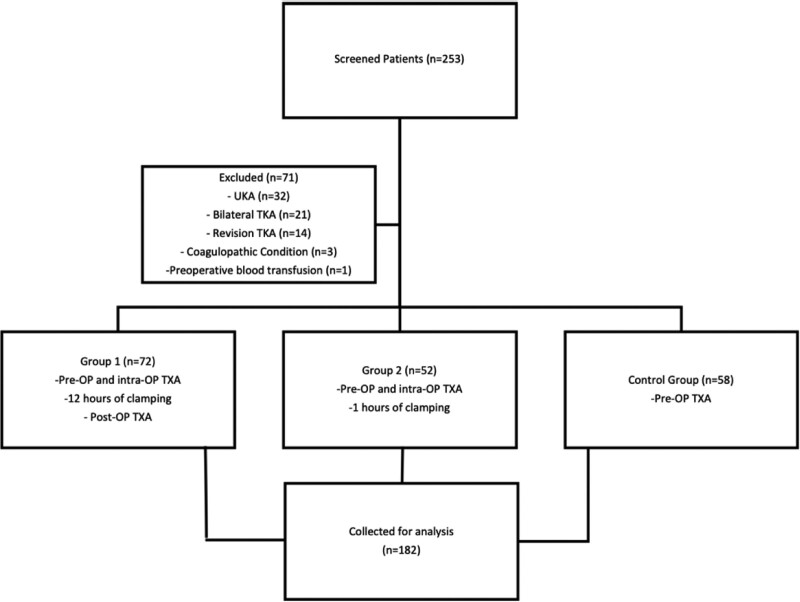
Many different methods and drain clamping periods have been described in systemic and local tranexamic acid (TXA) applications, and the superiority of the methods to each other has not been clearly demonstrated. The method of local infusion in combined TXA applications may not alter the Hb drop or total or hidden blood loss. We aim to compare two different combined TXA application methods. We retrospectively analyzed 182 patients who underwent total knee arthroplasty between 2018 and 2021. Patients over 40 years of age who underwent TKA for degenerative knee arthritis were included in the study. Unicondylar, revision, or bilateral arthroplasties and patients with the cardiovascular or cerebrovascular disease were excluded from the study. All patients in the study received 1 g TXA intravenously half an hour before the incision. For the first group, 1 g TXA was given intra-articularly at the drain site after closure, and the clamp was kept closed for 1 hour. In the second group, the drain was clamped for an additional 6 hours, and a 1 g intravenous dose was administered at the 5th hour postoperatively. No local applications were used in the control group. Total, hidden, and visible blood loss (total blood loss, hidden blood loss, visible blood loss), postoperative decreases in hemoglobin and hematocrit level (ΔHgb, ΔHtc), blood transfusion rates, and hospital stay durations were evaluated. There were 72 patients in the first group, 52 in the second, and 58 in control. A total of 37 patients received one or more blood transfusions postoperatively, and there was no statistical difference in the need for blood transfusions between the groups (P = .255). Although a statistically significant difference (P = .001) in total blood loss, hidden blood loss, visible blood loss and ΔHgb values was observed between the groups, the difference between the first and second groups was insignificant (P = .512). The duration of hospital stay was observed to be less in the first and second groups (P = .024). Local and systemic TXA applications were observed to be more effective than only systemic applications in reducing blood loss after total knee arthroplasty, regardless of the local method.

摘要

许多不同的方法和引流夹闭时间已在全身性和局部氨甲环酸(TXA)应用中被描述,且彼此之间哪种方法更优尚未明确。局部灌注联合 TXA 应用的方法可能不会改变 Hb 下降或总失血量或隐性失血量。我们旨在比较两种不同的联合 TXA 应用方法。我们回顾性分析了 2018 年至 2021 年间接受全膝关节置换术的 182 例患者。该研究纳入了年龄超过 40 岁、因退行性膝关节炎行 TKA 的患者。排除单髁、翻修或双侧关节置换术以及心血管或脑血管疾病患者。所有患者在术前半小时静脉给予 1gTXA。对于第 1 组,在关闭后于引流部位关节内给予 1gTXA,并保持夹闭 1 小时。在第 2 组中,引流管夹闭时间延长 6 小时,术后第 5 小时给予 1g 静脉剂量。对照组未局部应用。评估总失血量、隐性失血量、显性失血量(总失血量、隐性失血量、显性失血量)、术后血红蛋白和红细胞压积水平下降(ΔHgb、ΔHtc)、输血率和住院时间。第 1 组有 72 例患者,第 2 组有 52 例患者,对照组有 58 例患者。共有 37 例患者术后需要输血,各组间输血需求无统计学差异(P=0.255)。尽管组间总失血量、隐性失血量、显性失血量和ΔHgb 值存在统计学显著差异(P=0.001),但第 1 组和第 2 组之间的差异无统计学意义(P=0.512)。第 1 组和第 2 组的住院时间观察到较短(P=0.024)。局部和全身 TXA 应用比仅全身应用更有效,可减少全膝关节置换术后的失血,无论局部方法如何。
https://cdn.ncbi.nlm.nih.gov/pmc/blobs/3e9c/9509162/50e1e1c3b81d/medi-101-e30823-g001.jpg

相似文献

1
Does the clamping method in local and systemic TXA applications in total knee arthroplasty change the game?: A retrospective comparative cohort study.局部和全身使用氨甲环酸时在全膝关节置换术中的夹闭方法是否改变了游戏规则?:一项回顾性对比队列研究。
Medicine (Baltimore). 2022 Sep 23;101(38):e30823. doi: 10.1097/MD.0000000000030823.
2
Tranexamic Acid Effectively Reduces Blood Loss and Transfusion Rates during Simultaneous Bilateral Total Knee Arthroplasty.氨甲环酸可有效减少双侧全膝关节置换术中的失血量及输血量。
J Knee Surg. 2018 Mar;31(3):270-276. doi: 10.1055/s-0037-1603333. Epub 2017 May 15.
3
The optimal protocol to reduce blood loss and blood transfusion after unilateral total knee replacement: Low-dose IA-TXA plus 30-min drain clamping versus drainage clamping for the first 3 h without IA-TXA.减少单侧全膝关节置换术后失血和输血的最佳方案:低剂量关节内注射氨甲环酸加30分钟引流管夹闭与不使用关节内注射氨甲环酸的情况下最初3小时引流管夹闭。
J Orthop Surg (Hong Kong). 2017 Sep-Dec;25(3):2309499017731626. doi: 10.1177/2309499017731626.
4
Tranexamic acid plus drain-clamping can reduce blood loss in total knee arthroplasty: A systematic review and meta-analysis.氨甲环酸联合引流夹闭可减少全膝关节置换术失血:系统评价和荟萃分析。
Int J Surg. 2018 Apr;52:334-341. doi: 10.1016/j.ijsu.2018.01.040. Epub 2018 Feb 3.
5
A comparative, retrospective study of peri-articular and intra-articular injection of tranexamic acid for the management of postoperative blood loss after total knee arthroplasty.一项关于关节周围和关节内注射氨甲环酸用于全膝关节置换术后失血管理的比较性回顾性研究。
BMC Musculoskelet Disord. 2016 Oct 19;17(1):438. doi: 10.1186/s12891-016-1293-3.
6
[Local Application of Tranexamic Acid in Total Hip Arthroplasty Decreases Blood Loss and Consumption of Blood Transfusion].氨甲环酸局部应用于全髋关节置换术可减少失血及输血用量
Acta Chir Orthop Traumatol Cech. 2017;84(4):254-262.
7
2019 Mark Coventry Award: A multicentre randomized clinical trial of tranexamic acid in revision total knee arthroplasty: does the dosing regimen matter?2019 年马克·考文垂奖:氨甲环酸在翻修全膝关节置换术中的多中心随机临床试验:给药方案是否重要?
Bone Joint J. 2019 Jul;101-B(7_Supple_C):10-16. doi: 10.1302/0301-620X.101B7.BJJ-2018-1451.R1.
8
Combined Intra-Articular and Intravenous Tranexamic Acid Reduces Blood Loss in Total Knee Arthroplasty: A Randomized, Double-Blind, Placebo-Controlled Trial.关节内和静脉联合使用氨甲环酸减少全膝关节置换术失血:一项随机、双盲、安慰剂对照试验。
J Bone Joint Surg Am. 2016 May 18;98(10):835-41. doi: 10.2106/JBJS.15.00810.
9
Topical Tranexamic Acid in Revision Total Knee Arthroplasty Reduces Transfusion Rates and May Be Associated With Earlier Recovery.局部使用氨甲环酸减少翻修全膝关节置换术的输血率并可能与更早的恢复相关。
J Arthroplasty. 2019 Jul;34(7S):S249-S255. doi: 10.1016/j.arth.2018.10.018. Epub 2018 Oct 25.
10
Comparison of blood loss between intra-articular microporous polysaccharide hemospheres powder and tranexamic acid following primary total knee arthroplasty.初次全膝关节置换术后关节腔内微孔多糖微球粉末与氨甲环酸失血情况的比较。
Sci Rep. 2024 Mar 2;14(1):5188. doi: 10.1038/s41598-024-55871-3.

本文引用的文献

1
Octogenarians Are the New Sexagenarians: Cruciate-Retaining Total Knee Arthroplasty Is Not Inferior to Posterior-Stabilized Arthroplasty in Octogenarian Patients.八旬老人如今如六旬老人一般:在八旬老人患者中,保留交叉韧带的全膝关节置换术并不逊色于后稳定型人工关节置换术。
J Clin Med. 2022 Jun 30;11(13):3795. doi: 10.3390/jcm11133795.
2
Not all patients benefit from the postoperative antifibrinolytic treatment: clinical evidence against the universal use of tranexamic acid following total knee arthroplasty.并非所有患者都能从术后抗纤维蛋白溶解治疗中获益:全膝关节置换术后使用氨甲环酸的普遍应用缺乏临床证据。
J Orthop Surg Res. 2022 Jan 29;17(1):59. doi: 10.1186/s13018-022-02958-0.
3
Efficacy of a three-day prolonged-course of multiple-dose versus a single-dose of tranexamic acid in total hip and knee arthroplasty.
氨甲环酸多剂量三日延长疗程与单剂量在全髋关节和膝关节置换术中的疗效比较
Ann Transl Med. 2020 Mar;8(6):307. doi: 10.21037/atm.2020.02.99.
4
CORR Insights®: Combined Intravenous and Intraarticular Tranexamic Acid Does Not Offer Additional Benefit Compared with Intraarticular Use Alone in Bilateral TKA: A Randomized Controlled Trial.CORR 见解®:在双侧全膝关节置换术中,与单独关节内使用相比,静脉内和关节内联合使用氨甲环酸并无额外益处:一项随机对照试验。
Clin Orthop Relat Res. 2020 Jan;478(1):55-57. doi: 10.1097/CORR.0000000000001050.
5
Hidden blood loss after hip hemiarthroplasty using the superPATH approach: A retrospective study.采用 SuperPATH 入路行髋关节半髋关节置换术后隐性失血的回顾性研究。
Injury. 2019 Dec;50(12):2282-2286. doi: 10.1016/j.injury.2019.10.013. Epub 2019 Oct 4.
6
Combined intravenous and intra-articular tranexamic acid administration in total knee arthroplasty for preventing blood loss and hyperfibrinolysis: A randomized controlled trial.全膝关节置换术中联合静脉和关节内注射氨甲环酸预防失血和高纤溶状态:一项随机对照试验
Medicine (Baltimore). 2019 Feb;98(7):e14458. doi: 10.1097/MD.0000000000014458.
7
Comparison of intravenous, topical or combined routes of tranexamic acid administration in patients undergoing total knee and hip arthroplasty: a meta-analysis of randomised controlled trials.静脉内、局部或联合给予氨甲环酸在全膝关节和髋关节置换术患者中的比较:随机对照试验的荟萃分析。
BMJ Open. 2019 Jan 28;9(1):e024350. doi: 10.1136/bmjopen-2018-024350.
8
Fibrinolysis in trauma: a review.创伤中的纤维蛋白溶解:综述
Eur J Trauma Emerg Surg. 2018 Feb;44(1):35-44. doi: 10.1007/s00068-017-0833-3. Epub 2017 Sep 16.
9
Topical versus intravenous tranexamic acid as a blood conservation intervention for reduction of post-operative bleeding in hemiarthroplasty.局部应用与静脉注射氨甲环酸作为血液保护干预措施以减少半关节置换术后出血的比较
Anesth Essays Res. 2014 Jan-Apr;8(1):48-53. doi: 10.4103/0259-1162.128908.
10
Transfusion of plasma, platelets, and red blood cells in a 1:1:1 vs a 1:1:2 ratio and mortality in patients with severe trauma: the PROPPR randomized clinical trial.严重创伤患者血浆、血小板和红细胞以1:1:1与1:1:2比例输注及死亡率:PROPPR随机临床试验
JAMA. 2015 Feb 3;313(5):471-82. doi: 10.1001/jama.2015.12.