Department of Biosciences, COMSATS University Islamabad, Islamabad, Pakistan.
Plant Breeding Institute, Sydney Institute of Agriculture, University of Sydney, Sydney, Australia.
PLoS One. 2020 May 1;15(5):e0232269. doi: 10.1371/journal.pone.0232269. eCollection 2020.
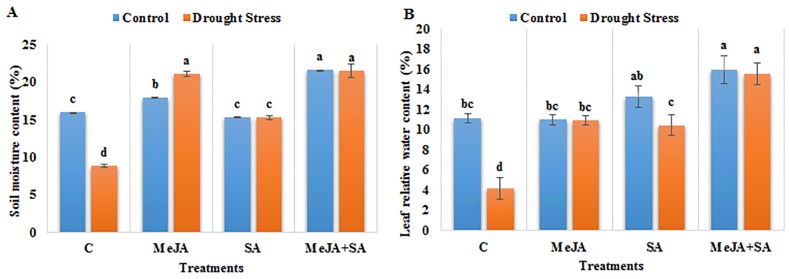
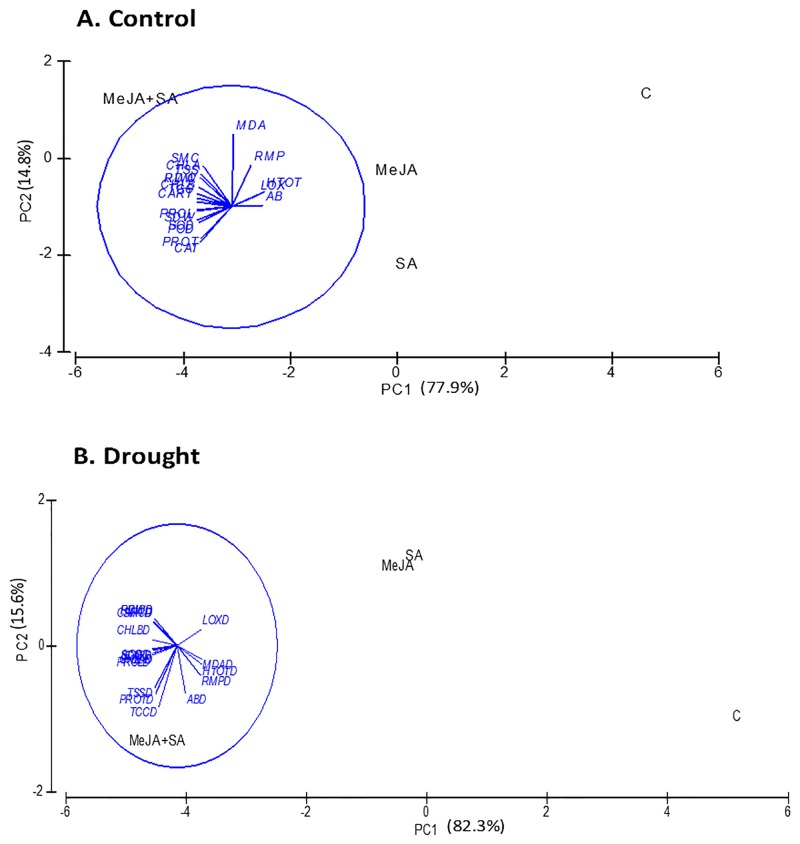
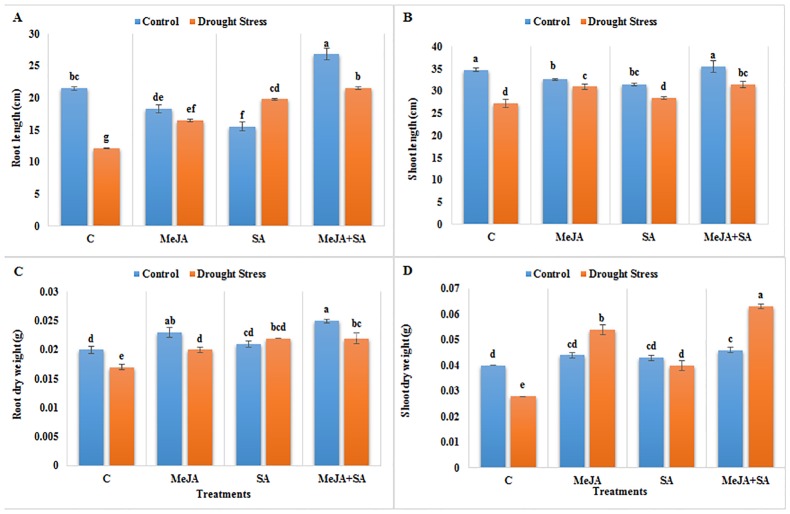
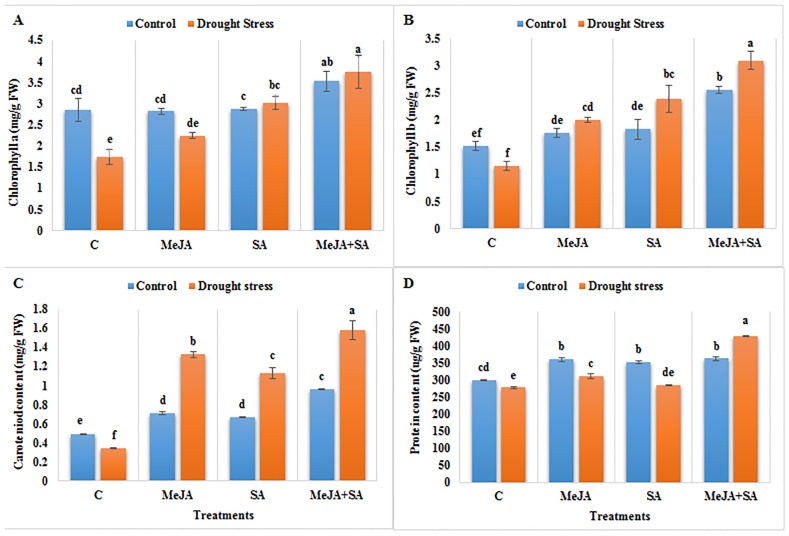
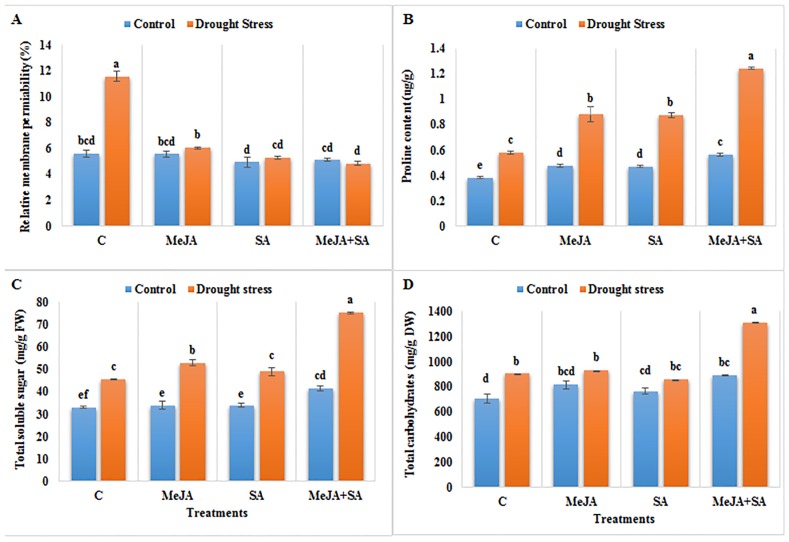
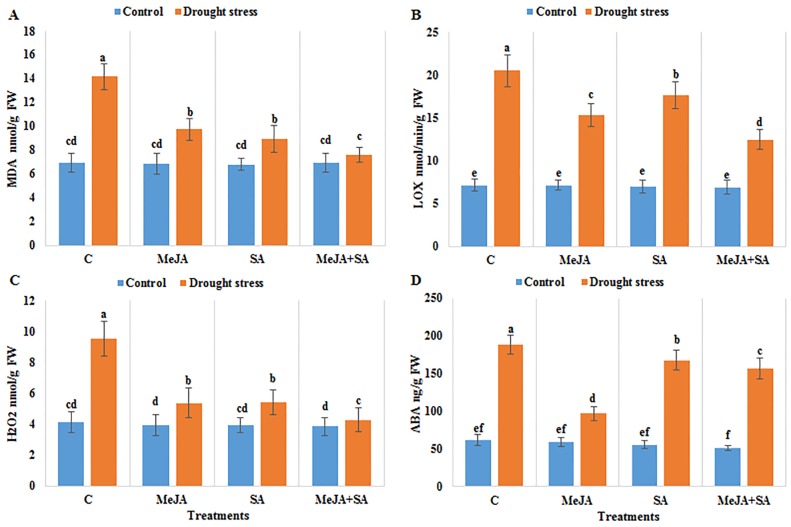
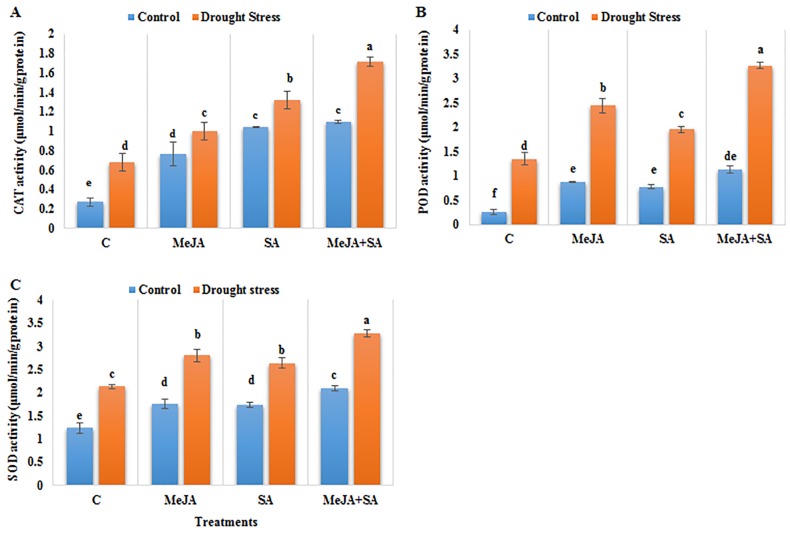
Susceptibility of plants to abiotic stresses, including extreme temperatures, salinity and drought, poses an increasing threat to crop productivity worldwide. Here the drought-induced response of maize was modulated by applications of methyl jasmonate (MeJA) and salicylic acid (SA) to seeds prior to sowing and to leaves prior to stress treatment. Pot experiments were conducted to ascertain the effects of exogenous applications of these hormones on maize growth, physiology and biochemistry under drought stress and well-watered (control) conditions. Maize plants were subjected to single as well as combined pre-treatments of MeJA and SA. Drought stress severely affected maize morphology and reduced relative water content, above and below-ground biomass, rates of photosynthesis, and protein content. The prolonged water deficit also led to increased relative membrane permeability and oxidative stress induced by the production of malondialdehyde (from lipid peroxidation), lipoxygenase activity (LOX) and the production of H2O2. The single applications of MeJA and SA were not found to be effective in maize for drought tolerance while the combined pre-treatments with exogenous MeJA+SA mitigated the adverse effects of drought-induced oxidative stress, as reflected in lower levels of lipid peroxidation, LOX activity and H2O2. The same pre-treatment also maintained adequate water status of the plants under drought stress by increasing osmolytes including proline, total carbohydrate content and total soluble sugars. Furthermore, exogenous applications of MeJA+SA approximately doubled the activities of the antioxidant enzymes catalase, peroxidase and superoxide dismutase. Pre-treatment with MeJA alone gave the highest increase in drought-induced production of endogenous abscisic acid (ABA). Pre-treatment with MeJA+SA partially prevented drought-induced oxidative stress by modulating levels of osmolytes and endogenous ABA, as well as the activities of antioxidant enzymes. Taken together, the results show that seed and foliar pre-treatments with exogenous MeJA and/or SA can have positive effects on the responses of maize seedlings to drought.
植物对非生物胁迫的敏感性,包括极端温度、盐度和干旱,对全球作物生产力构成了日益严重的威胁。在这里,通过在播种前向种子和在胁迫处理前向叶片施用茉莉酸甲酯(MeJA)和水杨酸(SA),调节了玉米对干旱的响应。进行了盆栽实验,以确定在干旱胁迫和充分浇水(对照)条件下,外源施用这些激素对玉米生长、生理和生物化学的影响。玉米植株同时接受 MeJA 和 SA 的单一和组合预处理。干旱胁迫严重影响玉米形态,降低了地上和地下生物量、光合作用速率和蛋白质含量的相对水分含量。长时间的水分亏缺也导致相对膜通透性增加,以及由脂质过氧化产生的丙二醛(MDA)、脂氧合酶活性(LOX)和 H2O2 的产生引起的氧化应激增加。在玉米中,单独施用 MeJA 和 SA 对其耐旱性没有效果,而用外源 MeJA+SA 进行组合预处理减轻了干旱诱导的氧化应激的不利影响,反映在较低水平的脂质过氧化、LOX 活性和 H2O2 产生。同样的预处理还通过增加脯氨酸、总碳水化合物含量和总可溶性糖等渗透物来维持植物在干旱胁迫下的适当水分状态。此外,外源施用 MeJA+SA 使抗氧化酶过氧化氢酶、过氧化物酶和超氧化物歧化酶的活性增加了近一倍。单独用 MeJA 预处理可使干旱诱导的内源脱落酸(ABA)产量增加幅度最大。MeJA+SA 预处理通过调节渗透物和内源 ABA 水平以及抗氧化酶活性,部分防止了干旱诱导的氧化应激。总之,这些结果表明,外源 MeJA 和/或 SA 对种子和叶片预处理可以对玉米幼苗对干旱的响应产生积极影响。