Cecelja Marina, Keehn Louise, Ye Li, Spector Tim D, Hughes Alun D, Chowienczyk Phil
Cardiovascular Division, Department of Clinical Pharmacology, King's College London British Heart Foundation Centre, St Thomas' Hospital, Westminster Bridge Road, London SE1 7EH, UK.
Department of Twin Research and Genetic Epidemiology, King's College London, St Thomas' Hospital, Westminster Bridge Road, London SE1 7EH, UK.
Eur Heart J. 2020 Sep 14;41(35):3314-3322. doi: 10.1093/eurheartj/ehaa238.
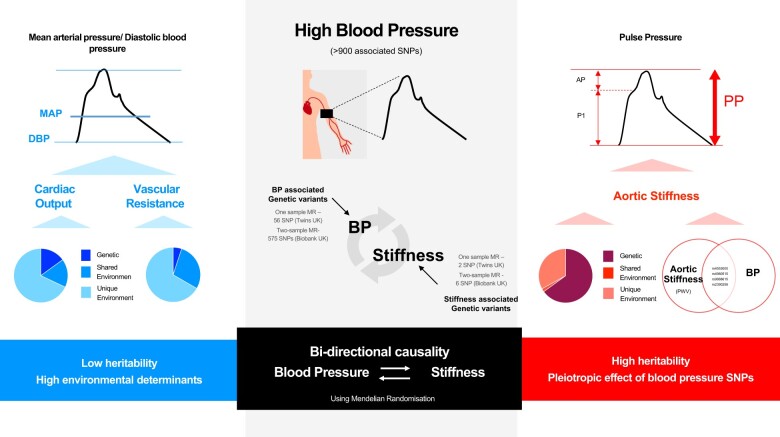
Haemodynamic determinants of blood pressure (BP) include cardiac output (CO), systemic vascular resistance (SVR), and arterial stiffness. We investigated the heritability of these phenotypes, their association with BP-related single-nucleotide polymorphisms (SNPs), and the causal association between BP and arterial stiffness.
We assessed BP, central BP components, and haemodynamic properties (during a single visit) including CO, SVR, and pulse wave velocity (PWV, measure of arterial stiffness) in 3531 (1934 monozygotic, 1586 dizygotic) female TwinsUK participants. Heritability was estimated using structural equation modelling. Association with 984 BP-associated SNP was examined using least absolute shrinkage and selection operator (LASSO) and generalized estimating equation regression. One and two-sample Mendelian randomization (MR) was used to estimate the causal direction between BP and arterial stiffness including data on 436 419 UK Biobank participants. We found high heritability for systolic and pulsatile components of BP (>50%) and PWV (65%) with overlapping genes accounting for >50% of their observed correlation. Environmental factors explained most of the variability of CO and SVR (>80%). Regression identified SNPs (n = 5) known to be associated with BP to also be associated with PWV. One-sample MR showed evidence of bi-directional causal association between BP and PWV in TwinsUK participants. Two-sample MR, confirmed a bi-directional causal effect of PWV on BP (inverse variance weighted (IVW) beta = 0.11, P < 0.02) and BP on arterial stiffness (IVW beta = 0.004, P < 0.0001).
The genetic basis of BP is mediated not only by genes regulating BP but also by genes that influence arterial stiffness. Mendelian randomization indicates a bi-directional causal association between BP and arterial stiffness.
血压(BP)的血流动力学决定因素包括心输出量(CO)、全身血管阻力(SVR)和动脉僵硬度。我们研究了这些表型的遗传力、它们与血压相关单核苷酸多态性(SNP)的关联以及血压与动脉僵硬度之间的因果关系。
我们在3531名(1934名同卵双胞胎、1586名异卵双胞胎)英国女性双胞胎参与者中评估了血压、中心血压成分和血流动力学特性(单次就诊时),包括心输出量、全身血管阻力和脉搏波速度(PWV,动脉僵硬度的测量指标)。使用结构方程模型估计遗传力。使用最小绝对收缩和选择算子(LASSO)和广义估计方程回归检查与984个血压相关SNP的关联。使用单样本和两样本孟德尔随机化(MR)来估计血压与动脉僵硬度之间的因果方向,包括来自436419名英国生物银行参与者的数据。我们发现血压的收缩压和搏动成分(>50%)以及脉搏波速度(65%)具有高遗传力,重叠基因占其观察到的相关性的>50%。环境因素解释了心输出量和全身血管阻力的大部分变异性(>80%)。回归分析确定已知与血压相关的SNP(n = 5)也与脉搏波速度相关。单样本孟德尔随机化显示英国双胞胎参与者中血压与脉搏波速度之间存在双向因果关联的证据。两样本孟德尔随机化证实了脉搏波速度对血压的双向因果效应(逆方差加权(IVW)β = 0.11,P < 0.02)以及血压对动脉僵硬度的双向因果效应(IVWβ = 0.004,P < 0.0001)。
血压的遗传基础不仅由调节血压的基因介导,还由影响动脉僵硬度的基因介导。孟德尔随机化表明血压与动脉僵硬度之间存在双向因果关联。