Laboratory of Food Chemistry and Biochemistry, Department of Microbial and Molecular Systems (M(2)S), KU Leuven, 3001 Leuven, Belgium.
Laboratory of Livestock Physiology, Department of Biosystems, KU Leuven, 3001 Leuven, Belgium.
Poult Sci. 2020 May;99(5):2555-2565. doi: 10.1016/j.psj.2019.12.041. Epub 2020 Mar 24.
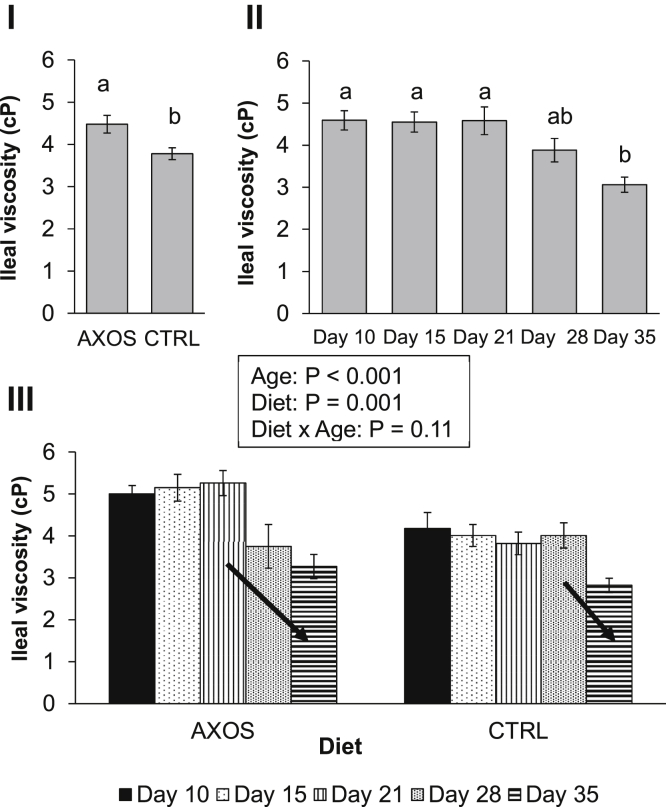
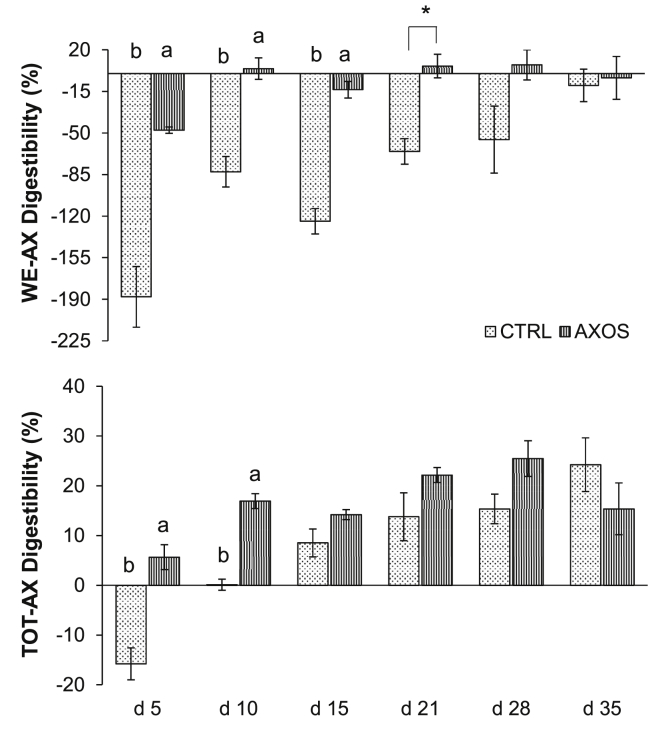
While arabinoxylans (AX), an important dietary fiber fraction of wheat-based broiler diets, are known for exerting antinutritional effects in the gastrointestinal (GI) tract of broilers, the prebiotic potential of arabinoxylan-oligosaccharides (AXOS) is also well-documented. However, inconsistent performance responses as well as the effectiveness of low amounts of AXOS used in diets of previously conducted experiments put into question the classical prebiotic route being the sole mode of action of AXOS. The objective of this study was to investigate the effects of dietary AXOS addition on the rate of AX digestion in the gastrointestinal tract of broilers as a function of broiler age to gain more insight into the mode of action of these oligosaccharides. A feeding trial was performed on 480 one-day-old chicks (Ross 308) receiving a wheat-based diet supplemented with or without 0.50% AXOS, containing no endoxylanases. Digesta samples from ileum and caeca and fecal samples were analyzed for AX content, AX digestibility, intestinal viscosity, and microbial AX-degrading enzyme activities at 6 different ages (day 5, 10, 15, 21, 28, 35). Chicks fed from hatching with 0.50% AXOS demonstrated a higher ileal viscosity (P < 0.05). Also higher levels of AX solubilization and fermentation compared to control birds at 10 D were observed. This was noted by the higher total tract AX digestibility of water-extractable AX (WE-AX) and total AX (TOT-AX) at this age (P < 0.05). Although no significant difference in AX-degrading enzyme activities was observed among the dietary treatments, AXOS supplementation in young broilers was shown to stimulate or "kick-start" dietary AX digestion, thereby speeding up the development of a fiber-fermenting microbiome in the young broiler. This stimulation effect of AXOS could enable greater functional value to be extracted from dietary fiber in broiler feeds.
尽管阿拉伯木聚糖(AX)是小麦基础肉鸡日粮中重要的膳食纤维部分,已知其在肉鸡胃肠道(GI)中具有抗营养作用,但阿拉伯木聚糖低聚糖(AXOS)的益生元潜力也有充分的记录。然而,先前进行的实验中使用的低剂量 AXOS 表现出不一致的效果,以及其有效性,这使得 AXOS 的经典益生元途径是否是其唯一作用模式受到质疑。本研究的目的是研究日粮中添加 AXOS 对肉鸡胃肠道中 AX 消化率的影响,作为随肉鸡年龄变化的函数,以更深入地了解这些低聚糖的作用模式。进行了一项饲养试验,共 480 只 1 日龄的小鸡(Ross 308)接受了含有或不含有 0.50%AXOS 的小麦基础日粮,日粮中不含内切木聚糖酶。在 6 个不同的年龄(第 5、10、15、21、28 和 35 天)时,对回肠和盲肠的食糜和粪便样本进行 AX 含量、AX 消化率、肠道粘度和微生物 AX 降解酶活性分析。从孵化开始就饲喂 0.50%AXOS 的小鸡显示出更高的回肠粘度(P<0.05)。与对照组相比,在 10 天龄时,还观察到 AX 溶解和发酵水平更高。这一点从该年龄时水可提取 AX(WE-AX)和总 AX(TOT-AX)的总肠道 AX 消化率更高得到证实(P<0.05)。尽管日粮处理之间的 AX 降解酶活性没有显著差异,但在年轻肉鸡中添加 AXOS 被证明可以刺激或“启动”日粮 AX 消化,从而加速年轻肉鸡中纤维发酵微生物群的发展。AXOS 的这种刺激作用可以使肉鸡饲料中的膳食纤维提取出更大的功能价值。