Department of Agricultural, Food and Nutritional Science, University of Alberta, Edmonton, AB T6G 2P5, Canada.
AB Vista, 64293 Darmstadt, Germany.
Poult Sci. 2020 May;99(5):2595-2607. doi: 10.1016/j.psj.2019.12.051. Epub 2020 Mar 18.
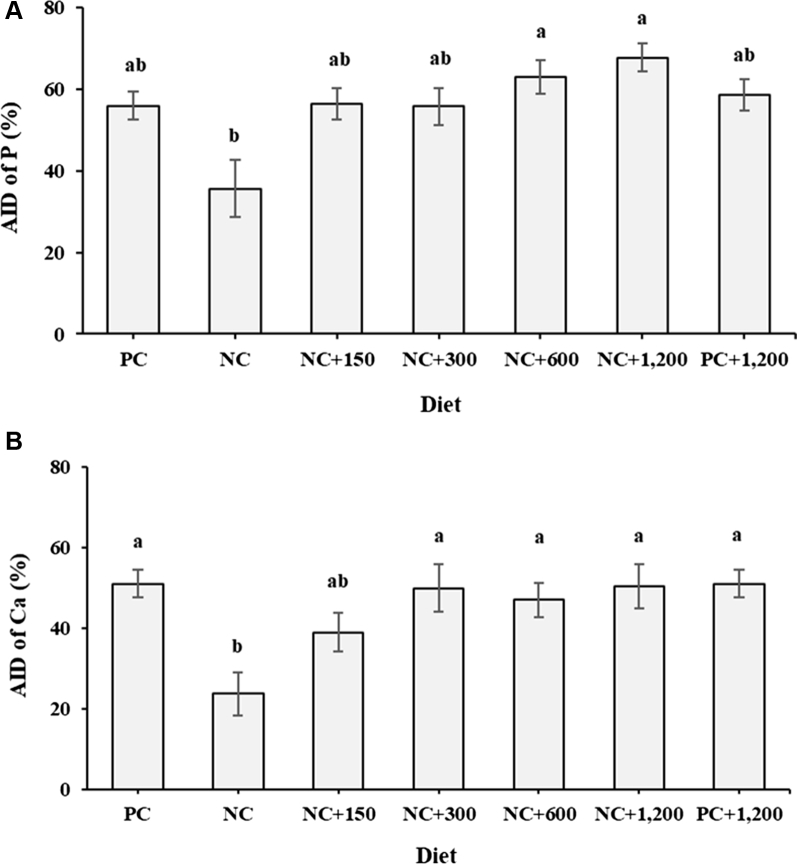
Effects of dietary available phosphorus (aP) and Ca levels and an Escherichia coli 6-phytase supplementation were studied in Lohmann LSL-Lite hens from 25 to 37 wk of age. Eighty-four hens were used in a completely randomized design with 7 treatments. The treatments were a positive control (PC) diet with 0.45% aP, 3.70% Ca, and 0.16% Na from 25 to 28 wk and 0.38% aP, 3.73% Ca, and 0.15% Na from 29 to 37 wk; a negative control (NC) diet, similar to the PC diet, with 0.22% aP, 3.00% Ca, and 0.13% Na from 25 to 28 wk and 0.19% aP, 3.02% Ca, and 0.13% Na from 29 to 37 wk; the NC diets supplemented with phytase at 150 (NC + 150), 300 (NC + 300), 600 (NC + 600), or 1,200 (NC + 1,200) phytase unit (FTU)/kg; and the PC diet supplemented with phytase at 1,200 (PC + 1,200) FTU/kg. Hen performance, eggshell, and bone quality were measured on a 4-wk basis. Bone breaking strength and ash and apparent ileal digestibility (AID) of P and Ca were determined at 37 wk. One- and 2-way ANOVA were conducted, and Tukey's range test was used to compare multiple means where P ≤ 0.05. No differences in hen performance, eggshell quality, bone breaking strength, bone ash, and P digestibility were observed between the PC and the NC treatments. The NC hens had lower cortical (P < 0.001) and trabecular + medullary bone mineral density (P = 0.004) and total bone mineral content (P < 0.001) than the PC hens. The PC + 1,200 increased cortical bone mineral density (P < 0.001). The reductions of aP and Ca in the NC diet were not deficient for performance but had a minor impact on bone mineralization. The NC + 600 and NC + 1,200 increased AID of P (P = 0.024), and all phytase treatments except the NC + 150 increased AID of Ca (P = 0.010) compared with the NC diet.
在 25 至 37 周龄的 Lohmann LSL-Lite 母鸡中研究了可利用磷(aP)和钙水平以及大肠杆菌 6-植酸酶补充的影响。84 只母鸡采用完全随机设计,有 7 种处理。这些处理是阳性对照(PC)饮食,25 至 28 周时含有 0.45%的 aP、3.70%的 Ca 和 0.16%的 Na,29 至 37 周时含有 0.38%的 aP、3.73%的 Ca 和 0.15%的 Na;阴性对照(NC)饮食与 PC 饮食相似,25 至 28 周时含有 0.22%的 aP、3.00%的 Ca 和 0.13%的 Na,29 至 37 周时含有 0.19%的 aP、3.02%的 Ca 和 0.13%的 Na;NC 饮食分别补充 150(NC + 150)、300(NC + 300)、600(NC + 600)或 1200(NC + 1200)植酸酶单位(FTU)/kg;PC 饮食补充 1200(PC + 1200)FTU/kg 的植酸酶。每 4 周测量一次母鸡的生产性能、蛋壳和骨骼质量。37 周时测定骨骼断裂强度和灰分以及表观回肠磷和钙的消化率。进行了单因素和双因素方差分析,当 P ≤ 0.05 时,采用 Tukey 范围检验比较多重均值。PC 和 NC 处理之间的母鸡生产性能、蛋壳质量、骨骼断裂强度、骨灰分和磷消化率没有差异。NC 母鸡的皮质骨(P < 0.001)和小梁+骨髓骨矿物质密度(P = 0.004)以及总骨矿物质含量(P < 0.001)低于 PC 母鸡。PC + 1200 增加了皮质骨矿物质密度(P < 0.001)。NC 饮食中 aP 和 Ca 的减少对生产性能没有缺乏,但对骨矿化有轻微影响。NC + 600 和 NC + 1200 增加了磷的表观回肠消化率(P = 0.024),与 NC 饮食相比,所有植酸酶处理(除 NC + 150 外)均增加了钙的表观回肠消化率(P = 0.010)。