• 文献检索
  • 文档翻译
  • 深度研究
  • 学术资讯
  • Suppr Zotero 插件Zotero 插件
  • 邀请有礼
  • 套餐&价格
  • 历史记录
应用&插件
Suppr Zotero 插件Zotero 插件浏览器插件Mac 客户端Windows 客户端微信小程序
定价
高级版会员购买积分包购买API积分包
服务
文献检索文档翻译深度研究API 文档MCP 服务
关于我们
关于 Suppr公司介绍联系我们用户协议隐私条款
关注我们

Suppr 超能文献

核心技术专利:CN118964589B侵权必究
粤ICP备2023148730 号-1Suppr @ 2026

文献检索

告别复杂PubMed语法,用中文像聊天一样搜索,搜遍4000万医学文献。AI智能推荐,让科研检索更轻松。

立即免费搜索

文件翻译

保留排版,准确专业,支持PDF/Word/PPT等文件格式,支持 12+语言互译。

免费翻译文档

深度研究

AI帮你快速写综述,25分钟生成高质量综述,智能提取关键信息,辅助科研写作。

立即免费体验

估算意大利、西班牙和法国的 COVID-19 流行率。

Estimation of COVID-19 prevalence in Italy, Spain, and France.

机构信息

Samsun University, Faculty of Engineering, Industrial Engineering Department, 55420 Samsun, Turkey.

出版信息

Sci Total Environ. 2020 Aug 10;729:138817. doi: 10.1016/j.scitotenv.2020.138817. Epub 2020 Apr 22.

DOI:10.1016/j.scitotenv.2020.138817
PMID:32360907
原文链接:https://pmc.ncbi.nlm.nih.gov/articles/PMC7175852/
Abstract

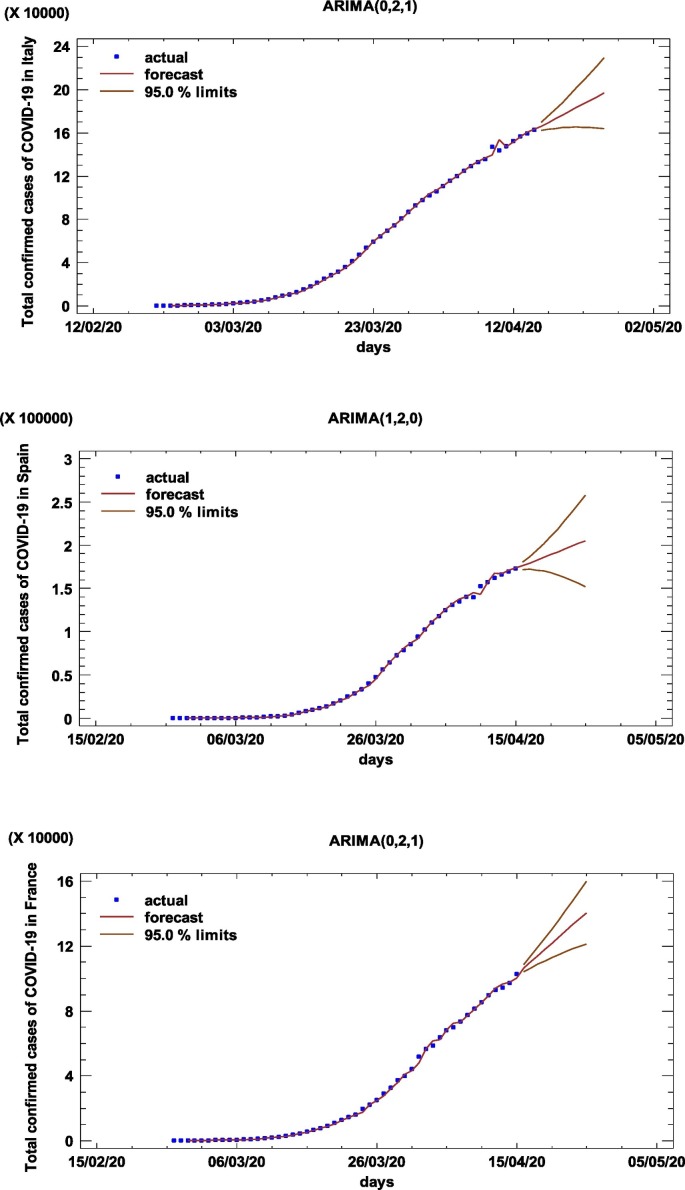
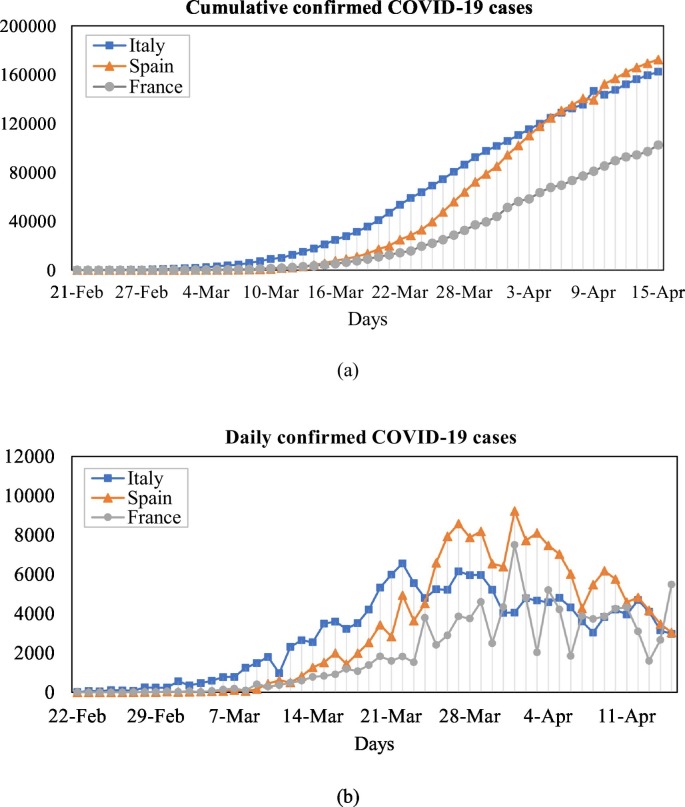
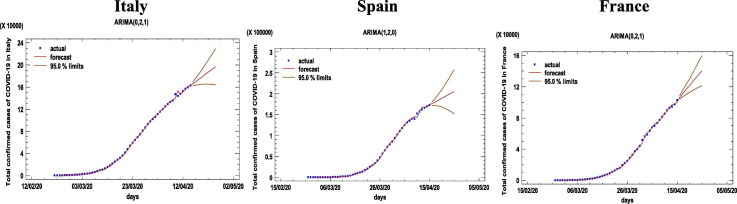
At the end of December 2019, coronavirus disease 2019 (COVID-19) appeared in Wuhan city, China. As of April 15, 2020, >1.9 million COVID-19 cases were confirmed worldwide, including >120,000 deaths. There is an urgent need to monitor and predict COVID-19 prevalence to control this spread more effectively. Time series models are significant in predicting the impact of the COVID-19 outbreak and taking the necessary measures to respond to this crisis. In this study, Auto-Regressive Integrated Moving Average (ARIMA) models were developed to predict the epidemiological trend of COVID-19 prevalence of Italy, Spain, and France, the most affected countries of Europe. The prevalence data of COVID-19 from 21 February 2020 to 15 April 2020 were collected from the World Health Organization website. Several ARIMA models were formulated with different ARIMA parameters. ARIMA (0,2,1), ARIMA (1,2,0), and ARIMA (0,2,1) models with the lowest MAPE values (4.7520, 5.8486, and 5.6335) were selected as the best models for Italy, Spain, and France, respectively. This study shows that ARIMA models are suitable for predicting the prevalence of COVID-19 in the future. The results of the analysis can shed light on understanding the trends of the outbreak and give an idea of the epidemiological stage of these regions. Besides, the prediction of COVID-19 prevalence trends of Italy, Spain, and France can help take precautions and policy formulation for this epidemic in other countries.

摘要

2019 年 12 月底,新型冠状病毒疾病(COVID-19)在中国武汉市出现。截至 2020 年 4 月 15 日,全球已确诊超过 190 万例 COVID-19 病例,其中包括超过 12 万人死亡。迫切需要监测和预测 COVID-19 的流行情况,以更有效地控制这种传播。时间序列模型在预测 COVID-19 爆发的影响和采取必要措施应对这一危机方面具有重要意义。在这项研究中,开发了自回归综合移动平均(ARIMA)模型,以预测欧洲受影响最严重的国家意大利、西班牙和法国 COVID-19 流行的流行病学趋势。从 2020 年 2 月 21 日至 2020 年 4 月 15 日,从世界卫生组织网站收集了 COVID-19 的流行数据。制定了几个具有不同 ARIMA 参数的 ARIMA 模型。具有最低平均绝对百分比误差(MAPE)值(4.7520、5.8486 和 5.6335)的 ARIMA(0,2,1)、ARIMA(1,2,0)和 ARIMA(0,2,1)模型分别被选为意大利、西班牙和法国的最佳模型。这项研究表明,ARIMA 模型适合预测 COVID-19 的未来流行情况。分析结果可以帮助了解疫情的趋势,并了解这些地区的流行病学阶段。此外,对意大利、西班牙和法国 COVID-19 流行趋势的预测,可以帮助其他国家为这一流行病做好预防和政策制定工作。
https://cdn.ncbi.nlm.nih.gov/pmc/blobs/3e47/7175852/04bd2f37039c/gr4_lrg.jpg
https://cdn.ncbi.nlm.nih.gov/pmc/blobs/3e47/7175852/65fe2decdc69/ga1_lrg.jpg
https://cdn.ncbi.nlm.nih.gov/pmc/blobs/3e47/7175852/14860053a415/gr1_lrg.jpg
https://cdn.ncbi.nlm.nih.gov/pmc/blobs/3e47/7175852/4cd6014cb28a/gr2_lrg.jpg
https://cdn.ncbi.nlm.nih.gov/pmc/blobs/3e47/7175852/9441455a5c38/gr3_lrg.jpg
https://cdn.ncbi.nlm.nih.gov/pmc/blobs/3e47/7175852/04bd2f37039c/gr4_lrg.jpg
https://cdn.ncbi.nlm.nih.gov/pmc/blobs/3e47/7175852/65fe2decdc69/ga1_lrg.jpg
https://cdn.ncbi.nlm.nih.gov/pmc/blobs/3e47/7175852/14860053a415/gr1_lrg.jpg
https://cdn.ncbi.nlm.nih.gov/pmc/blobs/3e47/7175852/4cd6014cb28a/gr2_lrg.jpg
https://cdn.ncbi.nlm.nih.gov/pmc/blobs/3e47/7175852/9441455a5c38/gr3_lrg.jpg
https://cdn.ncbi.nlm.nih.gov/pmc/blobs/3e47/7175852/04bd2f37039c/gr4_lrg.jpg

相似文献

1
Estimation of COVID-19 prevalence in Italy, Spain, and France.估算意大利、西班牙和法国的 COVID-19 流行率。
Sci Total Environ. 2020 Aug 10;729:138817. doi: 10.1016/j.scitotenv.2020.138817. Epub 2020 Apr 22.
2
Prediction of the COVID-19 Pandemic for the Top 15 Affected Countries: Advanced Autoregressive Integrated Moving Average (ARIMA) Model.预测受 COVID-19 影响最严重的 15 个国家:高级自回归综合移动平均 (ARIMA) 模型。
JMIR Public Health Surveill. 2020 May 13;6(2):e19115. doi: 10.2196/19115.
3
Testing the Accuracy of the ARIMA Models in Forecasting the Spreading of COVID-19 and the Associated Mortality Rate.检验 ARIMA 模型在预测 COVID-19 传播和相关死亡率方面的准确性。
Medicina (Kaunas). 2020 Oct 27;56(11):566. doi: 10.3390/medicina56110566.
4
Research on COVID-19 based on ARIMA model-Taking Hubei, China as an example to see the epidemic in Italy.基于 ARIMA 模型的 COVID-19 研究——以中国湖北省为例,观察意大利的疫情。
J Infect Public Health. 2020 Oct;13(10):1415-1418. doi: 10.1016/j.jiph.2020.06.019. Epub 2020 Jun 20.
5
ARIMA modelling & forecasting of COVID-19 in top five affected countries.受影响最严重的五个国家的新冠疫情自回归移动平均模型建模与预测
Diabetes Metab Syndr. 2020 Sep-Oct;14(5):1419-1427. doi: 10.1016/j.dsx.2020.07.042. Epub 2020 Jul 28.
6
Forecasting daily confirmed COVID-19 cases in Malaysia using ARIMA models.使用自回归积分滑动平均(ARIMA)模型预测马来西亚每日新增新冠肺炎确诊病例数。
J Infect Dev Ctries. 2020 Sep 30;14(9):971-976. doi: 10.3855/jidc.13116.
7
Forecasting the Spreading of COVID-19 across Nine Countries from Europe, Asia, and the American Continents Using the ARIMA Models.使用自回归积分滑动平均(ARIMA)模型预测新冠病毒在欧洲、亚洲和美洲九个国家的传播情况。
Microorganisms. 2020 Jul 30;8(8):1158. doi: 10.3390/microorganisms8081158.
8
Modelling the initial epidemic trends of COVID-19 in Italy, Spain, Germany, and France.对意大利、西班牙、德国和法国的 COVID-19 初始疫情趋势进行建模。
PLoS One. 2020 Nov 9;15(11):e0241743. doi: 10.1371/journal.pone.0241743. eCollection 2020.
9
Forecasting the epidemiological trends of COVID-19 prevalence and mortality using the advanced -Sutte Indicator.利用高级 Sutte 指标预测 COVID-19 流行和死亡率的流行病学趋势。
Epidemiol Infect. 2020 Oct 5;148:e236. doi: 10.1017/S095026882000237X.
10
SutteARIMA: Short-term forecasting method, a case: Covid-19 and stock market in Spain.SutteARIMA:短期预测方法,案例:新冠疫情与西班牙股市。
Sci Total Environ. 2020 Aug 10;729:138883. doi: 10.1016/j.scitotenv.2020.138883. Epub 2020 Apr 22.

引用本文的文献

1
Google search interests and new cases of COVID-19 in Bangladesh: a vector autoregression analysis for disease surveillance.谷歌搜索兴趣与孟加拉国新冠肺炎新病例:疾病监测的向量自回归分析
BMC Res Notes. 2025 Jul 19;18(1):312. doi: 10.1186/s13104-025-07381-2.
2
Analysis and 15-Year Projections of the Global Burden of Tension-Type Headache by Sex from 1990 to 2021: A Systematic Review of GBD 2021 Data.1990年至2021年全球紧张型头痛负担按性别分析及15年预测:基于全球疾病负担研究2021数据的系统评价
J Pain Res. 2025 Jul 10;18:3505-3517. doi: 10.2147/JPR.S512335. eCollection 2025.
3
Genetic variants in influence SARS-CoV-2 infection susceptibility within Mexican Mestizos.

本文引用的文献

1
Real-time estimation and prediction of mortality caused by COVID-19 with patient information based algorithm.基于患者信息算法的实时估计和预测 COVID-19 死亡率。
Sci Total Environ. 2020 Jul 20;727:138394. doi: 10.1016/j.scitotenv.2020.138394. Epub 2020 Apr 8.
2
Analysis and forecast of COVID-19 spreading in China, Italy and France.新冠病毒在中国、意大利和法国传播情况的分析与预测。
Chaos Solitons Fractals. 2020 May;134:109761. doi: 10.1016/j.chaos.2020.109761. Epub 2020 Mar 21.
3
Why is it difficult to accurately predict the COVID-19 epidemic?
基因变异影响墨西哥梅斯蒂索人对新冠病毒的感染易感性。
Front Genet. 2025 Apr 14;16:1558189. doi: 10.3389/fgene.2025.1558189. eCollection 2025.
4
The impact of non-pharmaceutical interventions on COVID-19 transmission and its effect on life expectancy in two European regions.非药物干预措施对两个欧洲地区新冠病毒传播的影响及其对预期寿命的作用。
BMC Public Health. 2025 Mar 14;25(1):1004. doi: 10.1186/s12889-025-22239-9.
5
Nursing care management strategies to address the COVID-19 pandemic.应对新冠疫情的护理管理策略。
Rev Bras Enferm. 2025 Jan 10;77Suppl 1(Suppl 1):e20230254. doi: 10.1590/0034-7167-20230254. eCollection 2025.
6
Modeling COVID-19 dynamics in the Basque Country: characterizing population immunity profile from 2020 to 2022.巴斯克地区新冠疫情动态建模:描绘2020年至2022年的群体免疫状况
BMC Infect Dis. 2025 Jan 2;25(1):9. doi: 10.1186/s12879-024-10342-y.
7
Epidemiological characteristics and prediction model construction of hand, foot and mouth disease in Quzhou City, China, 2005-2023.2005 - 2023年中国衢州市手足口病的流行病学特征及预测模型构建
Front Public Health. 2024 Dec 18;12:1474855. doi: 10.3389/fpubh.2024.1474855. eCollection 2024.
8
COVID-19, migrants, and world large urban areas: a thematic policy brief.2019冠状病毒病、移民与世界大型城市地区:一份主题政策简报
J Public Health Policy. 2024 Dec;45(4):757-770. doi: 10.1057/s41271-024-00519-9. Epub 2024 Nov 21.
9
Spatial-temporal analysis of hepatitis E in Hainan Province, China (2013-2022): insights from four major hospitals.中国海南省戊型肝炎的时空分析(2013-2022):四大医院的见解。
Front Public Health. 2024 Jun 27;12:1381204. doi: 10.3389/fpubh.2024.1381204. eCollection 2024.
10
High-resolution short-term prediction of the COVID-19 epidemic based on spatial-temporal model modified by historical meteorological data.基于历史气象数据修正的时空模型对新冠疫情的高分辨率短期预测
Fundam Res. 2024 Mar 5;4(3):527-539. doi: 10.1016/j.fmre.2024.02.006. eCollection 2024 May.
为什么准确预测新冠疫情很困难?
Infect Dis Model. 2020;5:271-281. doi: 10.1016/j.idm.2020.03.001. Epub 2020 Mar 25.
4
Data-based analysis, modelling and forecasting of the COVID-19 outbreak.基于数据的 COVID-19 疫情分析、建模和预测。
PLoS One. 2020 Mar 31;15(3):e0230405. doi: 10.1371/journal.pone.0230405. eCollection 2020.
5
Application of the ARIMA model on the COVID-2019 epidemic dataset.自回归积分滑动平均(ARIMA)模型在2019年冠状病毒病疫情数据集上的应用。
Data Brief. 2020 Feb 26;29:105340. doi: 10.1016/j.dib.2020.105340. eCollection 2020 Apr.
6
Forecasting incidence of infectious diarrhea using random forest in Jiangsu Province, China.利用随机森林在中国江苏省预测传染性腹泻的发病率。
BMC Infect Dis. 2020 Mar 14;20(1):222. doi: 10.1186/s12879-020-4930-2.
7
The time series seasonal patterns of dengue fever and associated weather variables in Bangkok (2003-2017).曼谷登革热及其相关气象变量的时间序列季节性模式(2003-2017 年)。
BMC Infect Dis. 2020 Mar 12;20(1):208. doi: 10.1186/s12879-020-4902-6.
8
Optimization Method for Forecasting Confirmed Cases of COVID-19 in China.中国新冠肺炎确诊病例预测的优化方法
J Clin Med. 2020 Mar 2;9(3):674. doi: 10.3390/jcm9030674.
9
Trend and forecasting of the COVID-19 outbreak in China.中国新冠疫情的趋势与预测。
J Infect. 2020 Apr;80(4):469-496. doi: 10.1016/j.jinf.2020.02.014. Epub 2020 Feb 27.
10
Real-time forecasts of the COVID-19 epidemic in China from February 5th to February 24th, 2020.2020年2月5日至2月24日中国新冠肺炎疫情的实时预测
Infect Dis Model. 2020 Feb 14;5:256-263. doi: 10.1016/j.idm.2020.02.002. eCollection 2020.