Cardiac Aging & Redox Signaling Laboratory, Molecular and Cellular Pathology, Department of Pathology, Birmingham, AL, USA; Division of Cardiovascular Medicine, Department of Medicine, University of Utah School of Medicine, Salt Lake City, UT, USA; Center for Free Radical Biology, University of Alabama at Birmingham, Birmingham, AL, USA.
Cardiac Aging & Redox Signaling Laboratory, Molecular and Cellular Pathology, Department of Pathology, Birmingham, AL, USA.
Redox Biol. 2020 Jul;34:101492. doi: 10.1016/j.redox.2020.101492. Epub 2020 Mar 4.
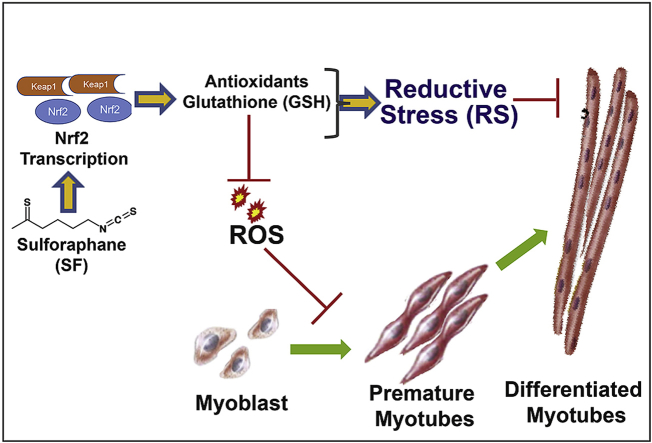
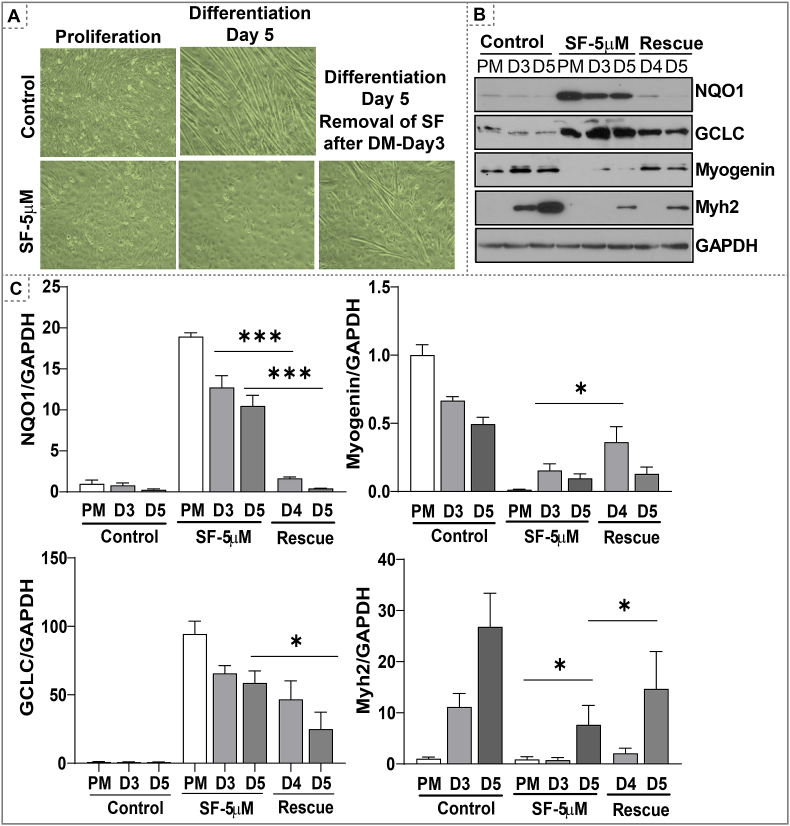
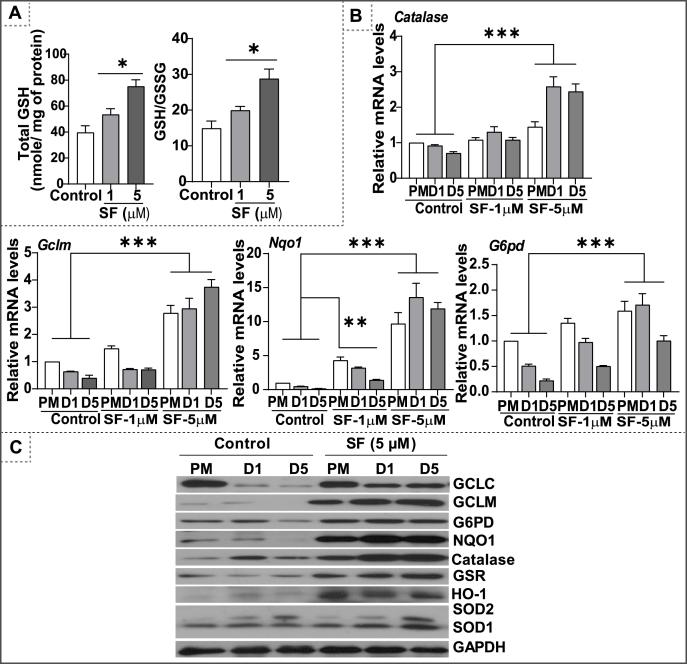
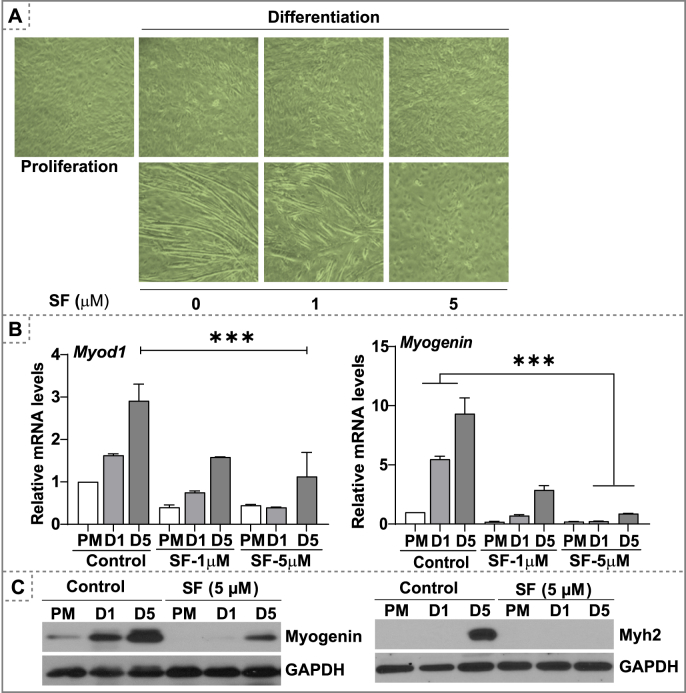
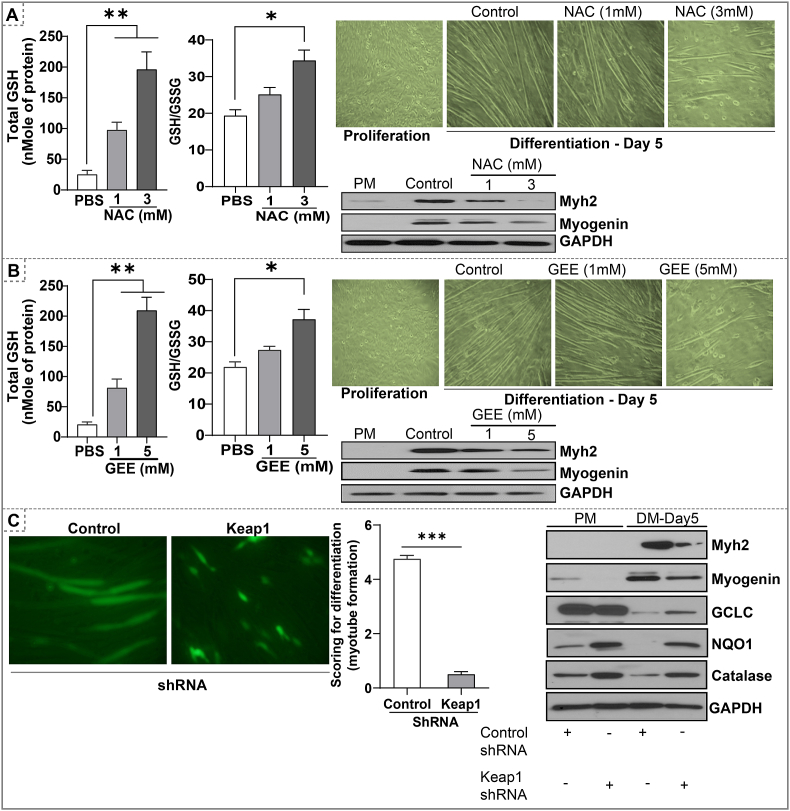
Myo-satellite cells regenerate and differentiate into skeletal muscle (SM) after acute or chronic injury. Changes in the redox milieu towards the oxidative arm at the wound site are known to compromise SM regeneration. Recently, we reported that abrogation of Nrf2/antioxidant signaling promotes oxidative stress and impairs SM regeneration in C57/Bl6 mice. Here, we investigated whether the activation of intracellular Nrf2 signaling favors antioxidant transcription and promotes myoblast differentiation. Satellite cell-like C2C12 myoblasts were treated with sulforaphane (SF; 1.0 & 5.0 μM) to activate Nrf2/antioxidant signaling during proliferation and differentiation (i.e. formation of myotubes/myofibers). SF-mediated Nrf2 activation resulted in increased expression of Nrf2-antioxidants (e.g. GCLC and G6PD) and augmented the production of reduced glutathione (GSH) leading to a reductive redox state. Surprisingly, this resulted in significant inhibition of myoblast differentiation, as observed from morphological changes and reduced expression of MyoD, Pax7, and Myh2, due to reductive stress (RS). Furthermore, supplementation of N-acetyl-cysteine (NAC) or GSH-ester or genetic knock-down of Keap1 (using siRNA) also resulted in RS-driven inhibition of differentiation. Interestingly, withdrawing Nrf2 activation rescued differentiation potential and formation of myotubes/myofibers from C2C12 myoblasts. Thus, abrogation of physiological ROS signaling through over-activation of Nrf2 (i.e. RS) and developing RS hampers differentiation of muscle satellite cells.
肌卫星细胞在急性或慢性损伤后会再生并分化为骨骼肌(SM)。已知伤口部位氧化环境的变化会损害 SM 再生。最近,我们报道了 Nrf2/抗氧化信号的缺失会促进氧化应激,并损害 C57/Bl6 小鼠的 SM 再生。在这里,我们研究了细胞内 Nrf2 信号的激活是否有利于抗氧化转录并促进成肌细胞分化。用萝卜硫素(SF;1.0 和 5.0 μM)处理卫星细胞样 C2C12 成肌细胞,以在增殖和分化(即肌管/肌纤维形成)过程中激活 Nrf2/抗氧化信号。SF 介导的 Nrf2 激活导致 Nrf2-抗氧化剂(如 GCLC 和 G6PD)的表达增加,并增加还原型谷胱甘肽(GSH)的产生,导致还原性氧化还原状态。令人惊讶的是,这导致成肌细胞分化明显受到抑制,从形态变化和 MyoD、Pax7 和 Myh2 的表达减少可以看出,这是由于还原性应激(RS)所致。此外,补充 N-乙酰半胱氨酸(NAC)或 GSH-酯或使用 siRNA 基因敲低 Keap1 也会导致 RS 驱动的分化抑制。有趣的是,撤回 Nrf2 激活可挽救 C2C12 成肌细胞的分化潜能和肌管/肌纤维的形成。因此,通过过度激活 Nrf2(即 RS)和产生 RS 来阻断生理 ROS 信号会阻碍肌肉卫星细胞的分化。