Department of Urology, Chung-Ang University Hospital, Chung-Ang University College of Medicine, Dongjak-gu, Seoul 06973, Korea.
Department of Urology, Asan Medical Center, University of Ulsan College of Medicine, Songpa-gu, Seoul 05505, Korea.
Asian J Androl. 2021 Jan-Feb;23(1):74-79. doi: 10.4103/aja.aja_16_20.
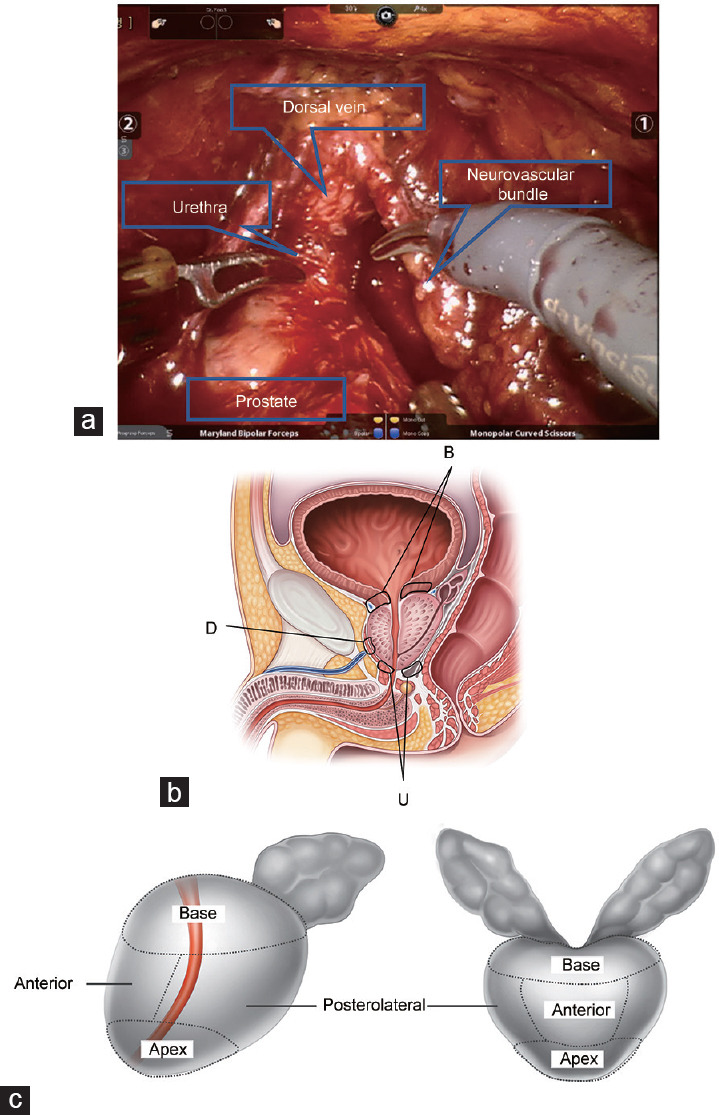
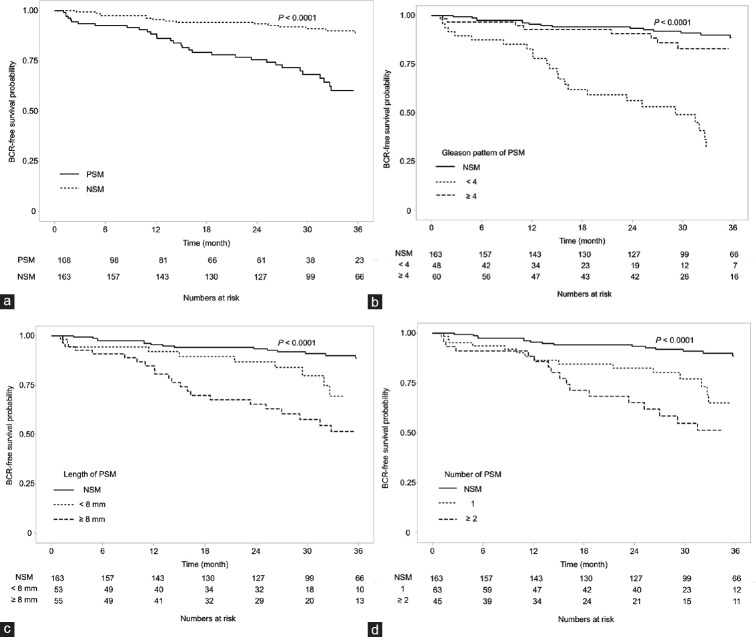
We investigated the relationship between positive surgical margin (PSM)-related factors and biochemical recurrence (BCR) and the ability of intraoperative frozen sections to predict significant PSM in patients with prostate cancer. The study included 271 patients who underwent robot-assisted laparoscopic prostatectomy with bilateral nerve sparing and maximal urethral preservation. Intraoperative frozen sections of the periurethra, dorsal vein, and bladder neck were analyzed. The ability of PSM-related factors to predict BCR and significant PSM was assessed by logistic regression. Of 271 patients, 108 (39.9%) had PSM and 163 (60.1%) had negative margins. Pathologic Gleason score ≥8 (18.9% vs 7.5%, P = 0.015) and T stage ≥T3a (51.9%vs 24.6%, P < 0.001) were significantly more frequent in the PSM group. Multivariate analysis showed that Gleason pattern ≥4 (vs <4; hazard ratio: 4.386; P = 0.0004) was the only significant predictor of BCR in the PSM cohort. Periurethral frozen sections had a sensitivity of 83.3% and a specificity of 84.2% in detecting PSM with Gleason pattern ≥4. Multivariate analysis showed that membranous urethra length (odds ratio [OR]: 0.79, P = 0.0376) and extracapsular extension of the apex (OR: 4.58, P = 0.0226) on magnetic resonance imaging (MRI) and positive periurethral tissue (OR: 17.85, P < 0.0001) were associated with PSM of the apex. PSM with Gleason pattern ≥4 is significantly predictive of BCR. Intraoperative frozen sections of periurethral tissue can independently predict PSM, whereas sections of the bladder neck and dorsal vein could not. Pathologic examination of these samples may help predict significant PSM in patients undergoing robot-assisted laparoscopic prostatectomy with preservation of functional outcomes.
我们研究了阳性切缘(PSM)相关因素与生化复发(BCR)之间的关系,以及术中冰冻切片在预测前列腺癌患者显著 PSM 方面的能力。本研究纳入了 271 例行机器人辅助腹腔镜前列腺癌根治术并保留双侧神经和最大限度保留尿道的患者。分析了尿道周围、背静脉和膀胱颈部的术中冰冻切片。通过逻辑回归评估 PSM 相关因素预测 BCR 和显著 PSM 的能力。在 271 例患者中,108 例(39.9%)有 PSM,163 例(60.1%)无切缘。PSM 组中病理 Gleason 评分≥8(18.9%比 7.5%,P=0.015)和 T 期≥T3a(51.9%比 24.6%,P<0.001)的比例显著更高。多变量分析显示,Gleason 模式≥4(比<4;危险比:4.386;P=0.0004)是 PSM 组中唯一显著预测 BCR 的因素。尿道周围冰冻切片在检测 Gleason 模式≥4 的 PSM 时具有 83.3%的敏感性和 84.2%的特异性。多变量分析显示,磁共振成像(MRI)上膜部尿道长度(比值比[OR]:0.79,P=0.0376)和尖部外囊延伸(OR:4.58,P=0.0226)以及阳性尿道周围组织(OR:17.85,P<0.0001)与尖部 PSM 相关。Gleason 模式≥4 的 PSM 与 BCR 显著相关。尿道周围组织的术中冰冻切片可独立预测 PSM,而膀胱颈部和背静脉的切片则不能。对这些样本的病理检查可能有助于预测接受机器人辅助腹腔镜前列腺癌根治术并保留功能结局的患者中显著 PSM 的发生。