Cury Maria Elisa Gisbert, Berberian Arthur, Scarpato Bruno Sini, Kerr-Gaffney Jess, Santos Flavia H, Claudino Angélica Medeiros
Eating Disorders Program (PROATA), Department of Psychiatry, Universidade Federal de São Paulo (UNIFESP), São Paulo, Brazil.
Interdisciplinary Laboratory of Clinical Neurosciences (LiNC), Department of Psychiatry, Universidade Federal de São Paulo (UNIFESP), São Paulo, Brazil.
Front Psychiatry. 2020 Apr 17;11:288. doi: 10.3389/fpsyt.2020.00288. eCollection 2020.
Cognitive deficits are implicated in theoretical explanatory models for binge eating disorder (BED). Furthermore, evidence suggest that alterations in executive function may underlie symptoms in BED. The current systematic review and meta-analysis provides an update on executive functioning in individuals with BED.
Literature searches (up to November 2019) were conducted in electronic databases combining binge eating or BED with executive functions. The Preferred Reporting Items for Systematic Reviews and Meta-Analyses statement guidelines was used. Studies of any design comparing adults with BED with those without BED in executive function domains were selected. Methodological quality of studies was based on the Newcastle-Ottawa scale.
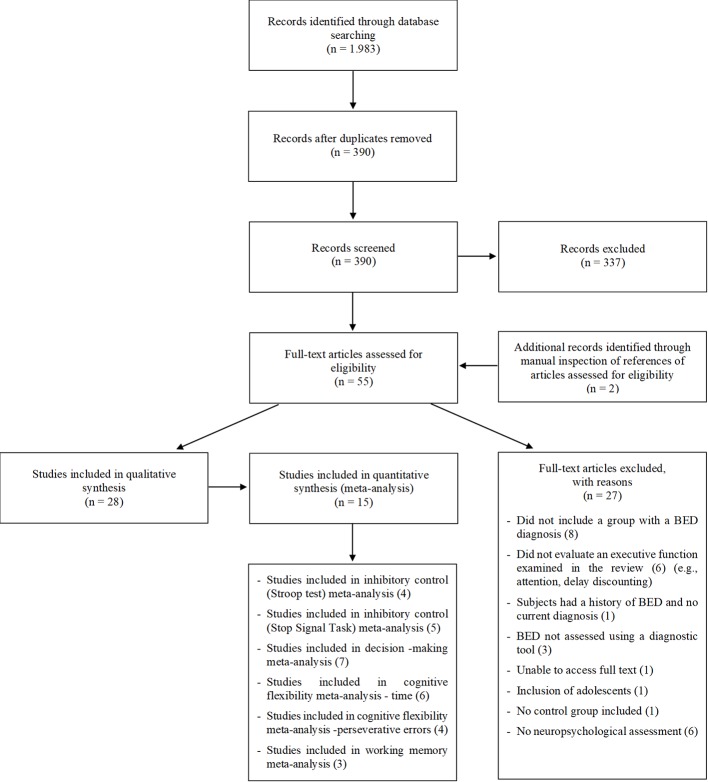
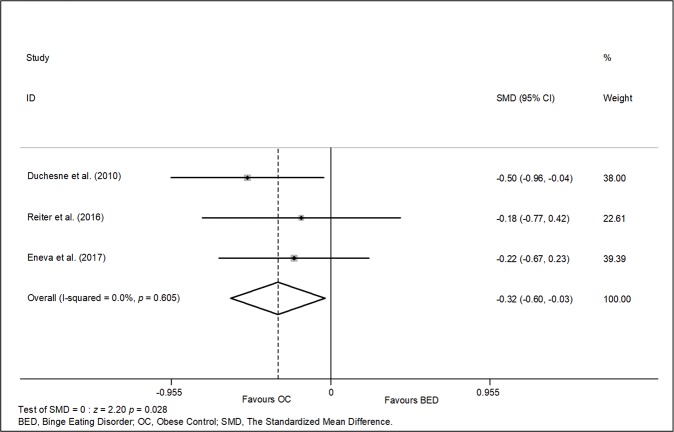
Of 1,983 citations identified, 28 case-control studies met inclusion criteria for this review. Six meta-analyses that examined four domains (decision-making, cognitive flexibility, inhibitory control, and working memory) were conducted. The only meta-analysis to show a significant difference in executive functioning between BED and obese controls was working memory (SMD = 0.32, 95% IC: -0.60, -0.03; = 0.028), with an effect size of small magnitude. Qualitative inspection of the literature indicated mixed findings for control inhibition, decision making and cognitive flexibility in individuals with BED compared to controls (obese or normal weight). In addition, people with BED showed poorer problem solving performance, but similar planning abilities to obese controls.
Individuals with BED were found to show worse performance on working memory tasks compared to obese individuals without the disorder. The findings did not provide definitive evidence of alterations in other aspects of executive functioning. Interest in executive functioning in people with BED is increasing but is limited by insufficient data from small studies with varied methodology. Future studies should focus on using similar tests and outcome measures, in order to enable more pertinent comparisons across studies.
认知缺陷在暴饮暴食症(BED)的理论解释模型中有所涉及。此外,有证据表明执行功能的改变可能是BED症状的潜在原因。当前的系统评价和荟萃分析提供了有关BED患者执行功能的最新情况。
在电子数据库中进行文献检索(截至2019年11月),将暴饮暴食或BED与执行功能相结合。使用系统评价和荟萃分析的首选报告项目声明指南。选择了在执行功能领域比较BED成年人与非BED成年人的任何设计的研究。研究的方法学质量基于纽卡斯尔-渥太华量表。
在识别出的1983篇文献中,有28项病例对照研究符合本评价的纳入标准。进行了六项荟萃分析,考察了四个领域(决策、认知灵活性、抑制控制和工作记忆)。唯一一项显示BED与肥胖对照在执行功能上有显著差异的荟萃分析是工作记忆(标准化均数差=0.32,95%置信区间:-0.60,-0.03;P=0.028),效应量较小。对文献的定性检查表明,与对照组(肥胖或正常体重)相比,BED患者在控制抑制、决策和认知灵活性方面的研究结果不一。此外,BED患者的问题解决能力较差,但规划能力与肥胖对照相似。
与没有该疾病的肥胖个体相比,发现BED患者在工作记忆任务上表现更差。这些发现没有提供执行功能其他方面改变的确切证据。对BED患者执行功能的研究兴趣在增加,但受到方法多样的小型研究数据不足的限制。未来的研究应专注于使用相似的测试和结果测量方法,以便能够在各项研究之间进行更相关的比较。