Eneva Kalina T, Arlt Jean M, Yiu Angelina, Murray Susan M, Chen Eunice Y
Temple Eating Disorders Program, Department of Psychology, Temple University, Philadelphia, Pennsylvania, 19122.
Int J Eat Disord. 2017 Aug;50(8):942-951. doi: 10.1002/eat.22738. Epub 2017 Jun 23.
Executive functioning (EF) problems may serve as vulnerability or maintenance factors for Binge-Eating Disorder (BED). However, it is unclear if EF problems observed in BED are related to overweight status or BED status. The current study extends this literature by examining EF in overweight and normal-weight BED compared to weight-matched controls.
Participants were normal-weight women with BED (n = 23), overweight BED (n = 32), overweight healthy controls (n = 48), and normal-weight healthy controls (n = 29). The EF battery utilized tests from the National Institutes of Health (NIH) Toolbox and Delis-Kaplan Executive Function System (D-KEFS).
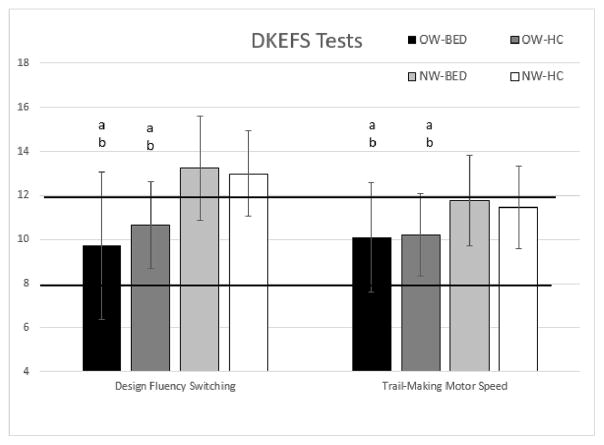
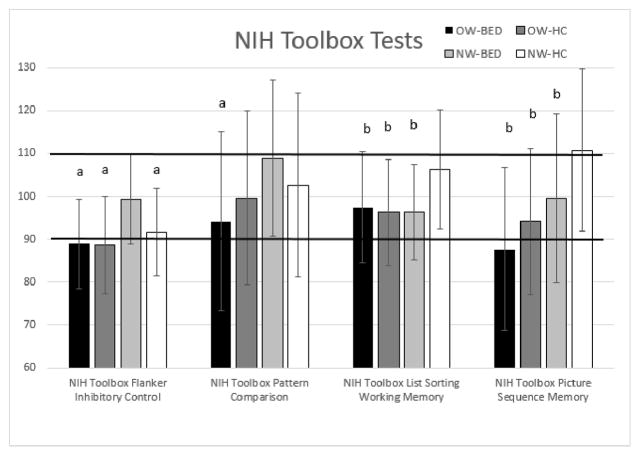
After controlling for years of education and minority status, overweight individuals performed more poorly than normal-weight individuals on a task of cognitive flexibility requiring generativity (p < .01), and speed on psychomotor performance tasks (p = .01). Normal-weight and overweight BED performed worse on working memory tasks compared to controls (p = .04). Unexpectedly, normal-weight BED individuals out-performed all other groups on an inhibitory control task (p < .01). No significant differences were found between the four groups on tasks of planning.
Regardless of weight status, BED is associated with working memory problems. Replication of the finding that normal-weight BED is associated with enhanced inhibitory control is needed.
执行功能(EF)问题可能是暴食症(BED)的易感性或维持因素。然而,尚不清楚在BED中观察到的EF问题是与超重状态还是BED状态相关。本研究通过比较超重和正常体重的BED患者与体重匹配的对照组的EF,扩展了这方面的文献。
参与者包括正常体重的BED女性(n = 23)、超重的BED女性(n = 32)、超重的健康对照组(n = 48)和正常体重的健康对照组(n = 29)。EF测试组合使用了美国国立卫生研究院(NIH)工具箱和德利斯科-卡普兰执行功能系统(D-KEFS)的测试。
在控制了受教育年限和少数族裔身份后,超重个体在一项需要创造性的认知灵活性任务上的表现比正常体重个体更差(p <.01),在心理运动表现任务上的速度也更慢(p =.01)。与对照组相比,正常体重和超重的BED患者在工作记忆任务上表现更差(p =.04)。出乎意料的是,正常体重的BED个体在抑制控制任务上的表现优于所有其他组(p <.01)。四组在计划任务上没有发现显著差异。
无论体重状况如何,BED都与工作记忆问题有关。需要重复验证正常体重的BED与增强的抑制控制相关这一发现。