Department of Bioscience, College of Natural Science, Keimyung University, Daegu, Korea.
Department of Rehabilitation Medicine, Eulji Hospital, Eulji University School of Medicine, Seoul, Korea.
Technol Health Care. 2020;28(S1):509-519. doi: 10.3233/THC-209051.
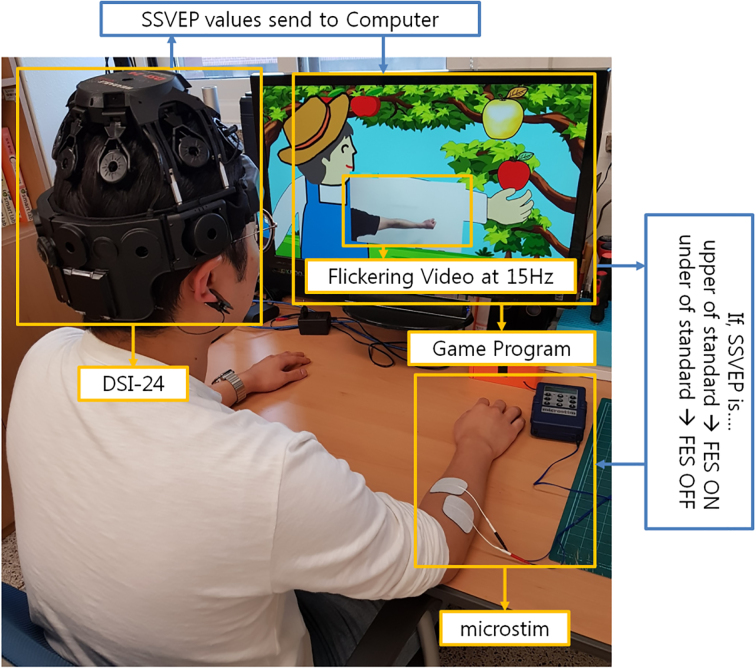
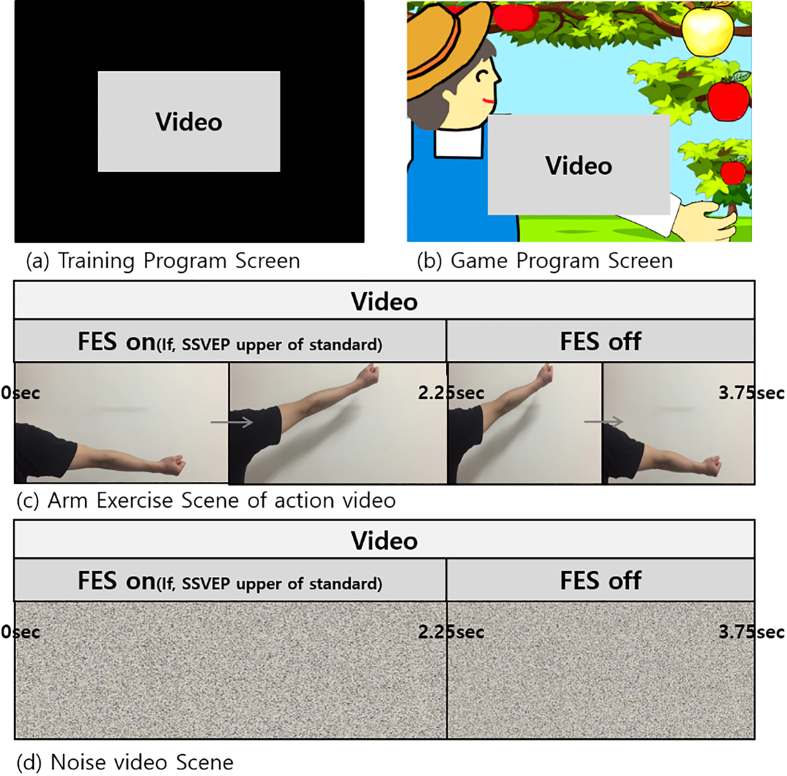
This study focused on developing an upper limb rehabilitation program. In this regard, a steady state visual evoked potential (SSVEP) triggered brain computer interface (BCI)-functional electrical stimulation (FES) based action observation game featuring a flickering action video was designed.
In particular, the synergetic effect of the game was investigated by combining the action observation paradigm with BCI based FES.
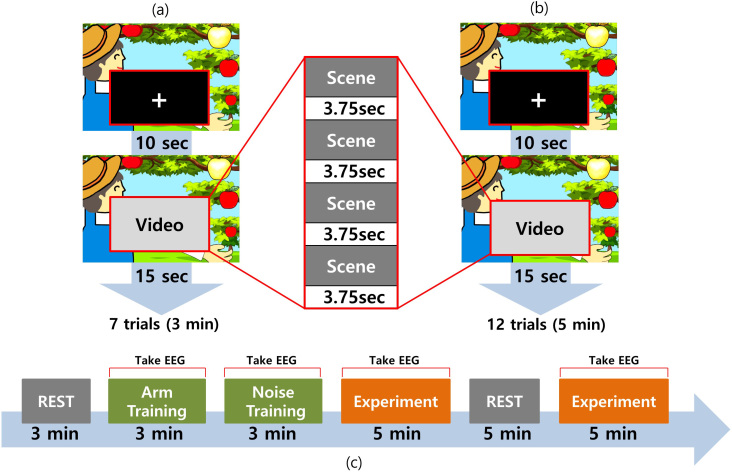
The BCI-FES system was contrasted under two conditions: with flickering action video and flickering noise video. In this regard, 11 right-handed subjects aged between 22-27 years were recruited. The differences in brain activation in response to the two conditions were examined.
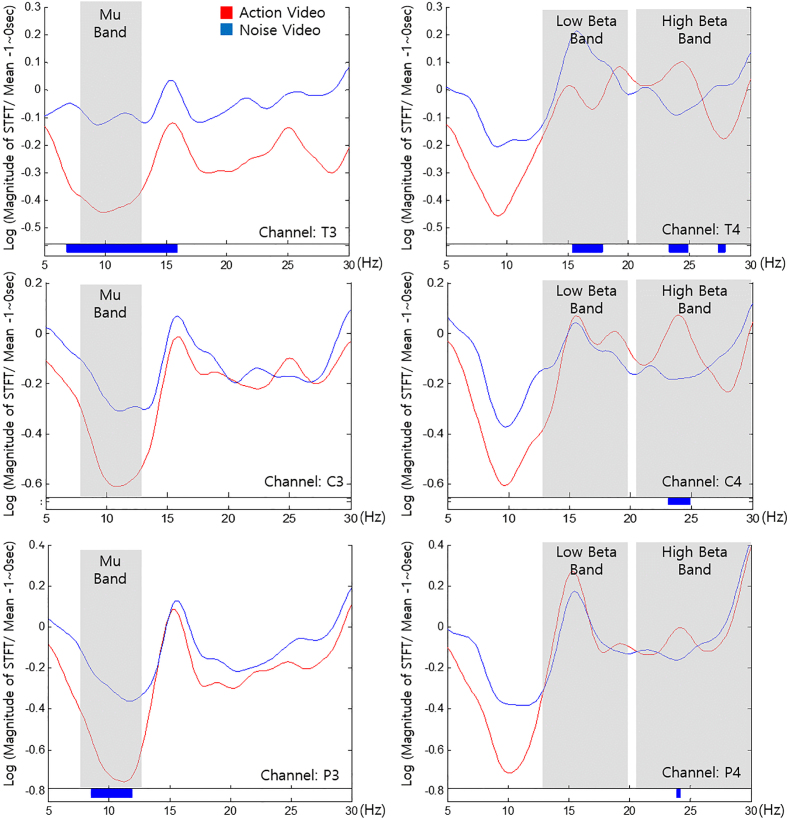
The results indicate that T3 and P3 channels exhibited greater Mu suppression in 8-13 Hz for the action video than the noise video. Furthermore, T4, C4, and P4 channels indicated augmented high beta (21-30 Hz) for the action in contrast to the noise video. Finally, T4 indicated suppressed low beta (14-20 Hz) for the action video in contrast to the noise video.
The flickering action video based BCI-FES system induced a more synergetic effect on cortical activation than the flickering noise based system.
本研究旨在开发一种上肢康复方案。为此,设计了一种基于稳态视觉诱发电位(SSVEP)触发脑机接口(BCI)-功能性电刺激(FES)的动作观察游戏,该游戏具有闪烁动作视频。
特别是通过将动作观察范式与基于 BCI 的 FES 相结合,研究了游戏的协同效应。
在两种条件下对比了 BCI-FES 系统:带有闪烁动作视频和闪烁噪声视频。为此,招募了 11 名年龄在 22-27 岁之间的右利手受试者。检查了两种条件下大脑激活的差异。
结果表明,与噪声视频相比,T3 和 P3 通道在 8-13 Hz 频段的 Mu 抑制更大。此外,与噪声视频相比,T4、C4 和 P4 通道的高 beta(21-30 Hz)增加。最后,与噪声视频相比,T4 通道的低 beta(14-20 Hz)受到抑制。
与基于闪烁噪声的系统相比,基于闪烁动作视频的 BCI-FES 系统对皮层激活产生了更协同的影响。