Korean Medicine (KM) Application Center, Korea Institute of Oriental Medicine (KIOM), 70 Cheomdan-ro, Dong-gu, Daegu 41062, Korea.
Molecules. 2020 Apr 29;25(9):2068. doi: 10.3390/molecules25092068.
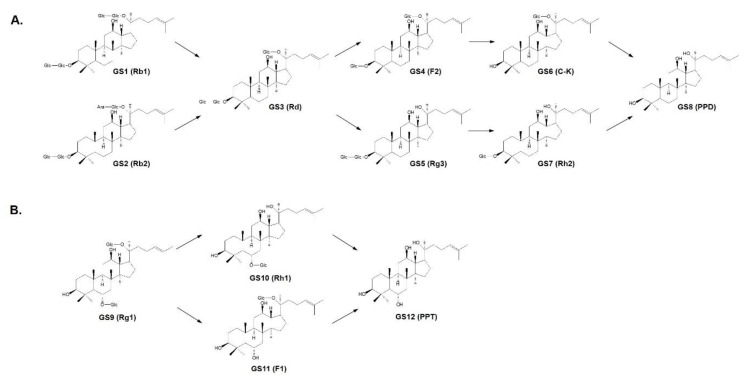
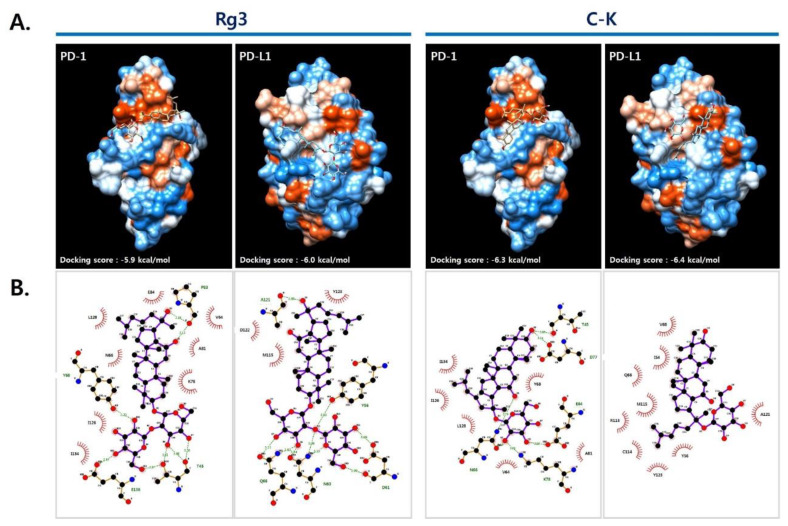
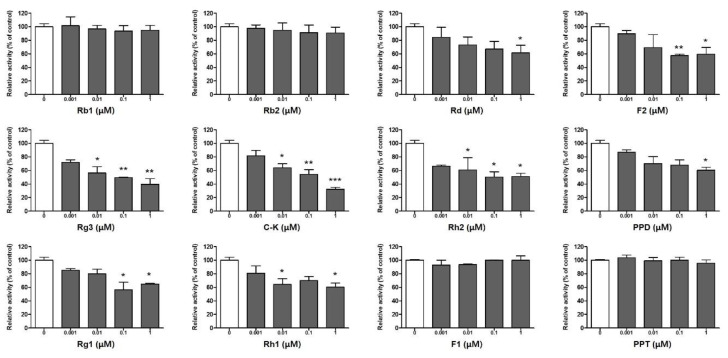
Evidence suggests that programmed death receptor-1/programmed death ligand-1 (PD-1/PD-L1) targeted inhibitors act as an immune checkpoint blockade, indicating that these compounds may be useful in cancer immunotherapy by inhibiting the immune response between T-cells and tumors. Previous studies have shown that ginsenosides can regulate the expression of PD-1 and PD-L1 in target diseases; however, it remains unknown whether ginsenosides act as a blockade of PD-1/PD-L1 interactions. In this study, we used competitive ELISA to investigate 12 ginsenosides for their ability to block PD-1/PD-L1 interactions. In addition, we performed a protein-ligand docking simulation and examined the hydrophobic interactions and hydrogen bonds formed at the interfaces between the ginsenosides and PD-L1/PD-1. Eight out of the 12 ginsenosides studied showed inhibition of PD-1/PD-L1 interactions at 35% at the maximum concentration (1 μM). Among them, Rg3 and Compound K (C-K) demonstrated the highest inhibitory effects. Rg3 and C-K were further identified for their interaction efficacy with PD-1/PD-L1, which supported our results demonstrating the blocking activity of these compounds against PD-1/PD-L1 binding interactions. Collectively, our findings suggest that some ginsenosides, including Rg3 and C-K, inhibit PD-1/PD-L1 binding interactions. Therefore, these compounds may prove useful as part of an overall immuno-oncological strategy.
有证据表明,程序性死亡受体 1/程序性死亡配体 1(PD-1/PD-L1)靶向抑制剂可作为免疫检查点阻断剂,这表明这些化合物通过抑制 T 细胞与肿瘤之间的免疫反应,可能在癌症免疫治疗中发挥作用。先前的研究表明,人参皂苷可调节靶向疾病中 PD-1 和 PD-L1 的表达;然而,人参皂苷是否作为 PD-1/PD-L1 相互作用的阻断剂尚不清楚。在这项研究中,我们使用竞争性 ELISA 来研究 12 个人参皂苷阻断 PD-1/PD-L1 相互作用的能力。此外,我们进行了蛋白质配体对接模拟,并检查了人参皂苷与 PD-L1/PD-1 界面形成的疏水相互作用和氢键。在所研究的 12 个人参皂苷中,有 8 种在最大浓度(1 μM)下对 PD-1/PD-L1 相互作用的抑制率达到 35%。其中,Rg3 和化合物 K(C-K)表现出最高的抑制效果。进一步鉴定了 Rg3 和 C-K 与人 PD-1/PD-L1 的相互作用效果,这支持了我们的研究结果,表明这些化合物对 PD-1/PD-L1 结合相互作用具有阻断活性。总的来说,我们的研究结果表明,一些人参皂苷,包括 Rg3 和 C-K,可抑制 PD-1/PD-L1 结合相互作用。因此,这些化合物可能作为整体免疫肿瘤学策略的一部分而具有应用价值。