1st Department of Internal Medicine, Faculty of Medicine, Pavol Jozef Safarik University and Louis Pasteur University Hospital, 040 11 Kosice, Slovakia.
Department of Infectology and Travel Medicine, Faculty of Medicine, Pavol Jozef Safarik University and Louis Pasteur University Hospital, 040 01 Kosice, Slovakia.
Int J Environ Res Public Health. 2020 Apr 29;17(9):3112. doi: 10.3390/ijerph17093112.
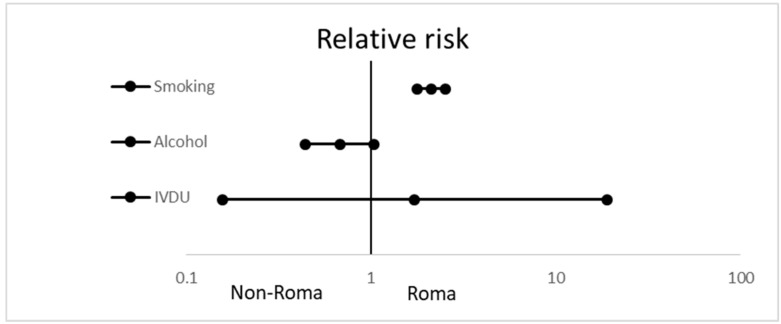
: The Roma population is one of the largest marginalized population groups in Europe. The aim of our work was to summarize the morbidity of lifestyle-related diseases and infectious diseases in the Roma population living in segregated settlements. : We used data from the cross-sectional study HepaMeta, in which we examined 452 Roma subjects with an average age of 34.7 ± 9.1 years, 35.2% of which were men, and 403 non-Roma subjects with an average age of 33.5 ± 7.4 years, 45.9% of which were men. We collected data by means of a questionnaire, anthropometric measures, and we analyzed blood and urine samples. : Roma subjects had a higher incidence of metabolic syndrome (RR: 1.478 (1.159-1.885), < 0.0001), obesity or waist circumference >94 cm in men/80 cm in women (RR: 1.287 (1.127-1.470), < 0.0001), and HDL-C < 1.03 mmol/L in men or <1.29 in women (RR: 2.004 (1.730-2.321), < 0.0001) than their non-Roma counterparts. Subjects of the Roma population were more frequently diagnosed with kidney disease (RR: 1.216 (1.096-1.349), < 0.0001), HBsAg positivity (RR: 4.468 (2.373-8.415), < 0.0001), anti HBc IgG positivity (RR: 3.13 (2.598-4.224), < 0.0001), and anti HEV positivity (RR: 2.972 (1.226-7.287), < 0.0001). Serological markers of infection and spp. were observed much more frequently among Roma than non-Roma subjects (RR: 1.868 (1.520-2.296), < 0.0001, for ; and RR: 21.812 (8.097-58.761), < 0.0001, for spp.). : Poor socio-economic conditions, an unhealthy lifestyle, and barriers precluding access to healthcare are factors that affect the Roma population in settlements and lead to an increased prevalence of metabolic syndrome and its components, kidney disease, viral hepatitis B and E, and some parasitic diseases.
罗姆人是欧洲最大的边缘化群体之一。我们的工作旨在总结居住在隔离定居点的罗姆人生活方式相关疾病和传染病的发病率。
我们使用了横断面研究 HepaMeta 的数据,其中我们检查了 452 名平均年龄为 34.7 ± 9.1 岁的罗姆人受试者,其中 35.2%为男性,以及 403 名非罗姆人受试者,平均年龄为 33.5 ± 7.4 岁,其中 45.9%为男性。我们通过问卷调查、人体测量学测量收集数据,并分析了血液和尿液样本。
罗姆人受试者代谢综合征的发病率更高(RR:1.478(1.159-1.885),<0.0001)、肥胖或腰围>男性 94cm/女性 80cm(RR:1.287(1.127-1.470),<0.0001)和男性 HDL-C<1.03mmol/L 或女性<1.29mmol/L(RR:2.004(1.730-2.321),<0.0001)比非罗姆人受试者更高。罗姆人受试者更频繁地被诊断患有肾脏疾病(RR:1.216(1.096-1.349),<0.0001)、HBsAg 阳性(RR:4.468(2.373-8.415),<0.0001)、抗 HBc IgG 阳性(RR:3.13(2.598-4.224),<0.0001)和抗 HEV 阳性(RR:2.972(1.226-7.287),<0.0001)。与非罗姆人受试者相比,罗姆人受试者中更频繁地观察到感染和 spp. 的血清学标志物(RR:1.868(1.520-2.296),<0.0001,用于 ;和 RR:21.812(8.097-58.761),<0.0001,用于 spp.)。
社会经济条件差、生活方式不健康以及获得医疗保健的障碍是影响定居点罗姆人健康的因素,导致代谢综合征及其组成部分、肾脏疾病、乙型和戊型肝炎以及一些寄生虫病的患病率增加。