Dall'Asta Margherita, Angelino Donato, Pellegrini Nicoletta, Martini Daniela
Department of Animal Science, Food and Nutrition, Università Cattolica del Sacro Cuore, 29122 Piacenza, Italy.
Faculty of Bioscience and Technology for Food, Agriculture and Environment, University of Teramo, 64100 Teramo, Italy.
Nutrients. 2020 Apr 30;12(5):1273. doi: 10.3390/nu12051273.
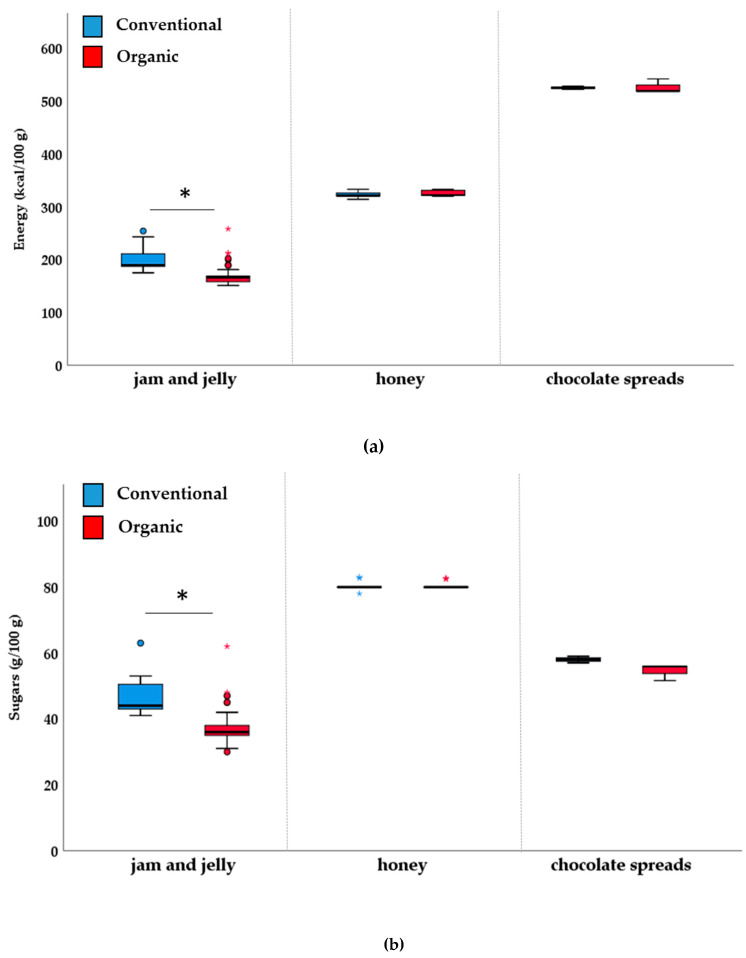
The market for organic products is growing rapidly, probably attributable to the general customer perception that they are healthier foods, with a better nutritional profile than conventional ones. Despite this, the available studies show limited differences in the nutrient profile of organically and conventionally primary food products. Apart from this literature, no studies have focused on the nutrition profile of commercially prepacked foods. Thus, the aim of the present survey was to compare the nutritional quality intended as nutrition facts of organic and conventional prepacked foods sold in Italy. A total of 569 pairs of prepacked products (organic and their conventional counterparts) were selected from nine food categories sold by online retailers. By comparing organic and conventional products in the "pasta, rice and other cereals" category, the former were lower in energy, protein, and higher in saturates compared to the latter. Organic "jams, chocolate spreads and honey" products were lower in energy, carbohydrates, sugars and higher in protein than their regular counterparts. No differences were found for energy, macronutrients and salt for other categories. Therefore, based on the mandatory information printed on their packaging, prepacked organic products are not of a superior nutritional quality than conventional ones, with just a few exceptions. Consequently, the present study suggests that organic certification cannot be considered an indication of better overall nutritional quality. Further studies examining the nutritional quality of organic foods, taking into account the ingredients used, might better explain the results obtained.
有机产品市场正在迅速增长,这可能归因于消费者普遍认为它们是更健康的食品,其营养成分比传统食品更好。尽管如此,现有研究表明,有机和传统初级食品的营养成分差异有限。除了这些文献外,没有研究关注商业预包装食品的营养成分。因此,本次调查的目的是比较在意大利销售的有机和传统预包装食品的营养质量(以营养成分表为准)。从在线零售商销售的九个食品类别中总共挑选了569对预包装产品(有机产品及其传统对应产品)。通过比较“面食、大米和其他谷物”类别的有机产品和传统产品,前者的能量、蛋白质含量较低,饱和脂肪含量高于后者。有机“果酱、巧克力酱和蜂蜜”产品的能量、碳水化合物、糖含量较低,蛋白质含量高于其常规对应产品。其他类别的能量、宏量营养素和盐含量没有差异。因此,根据包装上印刷的强制性信息,预包装有机产品的营养质量并不优于传统产品,只有少数例外。因此,本研究表明,有机认证不能被视为整体营养质量更好的指标。进一步研究有机食品的营养质量,考虑所使用的成分,可能会更好地解释所获得的结果。