ETH AI Center, ETH Zurich, 8092 Zurich, Switzerland.
Institute of Computer Science (ICS-HSG), University of St. Gallen, 9000 St. Gallen, Switzerland.
Nutrients. 2022 May 13;14(10):2044. doi: 10.3390/nu14102044.
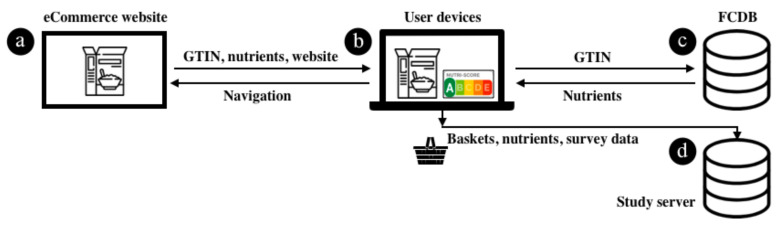
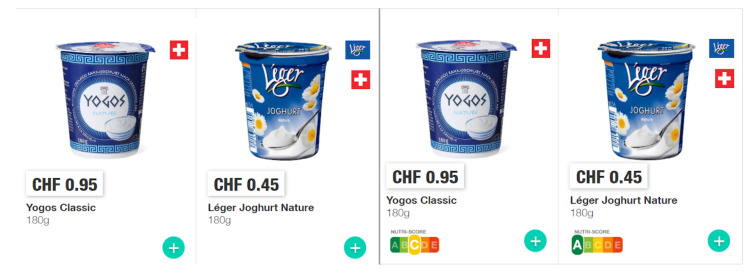
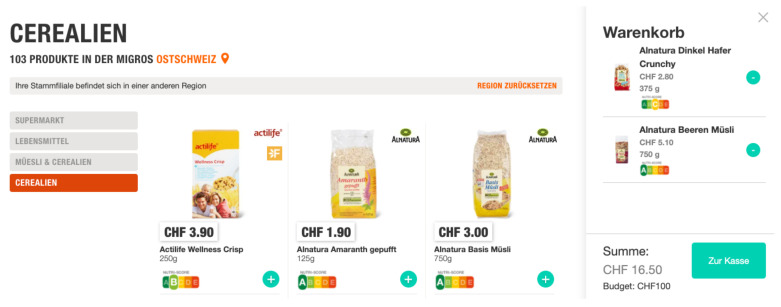
In order to induce the shift in consumer behavior necessary for the mitigation of diet-related diseases, front-of-package labels (FoPL) such as the Nutri-Score that support consumers in their efforts to identify nutritionally valuable products during grocery shopping have been found to be effective; however, they remain non-compulsory in most regions. Counter-intuitively, a similar stream of research on digital web-based FoPL does not yet exist, even though such digital labels hold several advantages over physical labels. Digital FoPL can provide scalable and personalized interventions, are easier to implement than physical labels, and are especially timely due to the recent increase in online grocery shopping. The goal of this study was to demonstrate the technical feasibility and intervention potential of novel, scalable, and passively triggered health behavior interventions distributed via easy-to-install web browser extensions designed to support healthy food choices via the inclusion of digital FoPL in online supermarkets. To that end, we developed a Chrome web browser extension for a real online supermarket and evaluated the effect of this digital food label intervention (i.e., display of the Nutri-Score next to visible products) on the nutritional quality of individuals' weekly grocery shopping in a randomized controlled laboratory trial ( = 135). Compared to the control group, individuals exposed to the intervention chose products with a higher nutritional quality (e.g., 8% higher healthy trolley index (HETI), 3.3% less sugar, 7.5% less saturated fat). In particular, users with low food literacy seemed to benefit from the digital FoPL (e.g., 11% higher HETI, 10.5% less sugar, 5.5% less saturated fat). Furthermore, participants exposed to the food label advocated its introduction more strongly than the control group ( = 0.081). Consumers worldwide could easily install such applications to display digital food labels on their end devices, and would thus not have to wait for stakeholders in the food industry to eventually reach consensus on mandatory food label introduction.
为了促使消费者行为发生必要转变,以减轻与饮食相关的疾病,在杂货店购物时,支持消费者识别有营养价值产品的前端包装标签(FoPL),如 Nutri-Score,已被证明是有效的;然而,在大多数地区,它们仍然是非强制性的。具有讽刺意味的是,尽管数字 FoPL 具有优于物理标签的几个优势,但类似的基于网络的数字 FoPL 研究却并不存在。数字 FoPL 可以提供可扩展和个性化的干预措施,比物理标签更容易实施,并且由于最近在线杂货购物的增加而特别及时。本研究的目的是展示通过易于安装的网络浏览器扩展分发新型、可扩展和被动触发的健康行为干预措施的技术可行性和干预潜力,这些扩展旨在通过在在线超市中包含数字 FoPL 来支持健康食品选择。为此,我们为一个真实的在线超市开发了一个 Chrome 网络浏览器扩展,并在一个随机对照实验室试验中评估了这种数字食品标签干预措施(即,在可见产品旁边显示 Nutri-Score)对个体每周杂货购物营养质量的影响(n = 135)。与对照组相比,暴露于干预措施的个体选择了营养质量更高的产品(例如,健康购物车指数(HETI)高 8%,糖少 3.3%,饱和脂肪少 7.5%)。特别是,食品知识水平较低的用户似乎受益于数字 FoPL(例如,HETI 高 11%,糖少 10.5%,饱和脂肪少 5.5%)。此外,暴露于食品标签的参与者比对照组更强烈地主张引入食品标签(β = 0.081)。全球消费者可以轻松地在其终端设备上安装此类应用程序来显示数字食品标签,因此,他们不必等待食品行业的利益相关者最终就强制性食品标签引入达成共识。