Wang Jin-Gui, Cai Ke-Long, Liu Zhi-Mei, Herold Fabian, Zou Liye, Zhu Li-Na, Xiong Xuan, Chen Ai-Guo
College of Physical Education, Yangzhou University, Yangzhou 225127, China.
Research Group Neuroprotection, German Center for Neurodegenerative Diseases (DZNE), Leipziger Str. 44, 39120 Magdeburg, Germany.
Brain Sci. 2020 Apr 30;10(5):263. doi: 10.3390/brainsci10050263.
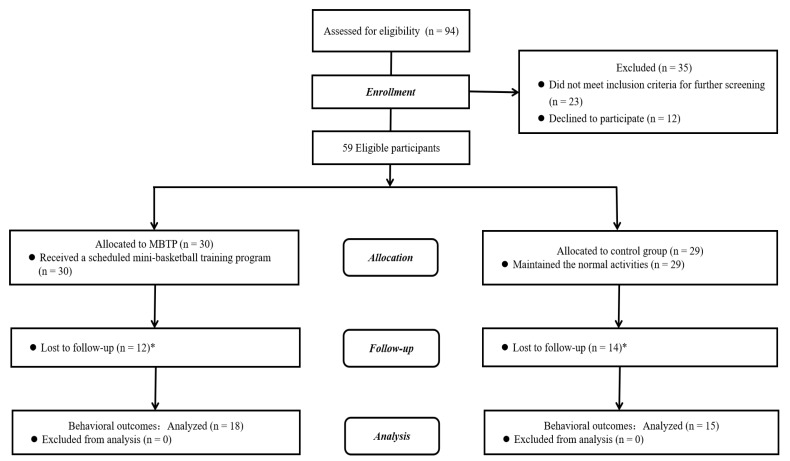
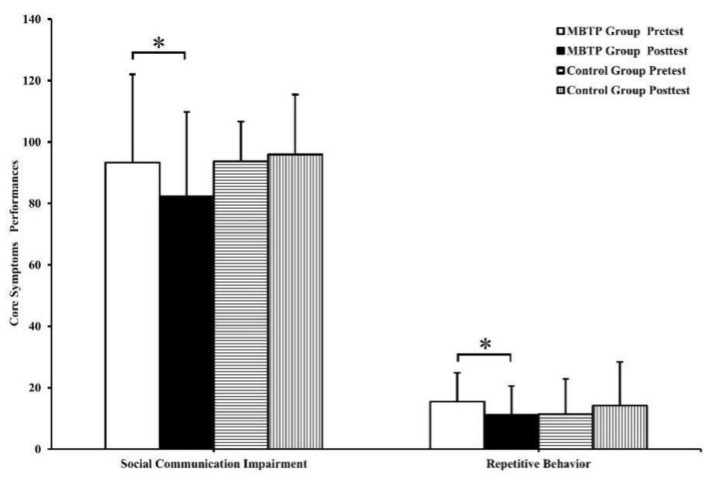
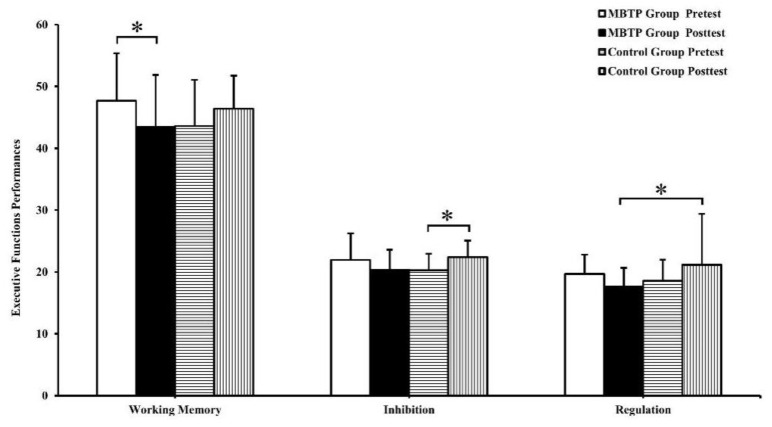
This study examined the effects of a 12-week mini-basketball training program (MBTP) on executive functions and core symptoms among preschoolers with autism spectrum disorder (ASD). In this quasi-experimental pilot study, 33 ASD preschoolers who received their conventional rehabilitation program were assigned to either a MBTP group ( = 18) or control group ( = 15). Specifically, the experimental group was required to take an additional 12-week MBTP (five days per week, one session per day, and forty minutes per session), while the control group was instructed to maintain their daily activities. Executive functions and core symptoms (social communication impairment and repetitive behavior) were evaluated by the Childhood Executive Functioning Inventory (CHEXI), the Social Responsiveness Scale-Second Edition (SRS-2), and the Repetitive Behavior Scale-Revised (RBS-R), respectively. After the 12-week intervention period, the MBTP group exhibited significantly better performances in working memory ( = 7.51, < 0.01, partial = 0.195) and regulation ( = 4.23, < 0.05, partial = 0.12) as compared to the control group. Moreover, the MBTP significantly improved core symptoms of ASD preschoolers, including the social communication impairment ( = 6.02, < 0.05, partial = 0.020) and repetitive behavior ( = 5.79, < 0.05, partial = 0.016). Based on our findings, we concluded that the 12-week MBTP may improve executive functions and core symptoms in preschoolers with ASD, and we provide new evidence that regular physical exercise in the form of a MBTP is a promising alternative to treat ASD.
本研究考察了为期12周的迷你篮球训练计划(MBTP)对自闭症谱系障碍(ASD)学龄前儿童执行功能和核心症状的影响。在这项准实验性试点研究中,33名接受常规康复计划的ASD学龄前儿童被分为MBTP组(n = 18)或对照组(n = 15)。具体而言,实验组需要额外参加为期12周的MBTP(每周五天,每天一节,每节40分钟),而对照组则被要求维持日常活动。执行功能和核心症状(社交沟通障碍和重复行为)分别通过儿童执行功能量表(CHEXI)、社交反应量表第二版(SRS - 2)和重复行为量表修订版(RBS - R)进行评估。在为期12周的干预期结束后,与对照组相比,MBTP组在工作记忆(t = 7.51,p < 0.01,偏η² = 0.195)和调节能力(t = 4.23,p < 0.05,偏η² = 0.12)方面表现出显著更好的成绩。此外,MBTP显著改善了ASD学龄前儿童的核心症状,包括社交沟通障碍(t = 6.02,p < 0.05,偏η² = 0.020)和重复行为(t = 5.79,p < 0.05,偏η² = 0.016)。基于我们的研究结果,我们得出结论,为期12周的MBTP可能改善ASD学龄前儿童的执行功能和核心症状,并且我们提供了新的证据,即MBTP形式的定期体育锻炼是治疗ASD的一种有前景的替代方法。