Ludyga Sebastian, Koutsandréou Flora, Reuter Eva-Maria, Voelcker-Rehage Claudia, Budde Henning
Department of Sport, Exercise and Health, University of Basel, 4052 Basel, Switzerland.
Faculty of Human Sciences, Medical School Hamburg, 20457 Hamburg, Germany.
J Clin Med. 2019 Feb 4;8(2):184. doi: 10.3390/jcm8020184.
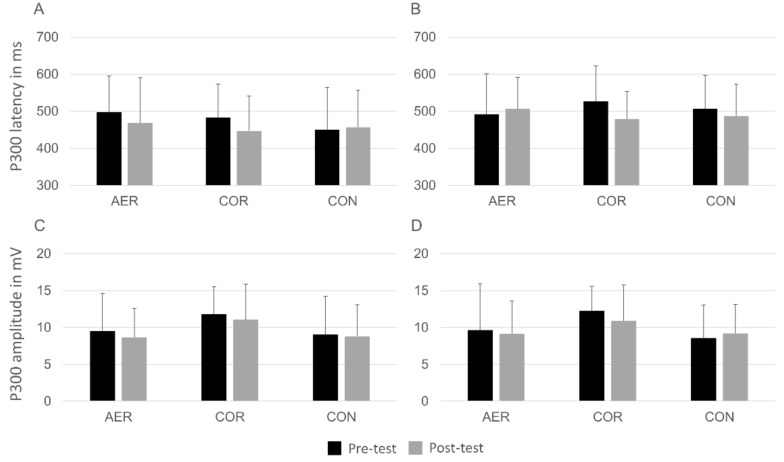
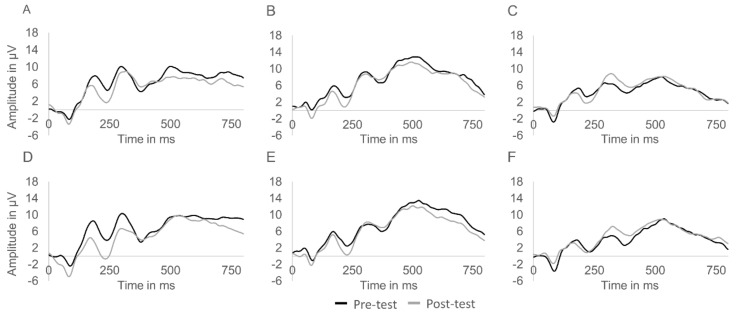
Whereas aerobic training has found to be beneficial for inhibitory control, less is known on the efficiency of other exercise types in children. The present study compared the effects of aerobic and coordinative training on behavioral and neurophysiological measures of inhibitory control. Forty-five children were randomly assigned (1:1:1 ratio) to groups performing aerobic training, coordinative training or assisted homework sessions over 10 weeks. Before and after intervention, all participants completed a Flanker task. The P300 component of event-related potentials elicited from the task was recorded via electroencephalography. Additionally, aerobic fitness and gross-motor skills were assessed using 20 m Shuttle Run and Heidelberg Gross-Motor Test, respectively. Statistical analyses revealed no time by group interactions for the P300 component (amplitude, latency), = 0.976, η² = 0.007, and behavioral performance (reaction time, accuracy), = 0.570, η² = 0.045. In contrast, there was a significant group-difference in pre- to post-test changes in aerobic fitness, = 0.008, η² = 0.246, with greater improvements following aerobic and coordinative training compared to assisted homework sessions. In conclusion, no differences regarding the efficiency of aerobic and coordinative training for the enhancement of inhibitory control were found as both exercise programs failed to elicit changes in speed and accuracy of stimulus evaluation and the allocation of attentional resources.
尽管有氧训练已被发现对抑制控制有益,但对于其他运动类型对儿童的效果了解较少。本研究比较了有氧训练和协调性训练对抑制控制的行为和神经生理学指标的影响。45名儿童被随机分配(比例为1:1:1)到进行有氧训练、协调性训练或辅助家庭作业的组中,为期10周。在干预前后,所有参与者都完成了一项侧翼任务。通过脑电图记录该任务诱发的事件相关电位的P300成分。此外,分别使用20米穿梭跑和海德堡大肌肉运动测试评估有氧适能和大肌肉运动技能。统计分析显示,P300成分(波幅、潜伏期)的组间时间交互作用不显著,F = 0.976,η² = 0.007,行为表现(反应时间、准确性)的组间时间交互作用也不显著,F = 0.570,η² = 0.045。相比之下,有氧适能的测试前至测试后变化存在显著的组间差异,F = 0.008,η² = 0.246,与辅助家庭作业相比,有氧训练和协调性训练后的改善更大。总之,未发现有氧训练和协调性训练在增强抑制控制效率方面存在差异,因为这两种运动方案均未引起刺激评估速度和准确性以及注意力资源分配的变化。