Department and Institute of Pharmacology, School of Medicine, National Yang-Ming University, Taipei 11221, Taiwan.
Department of Medical Research, Taipei Veterans General Hospital, Taipei 11217, Taiwan.
Int J Mol Sci. 2020 Apr 30;21(9):3172. doi: 10.3390/ijms21093172.
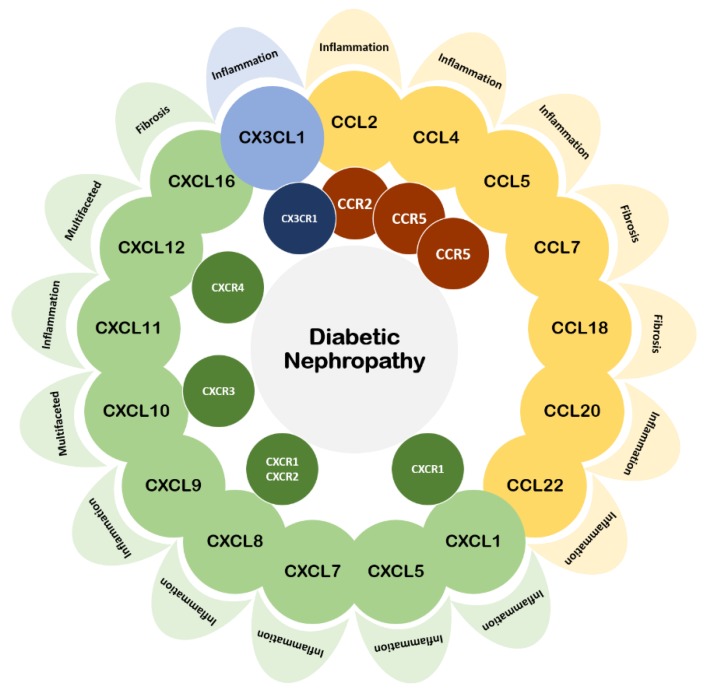
Kidney function decline is one of the complications of diabetes mellitus and may be indicated as diabetic nephropathy (DN). DN is a chronic inflammatory disease featuring proteinuria and a decreasing glomerular filtration rate. Despite several therapeutic options being currently available, DN is still the major cause of end-stage renal disease. Accordingly, widespread innovation is needed to improve outcomes in patients with DN. Chemokines and their receptors are critically involved in the inflammatory progression in the development of DN. Although recent studies have shown multiple pathways related to the chemokine system, the specific and direct effects of chemokines and their receptors remain unclear. In this review, we provide an overview of the potential role and mechanism of chemokine systems in DN proposed in recent years. Chemokine system-related mechanisms may provide potential therapeutic targets in DN.
肾功能下降是糖尿病的并发症之一,可能表现为糖尿病肾病(DN)。DN 是一种慢性炎症性疾病,特征是蛋白尿和肾小球滤过率下降。尽管目前有几种治疗选择,但 DN 仍然是终末期肾病的主要原因。因此,需要广泛创新以改善 DN 患者的预后。趋化因子及其受体在 DN 的炎症进展中起着至关重要的作用。尽管最近的研究表明,趋化因子系统与多种途径有关,但趋化因子及其受体的具体和直接作用仍不清楚。在这篇综述中,我们概述了近年来提出的趋化因子系统在 DN 中的潜在作用和机制。趋化因子系统相关机制可能为 DN 提供潜在的治疗靶点。