Advanced Diagnostic and Interventional Radiology Research Center (ADIR), Radiology Department, Imam Khomeini Hospital Complex (IKHC), Tehran University of Medical Sciences (TUMS), Tehran, No. 1419733141, Iran.
Faculty of Electrical Engineering, K.N. Toosi University of Technology, Tehran, No. 1631714191, Iran.
Sci Rep. 2020 May 4;10(1):7404. doi: 10.1038/s41598-020-64285-w.
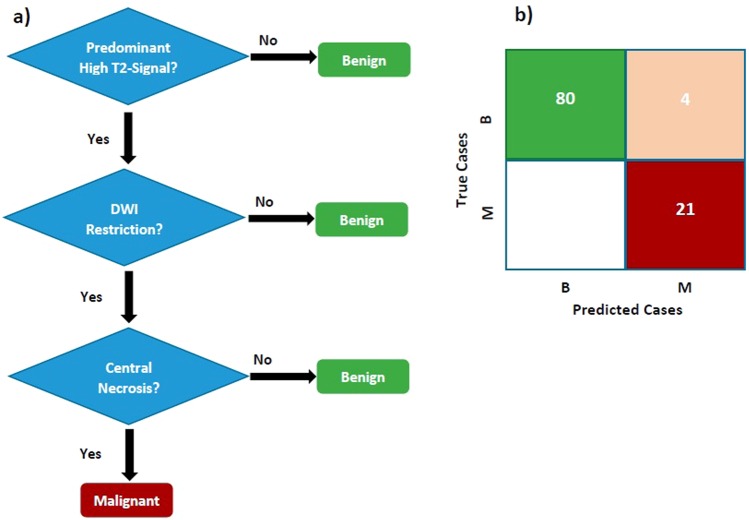
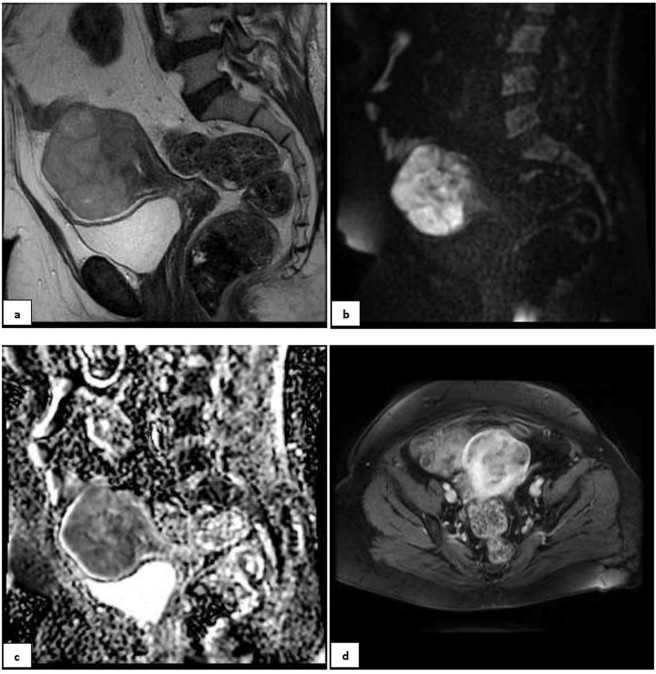
This study aimed to develop a diagnostic algorithm for preoperative differentiating uterine sarcoma from leiomyoma through a supervised machine-learning method using multi-parametric MRI. A total of 65 participants with 105 myometrial tumors were included: 84 benign and 21 malignant lesions (belonged to 51 and 14 patients, respectively; based on their postoperative tissue diagnosis). Multi-parametric MRI including T1-, T2-, and diffusion-weighted (DW) sequences with ADC-map, contrast-enhanced images, as well as MR spectroscopy (MRS), was performed for each lesion. Thirteen singular MRI features were extracted from the mentioned sequences. Various combination sets of selective features were fed into a machine classifier (coarse decision-tree) to predict malignant or benign tumors. The accuracy metrics of either singular or combinational models were assessed. Eventually, two diagnostic algorithms, a simple decision-tree and a complex one were proposed using the most accurate models. Our final simple decision-tree obtained accuracy = 96.2%, sensitivity = 100% and specificity = 95%; while the complex tree yielded accuracy, sensitivity and specificity of 100%. To summarise, the complex diagnostic algorithm, compared to the simple one, can differentiate tumors with equal sensitivity, but a higher specificity and accuracy. However, it needs some further time-consuming modalities and difficult imaging calculations. Trading-off costs and benefits in appropriate situations must be determinative.
本研究旨在通过使用多参数 MRI 的监督机器学习方法,开发一种用于术前区分子宫肉瘤和子宫肌瘤的诊断算法。共有 65 名参与者的 105 个子宫肌肿瘤纳入研究:84 个良性肿瘤和 21 个恶性肿瘤(分别属于 51 名和 14 名患者,基于术后组织诊断)。对每个病变进行多参数 MRI 检查,包括 T1、T2 和弥散加权(DW)序列,ADC 图、对比增强图像以及磁共振波谱(MRS)。从所述序列中提取了 13 个单一 MRI 特征。将各种选择性特征组合集输入到机器分类器(粗糙决策树)中,以预测良性或恶性肿瘤。评估了单一或组合模型的准确性指标。最终,使用最准确的模型提出了两种诊断算法,即简单决策树和复杂决策树。我们最终的简单决策树的准确性为 96.2%,灵敏度为 100%,特异性为 95%;而复杂树的准确性、灵敏度和特异性均为 100%。总之,与简单算法相比,复杂诊断算法可以在保持相同灵敏度的情况下,具有更高的特异性和准确性。然而,它需要一些额外的耗时的模态和困难的成像计算。在适当的情况下,权衡成本和收益必须是决定性的。