Baidaliuk Artem, Lequime Sébastian, Moltini-Conclois Isabelle, Dabo Stéphanie, Dickson Laura B, Prot Matthieu, Duong Veasna, Dussart Philippe, Boyer Sébastien, Shi Chenyan, Matthijnssens Jelle, Guglielmini Julien, Gloria-Soria Andrea, Simon-Lorière Etienne, Lambrechts Louis
Insect-Virus Interactions Unit, Department of Virology, Institut Pasteur, UMR2000, CNRS, 28 rue du Docteur Roux, 75015 Paris, France.
Sorbonne Université, Collège Doctoral, Paris F-75005, France.
Virus Evol. 2020 Apr 29;6(1):veaa018. doi: 10.1093/ve/veaa018. eCollection 2020 Jan.
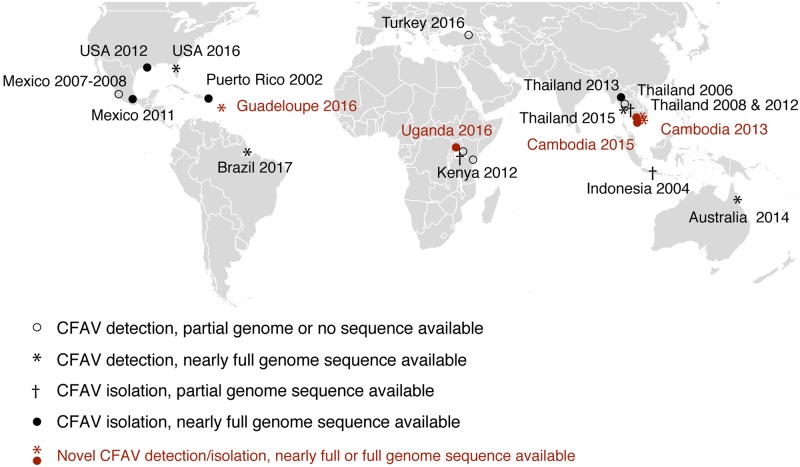
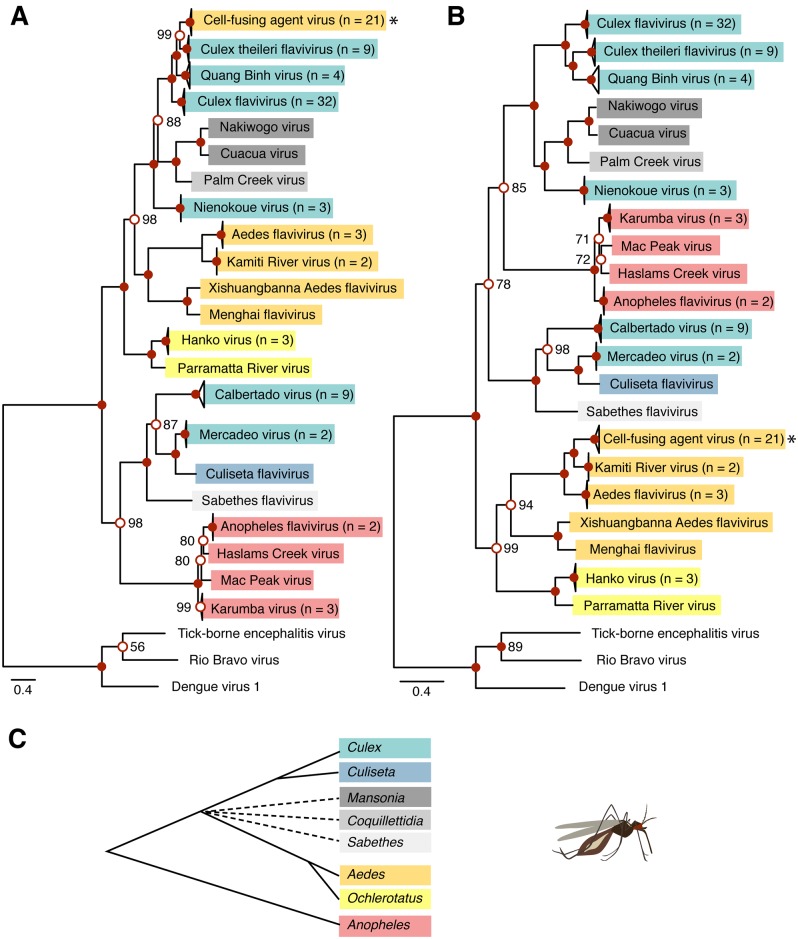
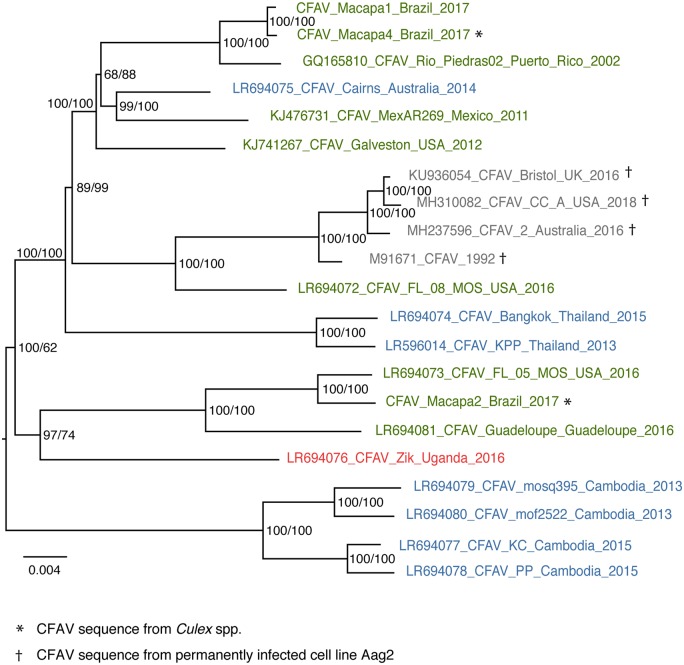
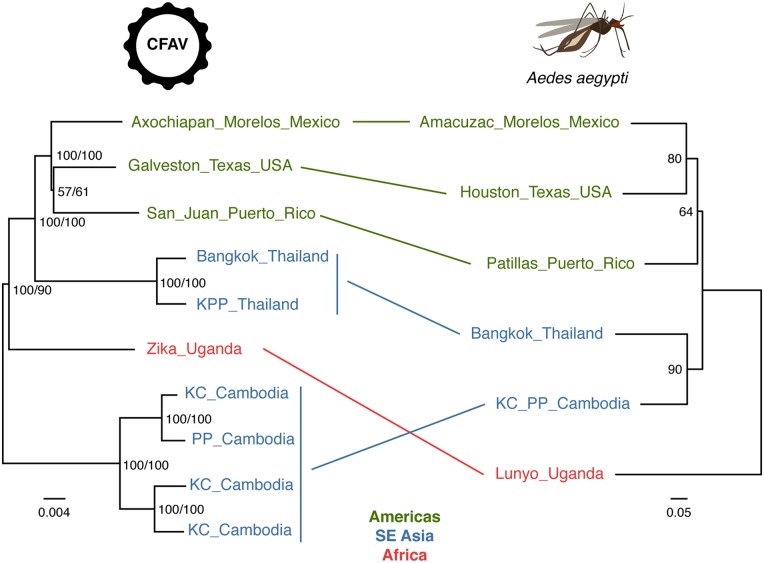
Flaviviruses encompass not only medically relevant arthropod-borne viruses (arboviruses) but also insect-specific flaviviruses (ISFs) that are presumably maintained primarily through vertical transmission in the insect host. Interestingly, ISFs are commonly found infecting important arbovirus vectors such as the mosquito . Cell-fusing agent virus (CFAV) was the first described ISF of mosquitoes more than four decades ago. Despite evidence for widespread CFAV infections in populations and for CFAV potential to interfere with arbovirus transmission, little is known about CFAV evolutionary history. Here, we generated six novel CFAV genome sequences by sequencing three new virus isolates and subjecting three mosquito samples to untargeted viral metagenomics. We used these new genome sequences together with published ones to perform a global phylogenetic analysis of CFAV genetic diversity. Although there was some degree of geographical clustering among CFAV sequences, there were also notable discrepancies between geography and phylogeny. In particular, CFAV sequences from Cambodia and Thailand diverged significantly, despite confirmation that populations from both locations are genetically close. The apparent phylogenetic discrepancy between CFAV and its host in Southeast Asia indicates that other factors than host population structure shape CFAV genetic diversity.
黄病毒不仅包括与医学相关的节肢动物传播病毒(虫媒病毒),还包括昆虫特异性黄病毒(ISFs),这些病毒可能主要通过在昆虫宿主中的垂直传播得以维持。有趣的是,ISFs 通常感染重要的虫媒病毒载体,如蚊子。细胞融合剂病毒(CFAV)是四十多年前首次描述的蚊子的 ISF。尽管有证据表明 CFAV 在种群中广泛感染,且有干扰虫媒病毒传播的潜力,但对 CFAV 的进化历史知之甚少。在这里,我们通过对三个新的病毒分离株进行测序,并对三个蚊子样本进行非靶向病毒宏基因组学分析,生成了六个新的 CFAV 基因组序列。我们将这些新的基因组序列与已发表的序列一起用于对 CFAV 遗传多样性进行全球系统发育分析。尽管 CFAV 序列之间存在一定程度的地理聚类,但地理和系统发育之间也存在明显差异。特别是,柬埔寨和泰国的 CFAV 序列差异显著,尽管已证实这两个地区的种群在基因上相近。东南亚 CFAV 与其宿主之间明显的系统发育差异表明,除宿主种群结构外,其他因素也塑造了 CFAV 的遗传多样性。