Chun Jaehyeong, Kim Youngjun, Shin Kyoung Yoon, Han Sun Hyup, Oh Sei Yeul, Chung Tae-Young, Park Kyung-Ah, Lim Dong Hui
Department of Industrial and System Engineering, Korea Advanced Institute of Science and Technology, Daejeon, Republic of Korea.
Department of Ophthalmology, Samsung Medical Center, Sungkyunkwan University School of Medicine, Seoul, Republic of Korea.
JMIR Med Inform. 2020 May 5;8(5):e16225. doi: 10.2196/16225.
Accurately predicting refractive error in children is crucial for detecting amblyopia, which can lead to permanent visual impairment, but is potentially curable if detected early. Various tools have been adopted to more easily screen a large number of patients for amblyopia risk.
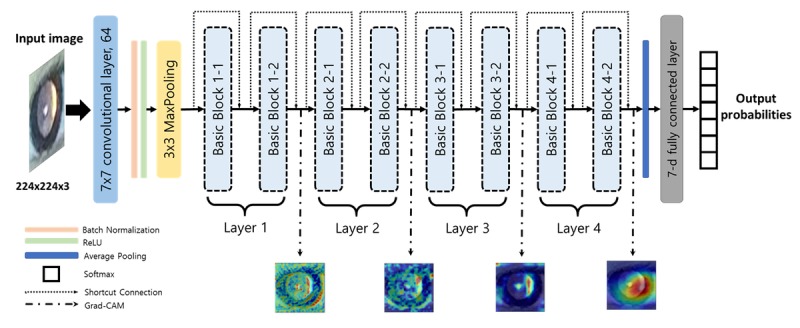
For efficient screening, easy access to screening tools and an accurate prediction algorithm are the most important factors. In this study, we developed an automated deep learning-based system to predict the range of refractive error in children (mean age 4.32 years, SD 1.87 years) using 305 eccentric photorefraction images captured with a smartphone.
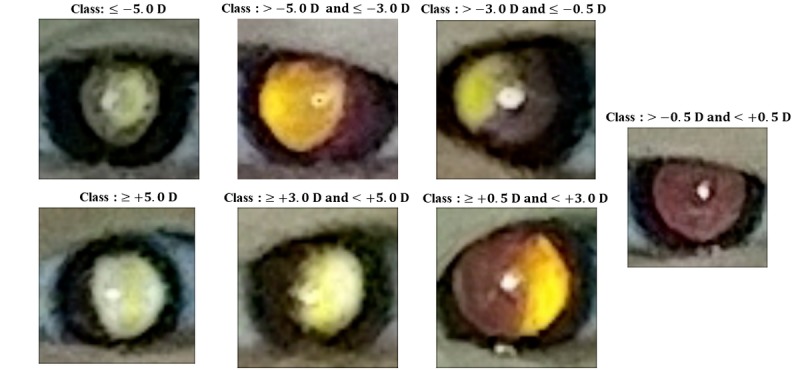
Photorefraction images were divided into seven classes according to their spherical values as measured by cycloplegic refraction.
The trained deep learning model had an overall accuracy of 81.6%, with the following accuracies for each refractive error class: 80.0% for ≤-5.0 diopters (D), 77.8% for >-5.0 D and ≤-3.0 D, 82.0% for >-3.0 D and ≤-0.5 D, 83.3% for >-0.5 D and <+0.5 D, 82.8% for ≥+0.5 D and <+3.0 D, 79.3% for ≥+3.0 D and <+5.0 D, and 75.0% for ≥+5.0 D. These results indicate that our deep learning-based system performed sufficiently accurately.
This study demonstrated the potential of precise smartphone-based prediction systems for refractive error using deep learning and further yielded a robust collection of pediatric photorefraction images.
准确预测儿童屈光不正对于检测弱视至关重要,弱视可导致永久性视力损害,但如果早期发现则有可能治愈。已采用各种工具来更轻松地筛查大量有弱视风险的患者。
为了进行高效筛查,易于使用筛查工具和准确的预测算法是最重要的因素。在本研究中,我们开发了一种基于深度学习的自动化系统,使用智能手机拍摄的305张偏心 photorefraction 图像来预测儿童(平均年龄4.32岁,标准差1.87岁)的屈光不正范围。
根据睫状肌麻痹验光测量的球镜值,将photorefraction图像分为七类。
训练后的深度学习模型总体准确率为81.6%,各屈光不正类别的准确率如下:≤-5.0屈光度(D)为80.0%,>-5.0 D且≤-3.0 D为77.8%,>-3.0 D且≤-0.5 D为82.0%,>-0.5 D且<+0.5 D为83.3%,≥+0.5 D且<+3.0 D为82.8%,≥+3.0 D且<+5.0 D为79.3%,≥+5.0 D为75.0%。这些结果表明,我们基于深度学习的系统表现足够准确。
本研究证明了使用深度学习的基于智能手机的精确屈光不正预测系统的潜力,并进一步生成了大量可靠的儿科photorefraction图像。