Yongping Liang, Juan Zhang, Zhou Ping, Yongfeng Zhao, Liu Wengang, Shi Yifan
The Xiangya Medical School, Central South University, Changsha, Hunan, China.
JMIR Med Inform. 2020 May 5;8(5):e18251. doi: 10.2196/18251.
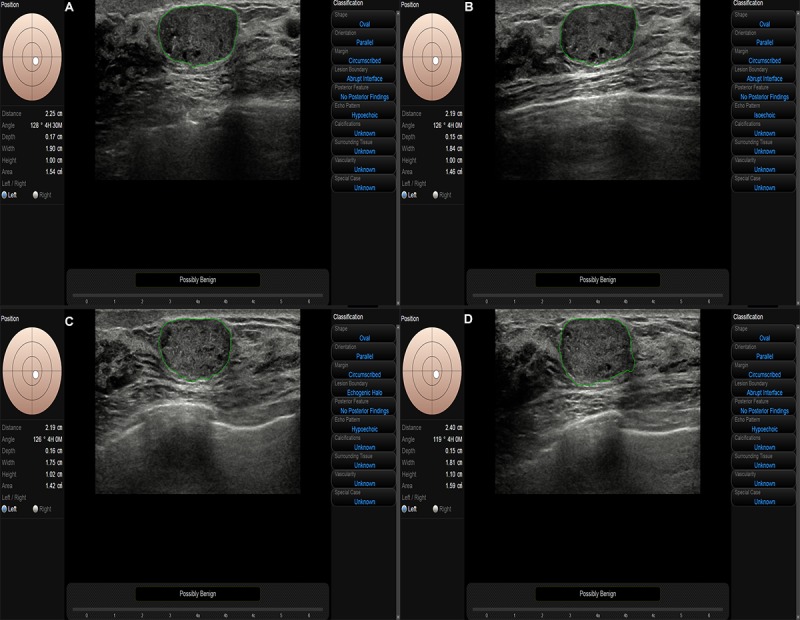
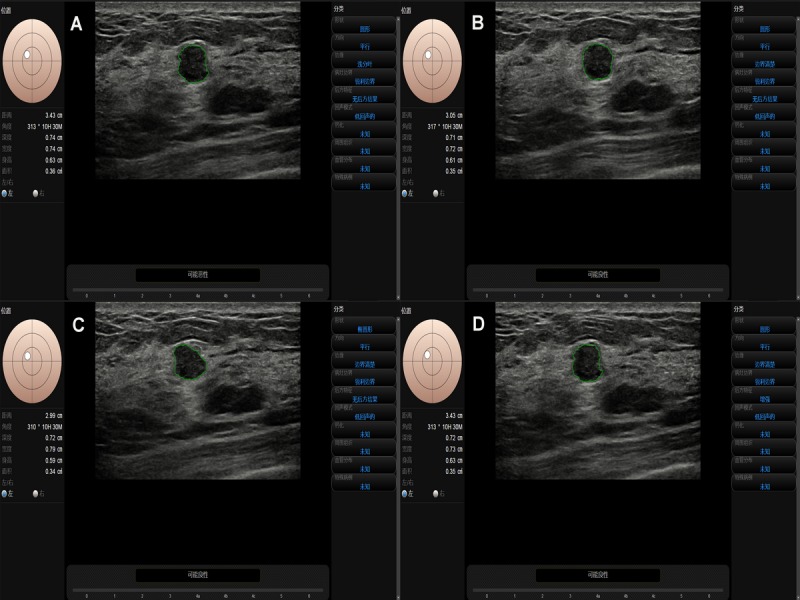
Computer-aided diagnosis (CAD) is a tool that can help radiologists diagnose breast lesions by ultrasonography. Previous studies have demonstrated that CAD can help reduce the incidence of missed diagnoses by radiologists. However, the optimal method to apply CAD to breast lesions using diagnostic planes has not been assessed.
The aim of this study was to compare the performance of radiologists with different levels of experience when using CAD with the quadri-planes method to detect breast tumors.
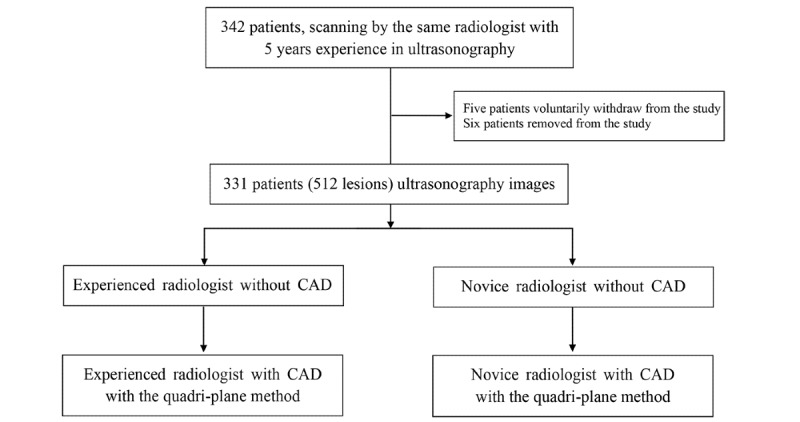
From November 2018 to October 2019, we enrolled patients in the study who had a breast mass as their most prominent symptom. We assigned 2 ultrasound radiologists (with 1 and 5 years of experience, respectively) to read breast ultrasonography images without CAD and then to perform a second reading while applying CAD with the quadri-planes method. We then compared the diagnostic performance of the readers for the 2 readings (without and with CAD). The McNemar test for paired data was used for statistical analysis.
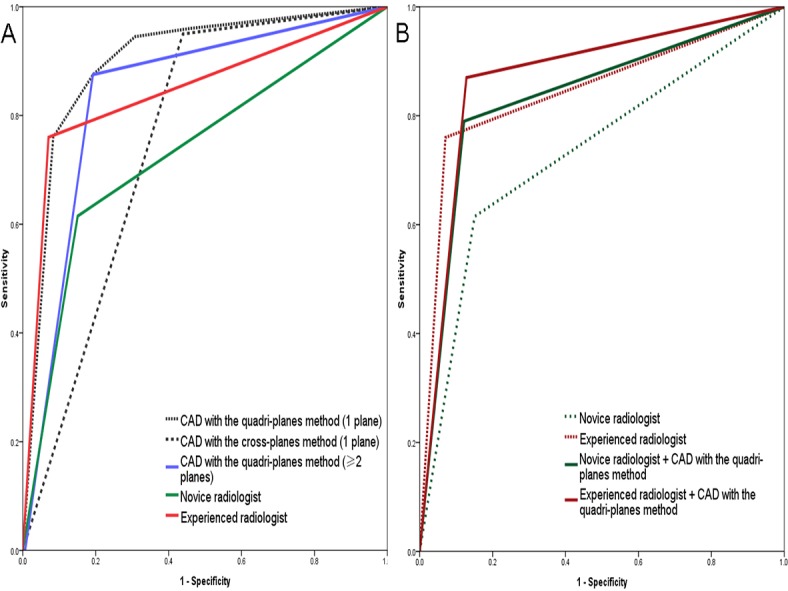
A total of 331 patients were included in this study (mean age 43.88 years, range 17-70, SD 12.10), including 512 lesions (mean diameter 1.85 centimeters, SD 1.19; range 0.26-9.5); 200/512 (39.1%) were malignant, and 312/512 (60.9%) were benign. For CAD, the area under the receiver operating characteristic curve (AUC) improved significantly from 0.76 (95% CI 0.71-0.79) with the cross-planes method to 0.84 (95% CI 0.80-0.88; P<.001) with the quadri-planes method. For the novice reader, the AUC significantly improved from 0.73 (95% CI 0.69-0.78) for the without-CAD mode to 0.83 (95% CI 0.80-0.87; P<.001) for the combined-CAD mode with the quadri-planes method. For the experienced reader, the AUC improved from 0.85 (95% CI 0.81-0.88) to 0.87 (95% CI 0.84-0.91; P=.15). The kappa indicating consistency between the experienced reader and the novice reader for the combined-CAD mode was 0.63. For the novice reader, the sensitivity significantly improved from 60.0% for the without-CAD mode to 79.0% for the combined-CAD mode (P=.004). The specificity, negative predictive value, positive predictive value, and accuracy improved from 84.9% to 87.8% (P=.53), 76.8% to 86.7% (P=.07), 71.9% to 80.6% (P=.13), and 75.2% to 84.4% (P=.12), respectively. For the experienced reader, the sensitivity improved significantly from 76.0% for the without-CAD mode to 87.0% for the combined-CAD mode (P=.045). The NPV and accuracy moderately improved from 85.8% and 86.3% to 91.0% (P=.27) and 87.0% (P=.84), respectively. The specificity and positive predictive value decreased from 87.4% to 81.3% (P=.25) and from 87.2% to 93.0% (P=.16), respectively.
S-Detect is a feasible diagnostic tool that can improve the sensitivity, accuracy, and AUC of the quadri-planes method for both novice and experienced readers while also improving the specificity for the novice reader. It demonstrates important application value in the clinical diagnosis of breast cancer.
ChiCTR.org.cn 1800019649; http://www.chictr.org.cn/showproj.aspx?proj=33094.
计算机辅助诊断(CAD)是一种可帮助放射科医生通过超声检查诊断乳腺病变的工具。以往研究表明,CAD有助于降低放射科医生漏诊的发生率。然而,尚未评估使用诊断平面将CAD应用于乳腺病变的最佳方法。
本研究旨在比较不同经验水平的放射科医生在使用CAD结合四平面法检测乳腺肿瘤时的表现。
2018年11月至2019年10月,我们纳入以乳腺肿块为最突出症状的患者进行研究。我们安排2名超声放射科医生(分别具有1年和5年经验)先在不使用CAD的情况下阅读乳腺超声图像,然后在应用CAD结合四平面法的情况下进行二次阅读。然后我们比较了两位读者在两次阅读(不使用CAD和使用CAD)时的诊断表现。配对数据的McNemar检验用于统计分析。
本研究共纳入331例患者(平均年龄43.88岁,范围17 - 70岁,标准差12.10),包括512个病变(平均直径1.85厘米,标准差1.19;范围0.26 - 9.5);200/512(39.1%)为恶性,312/512(60.9%)为良性。对于CAD,受试者操作特征曲线(AUC)下的面积从使用交叉平面法时的0.76(95%可信区间0.71 - 0.79)显著提高到使用四平面法时的0.84(95%可信区间0.80 - 0.88;P <.001)。对于新手读者,AUC从无CAD模式下的0.73(95%可信区间0.69 - 0.78)显著提高到四平面法联合CAD模式下的0.83(95%可信区间0.80 - 0.87;P <.001)。对于经验丰富的读者,AUC从0.85(95%可信区间0.81 - 0.88)提高到0.87(95%可信区间0.84 - 0.91;P = 0.15)。经验丰富的读者和新手读者在联合CAD模式下的一致性kappa值为0.63。对于新手读者,敏感性从无CAD模式下的60.0%显著提高到联合CAD模式下的79.0%(P = 0.004)。特异性、阴性预测值、阳性预测值和准确性分别从84.9%提高到87.8%(P = 0.53)、从76.8%提高到86.7%(P = 0.07)、从71.9%提高到80.6%(P = 0.13)和从75.2%提高到84.4%(P = 0.12)。对于经验丰富的读者,敏感性从无CAD模式下的76.0%显著提高到联合CAD模式下的87.0%(P = 0.045)。阴性预测值和准确性分别从中度从85.8%和86.3%提高到91.0%(P = 0.27)和87.0%(P = 0.84)。特异性和阳性预测值分别从87.4%降至81.3%(P = 0.25)和从87.2%升至93.0%(P = 0.16)。
S - Detect是一种可行的诊断工具,可提高新手和经验丰富读者四平面法的敏感性、准确性和AUC,同时也提高新手读者的特异性。它在乳腺癌临床诊断中显示出重要应用价值。
中国临床试验注册中心ChiCTR.org.cn 1800019649;http://www.chictr.org.cn/showproj.aspx?proj = 33094。