Rodrigues Denise R, Briggs Whitney, Duff Audrey, Chasser Kaylin, Murugesan Raj, Pender Chasity, Ramirez Shelby, Valenzuela Luis, Bielke Lisa R
Department of Animal Sciences, The Ohio State University, Columbus, Ohio, United States of America.
BIOMIN America Inc., Overland Park, Kansas, United States of America.
PLoS One. 2020 May 5;15(5):e0225871. doi: 10.1371/journal.pone.0225871. eCollection 2020.
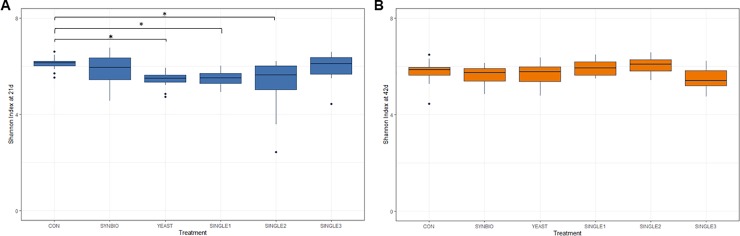
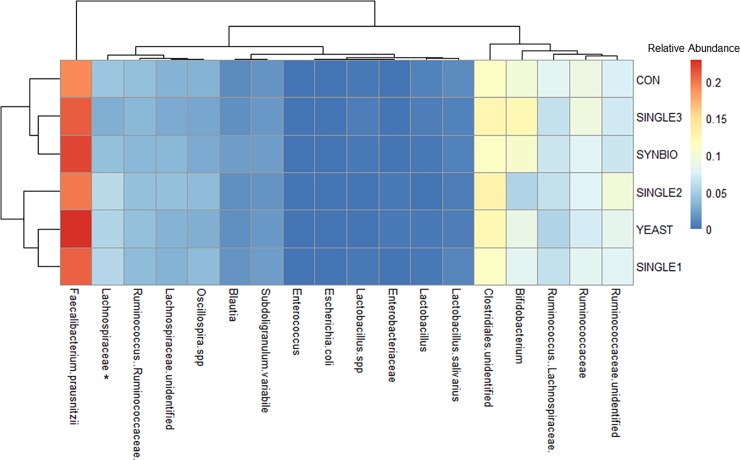
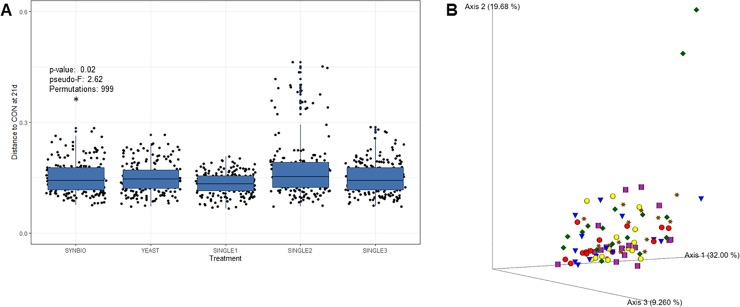
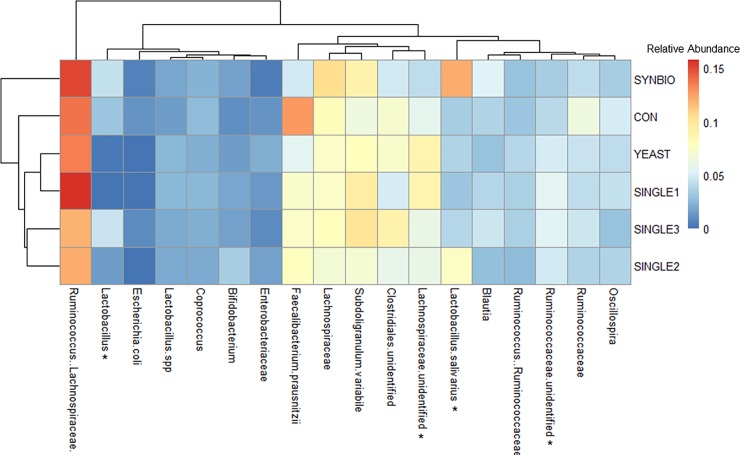
The potential of probiotics to manipulate the intestinal microbial ecosystem toward commensal bacteria growth offers great opportunity for enhancing health and performance in poultry. This study aimed to evaluate the efficacy of five probiotic-based formulations in modulating cecal microbiota in broilers at 21 and 42 days of age. Probiotics investigated included a synbiotic (SYNBIO), a yeast (YEAST), and three single-strain formulations of Bacillus amyloliquefaciens (SINGLE1), B. subtilis (SINGLE2) and B. licheniformis (SINGLE3). Alpha-diversity analyses showed that cecal microbiota of SINGLE1, SINGLE2, and YEAST had low diversity compared to the control diet with no feed additive (CON) at 21d. At the same age, weighted Unifrac distance measure showed significant differences between samples from SYNBIO and CON (P = 0.02). However, by analyzing principal coordinates analysis (PCoA) with unweighted Unifrac, there was no evidence of clustering between CON and probiotic treatments. By 42d, there were no differences in alpha or beta-diversity in the microbiota of probiotic treatments compared to CON. Similarly, taxonomic microbial profiling did not show major changes in cecal microbial taxa. In conclusion, not all probiotic-based formulations tested had a core benefit on the modulation of microbiota. However, based on the quantitative beta diversity results, SYNBIO greatly influenced the cecal microbial community structure attributable to transient variations in relative taxon abundance.
益生菌具有调控肠道微生物生态系统以促进共生菌生长的潜力,这为提高家禽健康水平和生产性能提供了巨大机遇。本研究旨在评估五种基于益生菌的制剂对21日龄和42日龄肉鸡盲肠微生物群的调节效果。所研究的益生菌包括一种合生元(SYNBIO)、一种酵母(YEAST)以及三种解淀粉芽孢杆菌单菌株制剂(SINGLE1)、枯草芽孢杆菌(SINGLE2)和地衣芽孢杆菌(SINGLE3)。α多样性分析表明,与21日龄时不添加饲料添加剂的对照日粮(CON)相比,SINGLE1、SINGLE2和YEAST的盲肠微生物群多样性较低。在同一年龄,加权UniFrac距离测量显示SYNBIO和CON的样本之间存在显著差异(P = 0.02)。然而,通过使用非加权UniFrac分析主坐标分析(PCoA),没有证据表明CON和益生菌处理之间存在聚类。到42日龄时,与CON相比,益生菌处理的微生物群在α或β多样性方面没有差异。同样,微生物分类学分析也未显示盲肠微生物分类群有重大变化。总之,并非所有测试的基于益生菌的制剂都对微生物群的调节有核心益处。然而,基于定量β多样性结果,SYNBIO极大地影响了盲肠微生物群落结构,这归因于相对分类群丰度的瞬时变化。