Oxford College of Emory University, Oxford, Georgia, United States of America.
Emory University, Atlanta, Georgia, United States of America.
PLoS One. 2020 May 5;15(5):e0232453. doi: 10.1371/journal.pone.0232453. eCollection 2020.
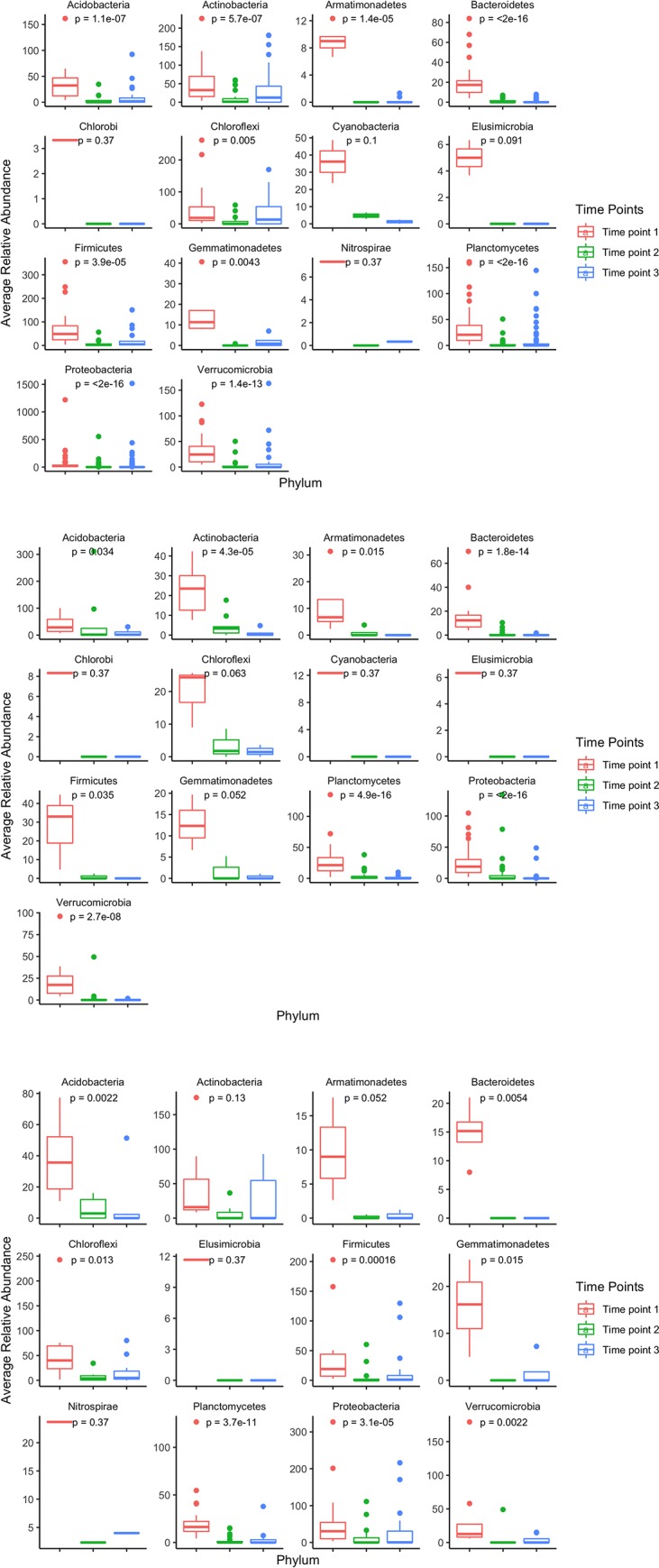
Soil-based microorganisms assume a direct and crucial role in the promotion of soil health, quality and fertility, all factors known to contribute heavily to the quality and yield of agricultural products. Cover cropping, used in both traditional and organic farming, is a particularly efficient and environmentally favorable tool for manipulating microbiome composition in agricultural soils and has had clear benefits for soil quality and crop output. Several long-term investigations have evaluated the influence of multi-mix (multiple species) cover crop treatments on soil health and microbial diversity. The present study investigated the short-term effects of a seven species multi-mix cover crop treatment on soil nutrient content and microbial diversity, compared to a single-mix cover crop treatment and control. Analysis of 16S sequencing data of isolated soil DNA revealed that the single-mix cover crop treatment decreased overall microbial abundance and diversity, whereas the control and multi-mix treatments altered the overall microbial composition in similar fluctuating trends. Furthermore, we observed significant changes in specific bacteria belonging to the phyla Acidobacteria, Actinobacteria, Planctomycetes, Proteobacteria and Verrucombicrobia for all treatments, but only the single-mix significantly decreased in abundance of the selected bacteria over time. Our findings indicate that the control and multi-mix treatments are better at maintaining overall microbial composition and diversity compared to the single-mix. Further study is required to elucidate the specific difference between the treatment effect of the multi-mix treatment and the control, given that their microbial composition changes over time were similar but they diverge into two populations of unique bacterial types by the end of this short-term study.
基于土壤的微生物在促进土壤健康、质量和肥力方面发挥着直接而关键的作用,所有这些因素都对农产品的质量和产量有很大的影响。覆盖作物在传统和有机农业中都有应用,是一种特别有效的、对环境有利的工具,可以改变农业土壤中的微生物群落组成,对土壤质量和作物产量有明显的益处。几项长期研究已经评估了多物种混合(多种物种)覆盖作物处理对土壤健康和微生物多样性的影响。本研究调查了七种混合覆盖作物处理对土壤养分含量和微生物多样性的短期影响,与单一覆盖作物处理和对照进行了比较。对分离土壤 DNA 的 16S 测序数据分析表明,单一覆盖作物处理降低了整体微生物丰度和多样性,而对照和多混合处理以相似的波动趋势改变了整体微生物组成。此外,我们观察到所有处理都导致了属于酸杆菌门、放线菌门、浮霉菌门、变形菌门和疣微菌门的特定细菌的显著变化,但只有单一混合处理随着时间的推移显著减少了所选细菌的丰度。我们的研究结果表明,与单一混合处理相比,对照和多混合处理更能维持整体微生物组成和多样性。需要进一步研究来阐明多混合处理和对照之间的具体区别,因为它们的微生物组成变化相似,但在这项短期研究结束时,它们会分为两种独特的细菌类型。