Centro Universitário de Mineiros (UNIFIMES), Rua 22-Setor Aeroporto, Mineiros, GO 75833-130, Brazil.
Department of Preventive Veterinary Medicine, Veterinary School, Universidade Federal de Minas Gerais (UFMG), Av. Antônio Carlos 6627, Belo Horizonte, MG 30123-970, Brasil.
Toxins (Basel). 2020 May 1;12(5):288. doi: 10.3390/toxins12050288.
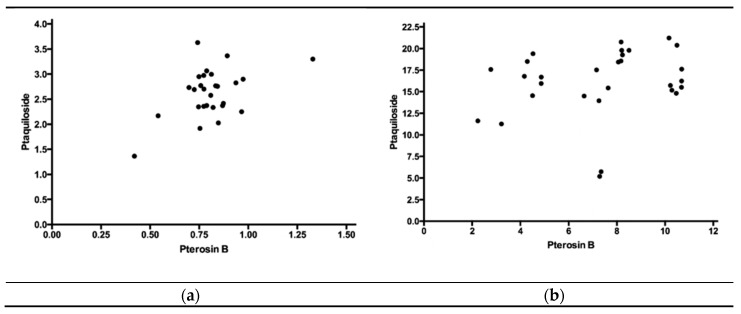
, a fern of the species complex found in South America, is responsible for several different syndromes of poisoning. Cases of bovine enzootic hematuria and upper alimentary squamous cell carcinoma are both frequent occurrences in Brazil, whereas only bovine enzootic hematuria is noted with any frequency around the world. The reason for the high frequency of upper alimentary squamous cell carcinoma in Brazil is not currently known. One possible explanation may be the higher levels of ptaquiloside and pterosin B in Brazilian than those present in the plant in other countries. However, these levels have not yet been determined in . Thus, the present study aimed to measure and compare ptaquiloside and pterosin B levels in mature green fronds and sprouts of collected from different locations in Brazil. Samples of were collected from the states of Minas Gerais and Rio Grande do Sul. A total of 28 mature leaf samples and 23 sprout samples were used. The mean concentrations of ptaquiloside and pterosin B present in the mature green fronds of ranged from 2.49 to 2.75 mg/g and 0.68 to 0.88 mg/g, respectively; in sprouts, mean concentrations of ptaquiloside and pterosin B ranged from 12.47 to 18.81 mg/g, and 4.03 to 10.42 mg/g for ptaquiloside and pterosin B, respectively. Thus, ptaquiloside and pterosin B levels in samples collected in Brazil were higher in sprouts than in mature green fronds, as observed in other countries. However, there was no variation in ptaquiloside levels among plants collected from different cities in Brazil. The high frequency of upper alimentary squamous cell carcinoma in Brazilian cattle may not be attributed to greater levels of ptaquiloside and pterosin B in than in other species in other countries.
在南美的 物种复合体中发现了一种蕨类植物,它是几种不同的中毒综合征的罪魁祸首。巴西经常出现牛地方性血尿和上消化道鳞状细胞癌病例,而在世界其他地方,只有牛地方性血尿经常发生。巴西上消化道鳞状细胞癌高发的原因目前尚不清楚。一种可能的解释是,巴西的 中 ptaquiloside 和 pterosin B 的含量高于其他国家的植物。然而,这些水平尚未在 中确定。因此,本研究旨在测量和比较从巴西不同地区采集的成熟绿色叶片和嫩芽中的 ptaquiloside 和 pterosin B 水平。从米纳斯吉拉斯州和南里奥格兰德州收集了 的样本。共采集了 28 个成熟叶片样本和 23 个芽样本。成熟绿色叶片中 ptaquiloside 和 pterosin B 的平均浓度范围分别为 2.49 至 2.75 毫克/克和 0.68 至 0.88 毫克/克;在 芽中,ptaquiloside 和 pterosin B 的平均浓度范围分别为 12.47 至 18.81 毫克/克和 4.03 至 10.42 毫克/克。因此,与其他国家一样,在巴西采集的样本中,芽中的 ptaquiloside 和 pterosin B 水平高于成熟的绿色叶片。然而,在巴西不同城市采集的植物中,ptaquiloside 的水平没有差异。巴西牛的上消化道鳞状细胞癌高发可能不是由于巴西的 中 ptaquiloside 和 pterosin B 的含量高于其他国家的其他 物种。