Pharmacology Section, Department of Pharmacology, Toxicology, and Therapeutic Chemistry. Faculty of Pharmacy and Food Sciences. Institute of Neuroscience, University of Barcelona (NeuroUB), Av. Joan XXIII 27-31, 08028 Barcelona, Spain.
Laboratori de Química Farmacèutica (Unitat Associada al CSIC), Department de Farmacologia, Toxicologia i Química Terapèutica, Facultat de Farmàcia i Ciències de l'Alimentació, and Institute of Biomedicine (IBUB), Universitat de Barcelona, Av. Joan XXIII, 27-31, 08028 Barcelona, Spain.
Biomolecules. 2020 May 1;10(5):703. doi: 10.3390/biom10050703.
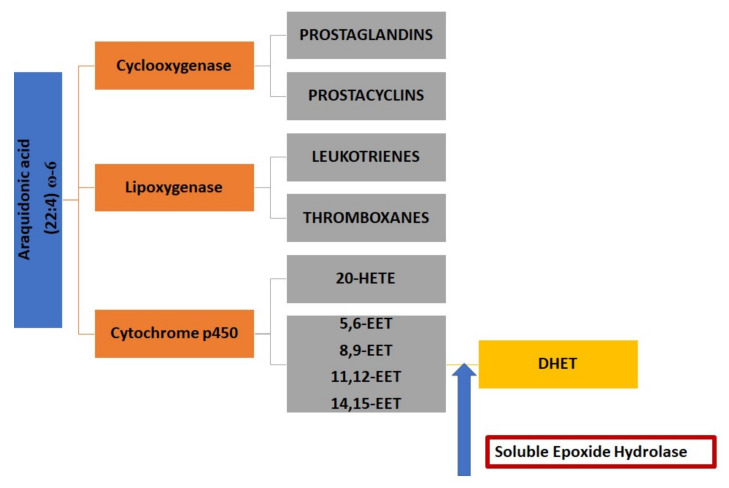
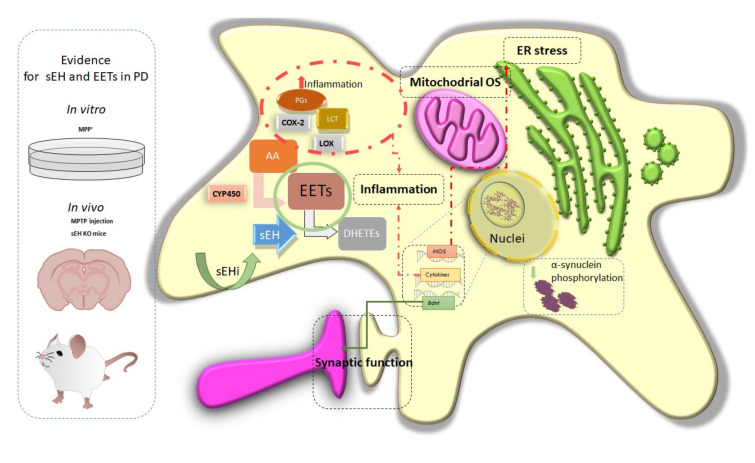
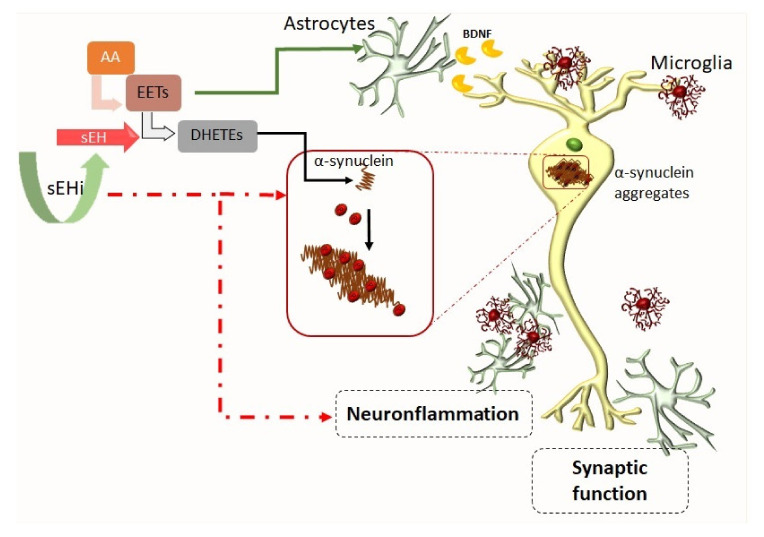
Neuroinflammation is a crucial process associated with the pathogenesis of neurodegenerative diseases, including Parkinson's disease (PD). Several pieces of evidence suggest an active role of lipid mediators, especially epoxy-fatty acids (EpFAs), in the genesis and control of neuroinflammation; 14,15-epoxyeicosatrienoic acid (14,15-EET) is one of the most commonly studied EpFAs, with anti-inflammatory properties. Soluble epoxide hydrolase (sEH) is implicated in the hydrolysis of 14,15-EET to its corresponding diol, which lacks anti-inflammatory properties. Preventing EET degradation thus increases its concentration in the brain through sEH inhibition, which represents a novel pharmacological approach to foster the reduction of neuroinflammation and by end neurodegeneration. Recently, it has been shown that sEH levels increase in brains of PD patients. Moreover, the pharmacological inhibition of the hydrolase domain of the enzyme or the use of sEH knockout mice reduced the deleterious effect of 1-methyl-4-phenyl-1,2,3,6-tetrahydropyridine (MPTP) administration. This paper overviews the knowledge of sEH and EETs in PD and the importance of blocking its hydrolytic activity, degrading EETs in PD physiopathology. We focus on imperative neuroinflammation participation in the neurodegenerative process in PD and the putative therapeutic role for sEH inhibitors. In this review, we also describe highlights in the general knowledge of the role of sEH in the central nervous system (CNS) and its participation in neurodegeneration. We conclude that sEH is one of the most promising therapeutic strategies for PD and other neurodegenerative diseases with chronic inflammation process, providing new insights into the crucial role of sEH in PD pathophysiology as well as a singular opportunity for drug development.
神经炎症是与神经退行性疾病(包括帕金森病)发病机制相关的关键过程。有几项证据表明,脂质介质,特别是环氧化物脂肪酸(EpFAs),在神经炎症的发生和控制中发挥着积极作用;14,15-环氧二十碳三烯酸(14,15-EET)是研究最多的 EpFAs 之一,具有抗炎特性。可溶性环氧化物水解酶(sEH)参与 14,15-EET 水解为无抗炎特性的相应二醇。通过 sEH 抑制防止 EET 降解,从而增加其在大脑中的浓度,这代表了一种促进减少神经炎症和阻止神经退行性变的新的药理学方法。最近,已经表明 sEH 水平在帕金森病患者的大脑中增加。此外,酶的水解酶结构域的药理学抑制或使用 sEH 敲除小鼠减少了 1-甲基-4-苯基-1,2,3,6-四氢吡啶(MPTP)给药的有害作用。本文综述了 sEH 和 EETs 在帕金森病中的知识以及阻断其水解活性、降解 EETs 在帕金森病病理生理学中的重要性。我们重点介绍了神经炎症在帕金森病神经退行性过程中的重要参与以及 sEH 抑制剂的潜在治疗作用。在这篇综述中,我们还描述了 sEH 在中枢神经系统(CNS)中的一般知识及其在神经退行性变中的作用的要点。我们得出结论,sEH 是帕金森病和其他具有慢性炎症过程的神经退行性疾病的最有希望的治疗策略之一,为 sEH 在帕金森病病理生理学中的关键作用以及药物开发的独特机会提供了新的见解。