Department of Midwifery and Reproductive Health, Faculty of Medical Sciences, Tarbiat Modares University, Ale-Ahmad Highway, Tehran, Iran.
Monash Centre for Health Research and Implementation, School of Public Health and Preventive Medicine, Monash University, Vic, Clayton, Australia.
BMC Womens Health. 2020 May 5;20(1):92. doi: 10.1186/s12905-020-00941-7.
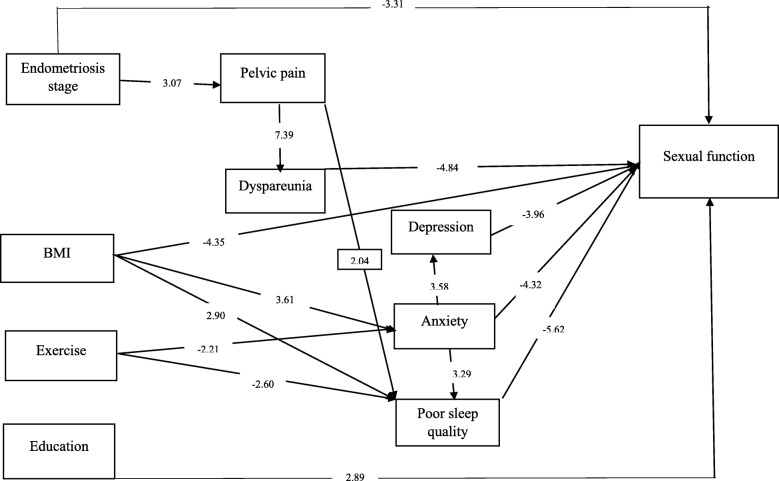
Endometriosis have a negative influence on women's sexual life. The aim of the current study was to test a conceptual model considering the interrelated role of anxiety, depression, sleep quality, physical activity, BMI, stage of endometriosis, the intensity of dyspareunia and pelvic pain on sexual function (SF) in infertile women with endometriosis. Also test the mediating role of sleep quality, anxiety, and depression.
In the present cross-sectional study, 220 infertile women with a laparoscopically confirmed endometriosis were recruited. Data were collected using a socio-demographic checklist, Female Sexual Function Index (FSFI), Pittsburgh Sleep Quality Index (PSQI), Hospital Anxiety and Depression Scale (HADS), Visual Analog Scale (VAS).
We found that anxiety, depression, sleep quality, BMI, level of education, stage of endometriosis, and dyspareunia have a direct effect on women's SF. In our study, sleep quality, anxiety, pelvic pain, and depression were the four major mediators that the higher scores lead to a decrease in the SF of endometriosis patients. The intensity of pelvic pain with an effect on sleep quality (SQ) and dyspareunia change women's SF. The lower level of physical activity, and higher BMI with indirect effect thorough anxiety, and SQ can worsen SF. Also, a higher level of anxiety leads to poor SQ and depression. Anxiety with both direct and indirect effect impress women's SF.
It seems that the main risk factors for sexual dysfunction in women with endometriosis are higher rates of anxiety, depression, poor sleep quality, pelvic pain, and dyspareunia. In the care of women with endometriosis, not only laparoscopy and medical treatment should be performed but also psychotherapeutic and psychosexual help should be offered.
子宫内膜异位症对女性的性生活有负面影响。本研究的目的是测试一个概念模型,该模型考虑了焦虑、抑郁、睡眠质量、身体活动、BMI、子宫内膜异位症分期、性交痛和盆腔痛对不孕子宫内膜异位症女性性功能(SF)的相互作用,以及睡眠质量、焦虑和抑郁的中介作用。
在本横断面研究中,招募了 220 名经腹腔镜证实的子宫内膜异位症不孕妇女。使用社会人口统计学检查表、女性性功能指数(FSFI)、匹兹堡睡眠质量指数(PSQI)、医院焦虑抑郁量表(HADS)、视觉模拟量表(VAS)收集数据。
我们发现焦虑、抑郁、睡眠质量、BMI、受教育程度、子宫内膜异位症分期和性交痛对女性 SF 有直接影响。在我们的研究中,睡眠质量、焦虑、盆腔痛和抑郁是四个主要的中介因素,得分越高导致子宫内膜异位症患者 SF 下降。盆腔痛的严重程度对睡眠质量(SQ)和性交痛的影响改变了患者的 SF。较低的身体活动水平和较高的 BMI 通过间接影响焦虑和 SQ 可以恶化 SF。此外,较高的焦虑水平导致较差的 SQ 和抑郁。焦虑对 SF 有直接和间接的影响。
似乎子宫内膜异位症女性性功能障碍的主要危险因素是焦虑、抑郁、睡眠质量差、盆腔痛和性交痛发生率较高。在子宫内膜异位症女性的护理中,不仅应进行腹腔镜检查和药物治疗,还应提供心理治疗和性心理帮助。