• 文献检索
  • 文档翻译
  • 深度研究
  • 学术资讯
  • Suppr Zotero 插件Zotero 插件
  • 邀请有礼
  • 套餐&价格
  • 历史记录
应用&插件
Suppr Zotero 插件Zotero 插件浏览器插件Mac 客户端Windows 客户端微信小程序
定价
高级版会员购买积分包购买API积分包
服务
文献检索文档翻译深度研究API 文档MCP 服务
关于我们
关于 Suppr公司介绍联系我们用户协议隐私条款
关注我们

Suppr 超能文献

核心技术专利:CN118964589B侵权必究
粤ICP备2023148730 号-1Suppr @ 2026

文献检索

告别复杂PubMed语法,用中文像聊天一样搜索,搜遍4000万医学文献。AI智能推荐,让科研检索更轻松。

立即免费搜索

文件翻译

保留排版,准确专业,支持PDF/Word/PPT等文件格式,支持 12+语言互译。

免费翻译文档

深度研究

AI帮你快速写综述,25分钟生成高质量综述,智能提取关键信息,辅助科研写作。

立即免费体验

儿科危重病期间的微量营养素状况:范围综述。

Micronutrient status during paediatric critical illness: A scoping review.

机构信息

Department of Dietetics/Speech & Language Therapy, NIHR Biomedical Research Centre Southampton, University Hospital Southampton NHS Foundation Trust and School of Health Sciences, University of Southampton, Southampton, UK.

Paediatric Intensive Care Unit, Hôpital Femme Mère Enfant, CarMEN INSERM UMR 1060 Hospices Civils de Lyon, Lyon-Bron, France.

出版信息

Clin Nutr. 2020 Dec;39(12):3571-3593. doi: 10.1016/j.clnu.2020.04.015. Epub 2020 Apr 22.

DOI:10.1016/j.clnu.2020.04.015
PMID:32371094
原文链接:https://pmc.ncbi.nlm.nih.gov/articles/PMC7735376/
Abstract

BACKGROUND

No evidence based recommendations for micronutrient requirements during paediatric critical illness are available, other than those arising from recommended nutrient intakes (RNI) for healthy children and expert opinion.

OBJECTIVES

The objective of this review is to examine the available evidence from micronutrient status in critically ill children considering studies which describe 1) micronutrient levels, 2) associations between micronutrient levels and clinical outcome, and 3) impact on clinical outcome with micronutrient supplementation during PICU admission.

DESIGN

Scoping review.

ELIGIBILITY CRITERIA

Any study which used a qualitative and quantitative design considering causes and consequences of micronutrient levels or micronutrient supplementation during paediatric critical illness.

SOURCES OF EVIDENCE

NICE Healthcare Databases Advanced Search website (https://hdas.nice.org.uk/) was used as a tool for multiple searches, with a content analysis and charting of data extracted.

RESULTS

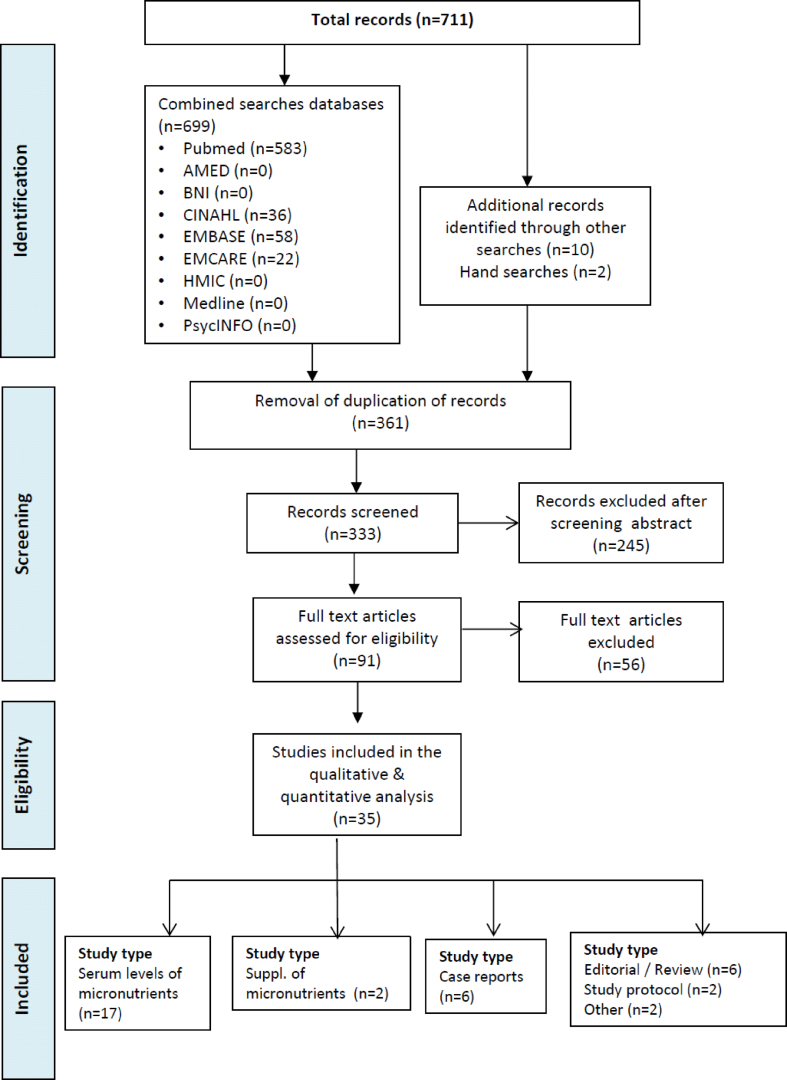
711 records were identified, 35 were included in the review. Studies evaluated serum micronutrient status was determined on admission day in majority of patients. A content analysis identified (n = 49) initial codes, (n = 14) sub-categories and (n = 5) overarching themes during critical illness, which were identified as: i) low levels of micronutrients, ii) causes of aberrant micronutrient levels, iii) associations between micronutrients levels and outcome, iv) supplementation of micronutrients.

CONCLUSION

During critical illness, micronutrients should be provided in sufficient amounts to meet reference nutrient intakes for age. Although, there is insufficient data to recommend routine supplementations of micronutrients at higher doses during critical illness, the 'absence of evidence should not imply evidence of absence', and well designed prospective studies are urgently needed to elucidate paediatric micronutrient requirements during critical illness. The absence of reliable biomarkers make it challenging to determine whether low serum levels are reflective of a true deficiency or as a result redistribution, particularly during the acute phase of critical illness. As more children continue to survive a PICU admission, particularly those with complex diseases micronutrient supplementation research should also be inclusive of the recovery phase following critical illness.

摘要

背景

目前尚无针对儿科危重症患者微量营养素需求的循证推荐,除了健康儿童的推荐营养素摄入量(RNI)和专家意见之外。

目的

本综述的目的是检查危重症儿童微量营养素状态的现有证据,考虑描述 1)微量营养素水平、2)微量营养素水平与临床结局之间的关联,以及 3)在 PICU 入院期间补充微量营养素对临床结局的影响的研究。

设计

范围综述。

纳入标准

任何使用定性和定量设计考虑儿科危重症期间微量营养素水平或微量营养素补充的原因和后果的研究。

证据来源

使用 NICE Healthcare Databases Advanced Search 网站(https://hdas.nice.org.uk/)作为多种搜索的工具,对数据进行内容分析和图表绘制。

结果

确定了 711 条记录,其中 35 条被纳入综述。大多数患者在入院当天评估血清微量营养素状态。内容分析确定了(n=49)初始代码、(n=14)子类别和(n=5)危重病期间的总体主题,分别为:i)微量营养素水平低,ii)异常微量营养素水平的原因,iii)微量营养素水平与结局之间的关联,iv)微量营养素补充。

结论

在危重病期间,应提供足够数量的微量营养素以满足年龄的参考营养素摄入量。尽管目前尚无足够的数据推荐在危重病期间以更高剂量常规补充微量营养素,但“缺乏证据不应意味着缺乏证据”,迫切需要进行精心设计的前瞻性研究,以阐明危重病期间儿科微量营养素需求。缺乏可靠的生物标志物使得确定低血清水平是否反映真正的缺乏或由于再分布而导致的缺乏变得具有挑战性,尤其是在危重病的急性期。随着越来越多的儿童继续在 PICU 接受治疗,特别是那些患有复杂疾病的儿童,微量营养素补充研究也应包括危重病后的康复阶段。
https://cdn.ncbi.nlm.nih.gov/pmc/blobs/3b96/7735376/2dd523f85037/gr4.jpg
https://cdn.ncbi.nlm.nih.gov/pmc/blobs/3b96/7735376/2d2c4de11a09/gr1.jpg
https://cdn.ncbi.nlm.nih.gov/pmc/blobs/3b96/7735376/eae0adc3a1b1/gr2.jpg
https://cdn.ncbi.nlm.nih.gov/pmc/blobs/3b96/7735376/1cdc213a2cf8/gr3.jpg
https://cdn.ncbi.nlm.nih.gov/pmc/blobs/3b96/7735376/2dd523f85037/gr4.jpg
https://cdn.ncbi.nlm.nih.gov/pmc/blobs/3b96/7735376/2d2c4de11a09/gr1.jpg
https://cdn.ncbi.nlm.nih.gov/pmc/blobs/3b96/7735376/eae0adc3a1b1/gr2.jpg
https://cdn.ncbi.nlm.nih.gov/pmc/blobs/3b96/7735376/1cdc213a2cf8/gr3.jpg
https://cdn.ncbi.nlm.nih.gov/pmc/blobs/3b96/7735376/2dd523f85037/gr4.jpg

相似文献

1
Micronutrient status during paediatric critical illness: A scoping review.儿科危重病期间的微量营养素状况:范围综述。
Clin Nutr. 2020 Dec;39(12):3571-3593. doi: 10.1016/j.clnu.2020.04.015. Epub 2020 Apr 22.
2
Folic acid supplementation and malaria susceptibility and severity among people taking antifolate antimalarial drugs in endemic areas.在流行地区,服用抗叶酸抗疟药物的人群中,叶酸补充剂与疟疾易感性和严重程度的关系。
Cochrane Database Syst Rev. 2022 Feb 1;2(2022):CD014217. doi: 10.1002/14651858.CD014217.
3
Assessment of Micronutrient Status in Critically Ill Children: Challenges and Opportunities.危重症患儿微量营养素状况评估:挑战与机遇。
Nutrients. 2017 Oct 28;9(11):1185. doi: 10.3390/nu9111185.
4
Multiple Micronutrient Plasma Level Changes Are Related to Oxidative Stress Intensity in Critically Ill Children.多种微量营养素血浆水平变化与危重症患儿氧化应激强度有关。
Pediatr Crit Care Med. 2018 Sep;19(9):e455-e463. doi: 10.1097/PCC.0000000000001626.
5
Micronutrient deficiencies in critical illness.危重病中的微量营养素缺乏。
Clin Nutr. 2021 Jun;40(6):3780-3786. doi: 10.1016/j.clnu.2021.05.003. Epub 2021 May 11.
6
Plasma and red blood cell concentrations of zinc, copper, selenium and magnesium in the first week of paediatric critical illness.儿科危重症发病第一周患儿血浆和红细胞中锌、铜、硒、镁浓度。
Clin Nutr. 2024 Feb;43(2):543-551. doi: 10.1016/j.clnu.2024.01.004. Epub 2024 Jan 9.
7
Supplementation with multiple micronutrients for breastfeeding women for improving outcomes for the mother and baby.为哺乳期妇女补充多种微量营养素以改善母婴结局。
Cochrane Database Syst Rev. 2016 Feb 18;2(2):CD010647. doi: 10.1002/14651858.CD010647.pub2.
8
Feeding difficulties in young paediatric intensive care survivors: A scoping review.小儿重症监护病房年轻幸存者的喂养困难:一项范围综述。
Clin Nutr ESPEN. 2019 Apr;30:1-9. doi: 10.1016/j.clnesp.2019.01.013. Epub 2019 Feb 16.
9
Use of lipid-based nutrient supplements (LNS) to improve the nutrient adequacy of general food distribution rations for vulnerable sub-groups in emergency settings.在紧急情况下,使用基于脂质的营养补充剂(LNS)来提高弱势群体一般食品分配口粮的营养充足度。
Matern Child Nutr. 2010 Jan;6 Suppl 1(Suppl 1):1-69. doi: 10.1111/j.1740-8709.2009.00224.x.
10
Micronutrient supplementation in adults with HIV infection.对感染艾滋病毒的成年人进行微量营养素补充
Cochrane Database Syst Rev. 2017 May 18;5(5):CD003650. doi: 10.1002/14651858.CD003650.pub4.

引用本文的文献

1
Personalized Nutrition in the Pediatric ICU: Steering the Shift from Acute Stress to Metabolic Recovery and Rehabilitation.儿科重症监护中的个性化营养:从急性应激转向代谢恢复和康复。
Nutrients. 2024 Oct 17;16(20):3523. doi: 10.3390/nu16203523.
2
Evaluation of serum vitamin B12 and D, iron, ferritin, folate, calcium, phosphorus and magnesium levels in children in palliative care clinic: a single-center cross-sectional study.评估姑息治疗诊所中儿童的血清维生素 B12 和 D、铁、铁蛋白、叶酸、钙、磷和镁水平:一项单中心横断面研究。
BMC Palliat Care. 2024 Sep 4;23(1):218. doi: 10.1186/s12904-024-01546-9.
3
Advances in pediatric acute kidney injury pharmacology and nutrition: a report from the 26th Acute Disease Quality Initiative (ADQI) consensus conference.

本文引用的文献

1
A Narrative Role of Vitamin D and Its Receptor: With Current Evidence on the Gastric Tissues.维生素 D 及其受体的叙述性作用:基于目前对胃组织的证据。
Int J Mol Sci. 2019 Aug 5;20(15):3832. doi: 10.3390/ijms20153832.
2
Vitamin A deficiency in critically ill children with sepsis.严重脓毒症患儿维生素 A 缺乏。
Crit Care. 2019 Aug 1;23(1):267. doi: 10.1186/s13054-019-2548-9.
3
Micronutrient deficiency in critical illness: an invisible foe?危重症中的微量营养素缺乏:一个无形的敌人?
儿科急性肾损伤药理学与营养领域的进展:第26届急性疾病质量改进倡议(ADQI)共识会议报告
Pediatr Nephrol. 2024 Mar;39(3):981-992. doi: 10.1007/s00467-023-06178-4. Epub 2023 Oct 25.
4
Nutritional management of children with acute kidney injury-clinical practice recommendations from the Pediatric Renal Nutrition Taskforce.儿童急性肾损伤的营养管理 - 儿科肾脏营养工作组的临床实践建议。
Pediatr Nephrol. 2023 Nov;38(11):3559-3580. doi: 10.1007/s00467-023-05884-3. Epub 2023 Mar 20.
5
Association of COVID-19 mortality with serum selenium, zinc and copper: Six observational studies across Europe.血清硒、锌和铜与 COVID-19 死亡率的关联:欧洲六国的观察性研究。
Front Immunol. 2022 Nov 28;13:1022673. doi: 10.3389/fimmu.2022.1022673. eCollection 2022.
6
A Scoping Review: Urinary Markers of Metabolic Maturation in Preterm Infants and Future Interventions to Improve Growth.范围综述:早产儿代谢成熟的尿液标志物及改善生长的未来干预措施。
Nutrients. 2022 Sep 23;14(19):3957. doi: 10.3390/nu14193957.
7
Research on the Application Effect of Strengthening Risk Management in Continuous Renal Replacement Therapy Nursing of Critically Ill Patients.强化风险管理在危重症患者连续性肾脏替代治疗护理中的应用效果研究
Evid Based Complement Alternat Med. 2022 Jul 8;2022:2363877. doi: 10.1155/2022/2363877. eCollection 2022.
8
PN Administration in Critically Ill Children in Different Phases of the Stress Response.应激反应不同阶段的危重症患儿的 PN 管理。
Nutrients. 2022 Apr 27;14(9):1819. doi: 10.3390/nu14091819.
9
The metabolic effects of multi-trace elements on parenteral nutrition for critically ill pediatric patients: a randomized controlled trial and metabolomic research.多微量元素对危重症儿科患者肠外营养的代谢影响:一项随机对照试验及代谢组学研究
Transl Pediatr. 2021 Oct;10(10):2579-2593. doi: 10.21037/tp-21-456.
10
Pediatric thiamine deficiency disorders in high-income countries between 2000 and 2020: a clinical reappraisal.2000 年至 2020 年高收入国家小儿硫胺素缺乏症:临床再评估。
Ann N Y Acad Sci. 2021 Aug;1498(1):57-76. doi: 10.1111/nyas.14669. Epub 2021 Jul 26.
Intensive Care Med. 2019 Aug;45(8):1136-1139. doi: 10.1007/s00134-019-05678-y. Epub 2019 Jul 23.
4
Matched Retrospective Cohort Study of Thiamine to Treat Persistent Hyperlactatemia in Pediatric Septic Shock.维生素 B1 治疗儿童脓毒性休克持续性高乳酸血症的配对回顾性队列研究。
Pediatr Crit Care Med. 2019 Sep;20(9):e452-e456. doi: 10.1097/PCC.0000000000002074.
5
Tocopherols, tocotrienols and tocomonoenols: Many similar molecules but only one vitamin E.生育酚、三烯生育酚和生育三烯酚:多种类似分子,唯有维生素 E 一种。
Redox Biol. 2019 Sep;26:101259. doi: 10.1016/j.redox.2019.101259. Epub 2019 Jun 19.
6
Nutritional Status Deterioration Occurs Frequently During Children's ICU Stay.患儿在重症监护病房期间常出现营养状况恶化。
Pediatr Crit Care Med. 2019 Aug;20(8):714-721. doi: 10.1097/PCC.0000000000001979.
7
Lactic Acidosis as Presenting Symptom of Thiamine Deficiency in Children with Hematologic Malignancy.乳酸酸中毒作为血液系统恶性肿瘤患儿硫胺素缺乏的首发症状
J Pediatr Intensive Care. 2017 Jun;6(2):132-135. doi: 10.1055/s-0036-1587325. Epub 2016 Aug 8.
8
Modification of Nutrition Therapy During Continuous Renal Replacement Therapy in Critically Ill Pediatric Patients: A Narrative Review and Recommendations.危重症儿科患者连续性肾脏替代治疗期间营养治疗的调整:叙事性综述及推荐意见
Nutr Clin Pract. 2019 Feb;34(1):37-47. doi: 10.1002/ncp.10231. Epub 2018 Dec 20.
9
Feeding mitochondria: Potential role of nutritional components to improve critical illness convalescence.给线粒体供能:营养成分在改善危重症康复中的潜在作用。
Clin Nutr. 2019 Jun;38(3):982-995. doi: 10.1016/j.clnu.2018.08.032. Epub 2018 Aug 31.
10
Micronutrients in Critical Illness: Essential and Enigmatic.危重症中的微量营养素:至关重要且神秘莫测。
Pediatr Crit Care Med. 2018 Sep;19(9):907-908. doi: 10.1097/PCC.0000000000001645.