Pediatric Intensive Care Unit, Department of Critical Care Medicine, West China Hospital of Sichuan University, Chengdu, 610041, China.
Division of Oncology, Department of Pediatric Surgery, West China Hospital of Sichuan University, Chengdu, 610041, China.
Crit Care. 2019 Aug 1;23(1):267. doi: 10.1186/s13054-019-2548-9.
Data that indicate vitamin A status in critically ill children with sepsis are sparse. The association between serum vitamin A levels and the clinical outcomes of sepsis has not been well assessed. The aim of this study was to assess the prevalence of vitamin A deficiency in critically ill children with sepsis and its association with clinical outcomes.
Critically ill children with sepsis admitted to the pediatric intensive care unit were engaged in this prospective study. Sex- and age-matched approximate-health children from the Department of Pediatric Surgery were enrolled as the control group. Blood samples were collected from all patients in the first 24 h of admission for the measurement of serum vitamin A status. We compared vitamin A status between the sepsis group and the control group. In addition, we compared the clinical characteristics of the two subgroups of septic patients with vitamin A deficiency and those without vitamin A deficiency. Univariate and multivariable methods were used to evaluate the association between vitamin A deficiency and septic shock.
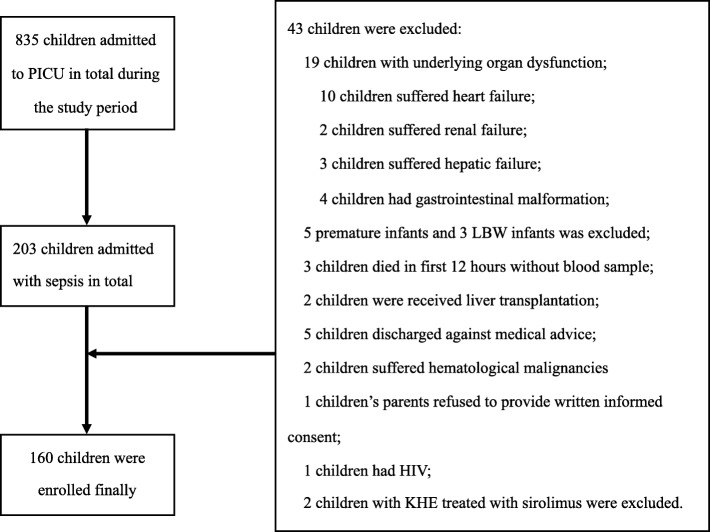
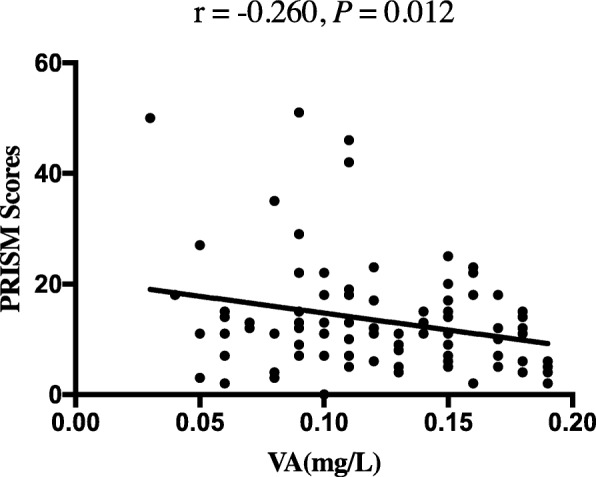
One hundred sixty septic children and 49 approximate-health children were enrolled in this study. Vitamin A deficiency was found in 94 (58.8%) subjects in the study group and 6 (12.2%) subjects in the control group (P < 0.001). In septic patients, 28-day mortality and hospital mortality in patients with vitamin A deficiency were not significantly higher than that in patients without vitamin A deficiency (P > 0.05). However, vitamin A levels were inversely associated with higher PRISM scores in septic children with VAD (r = - 0.260, P = 0.012). Vitamin A deficiency was associated with septic shock with an unadjusted odds ratio (OR) of 3.297 (95% confidence interval (CI), 1.169 to 9.300; P = 0.024). In a logistic model, vitamin A deficiency (OR, 4.630; 95% CI, 1.027-20.866; P = 0.046), procalcitonin (OR, 1.029; 95% CI, 1.009-1.048; P = 0.003), and the Pediatric Risk of Mortality scores (OR, 1.132; 95% CI, 1.009-1.228; P = 0.003) were independently associated with septic shock.
The prevalence of vitamin A deficiency was high in children with sepsis. Vitamin A deficiency may be a marker of mortality in critically ill children with sepsis.
Clinicaltrials.gov , NCT03598127.
关于脓毒症危重症患儿维生素 A 状态的数据很少。血清维生素 A 水平与脓毒症临床结局的关系尚未得到很好的评估。本研究旨在评估脓毒症危重症患儿维生素 A 缺乏的发生率及其与临床结局的关系。
本前瞻性研究纳入了入住儿科重症监护病房的脓毒症危重症患儿。从小儿外科科室选取性别和年龄匹配的近似健康儿童作为对照组。所有患者在入院后 24 小时内采集血样,用于测量血清维生素 A 状态。我们比较了脓毒症组和对照组的维生素 A 状态。此外,我们比较了维生素 A 缺乏和不缺乏的两组脓毒症患儿的临床特征。采用单因素和多因素方法评估维生素 A 缺乏与脓毒性休克的关系。
本研究纳入了 160 例脓毒症患儿和 49 名近似健康儿童。研究组中有 94 例(58.8%)患儿存在维生素 A 缺乏,对照组中有 6 例(12.2%)患儿存在维生素 A 缺乏(P<0.001)。在脓毒症患儿中,维生素 A 缺乏组与非维生素 A 缺乏组 28 天死亡率和住院死亡率无显著差异(P>0.05)。然而,维生素 A 水平与脓毒症合并 VAD 患儿的 PRISM 评分呈负相关(r=-0.260,P=0.012)。维生素 A 缺乏与脓毒性休克相关,未经调整的优势比(OR)为 3.297(95%置信区间(CI),1.169 至 9.300;P=0.024)。在逻辑模型中,维生素 A 缺乏(OR,4.630;95%CI,1.027-20.866;P=0.046)、降钙素原(OR,1.029;95%CI,1.009-1.048;P=0.003)和儿科死亡率评分(OR,1.132;95%CI,1.009-1.228;P=0.003)与脓毒性休克独立相关。
脓毒症患儿维生素 A 缺乏的发生率较高。维生素 A 缺乏可能是脓毒症危重症患儿死亡的一个标志物。
Clinicaltrials.gov,NCT03598127。