Department of Oto-Rhino-Laryngology, Head and Neck Surgery "Otto Körner", Rostock University Medical Center, Doberaner Strasse 137-139, 18057, Rostock, Germany.
Department of Otorhinolaryngology, Head and Neck Surgery, University Hospital Zurich, Zurich, Switzerland.
Eur Arch Otorhinolaryngol. 2020 Oct;277(10):2729-2738. doi: 10.1007/s00405-020-06002-x. Epub 2020 May 5.
To investigate the association between the "ChOLE" classification, hearing outcomes and disease-specific health-related quality of life (HRQoL).
In two tertiary referral centers, patients requiring primary or revision surgery for cholesteatoma were assessed for eligibility. Audiometric assessment was performed pre- and postoperatively. The ChOLE classification was determined intraoperatively and via the preoperative CT scan. HRQoL was assessed pre- and postoperatively using the Zurich Chronic Middle Ear Inventory (ZCMEI-21).
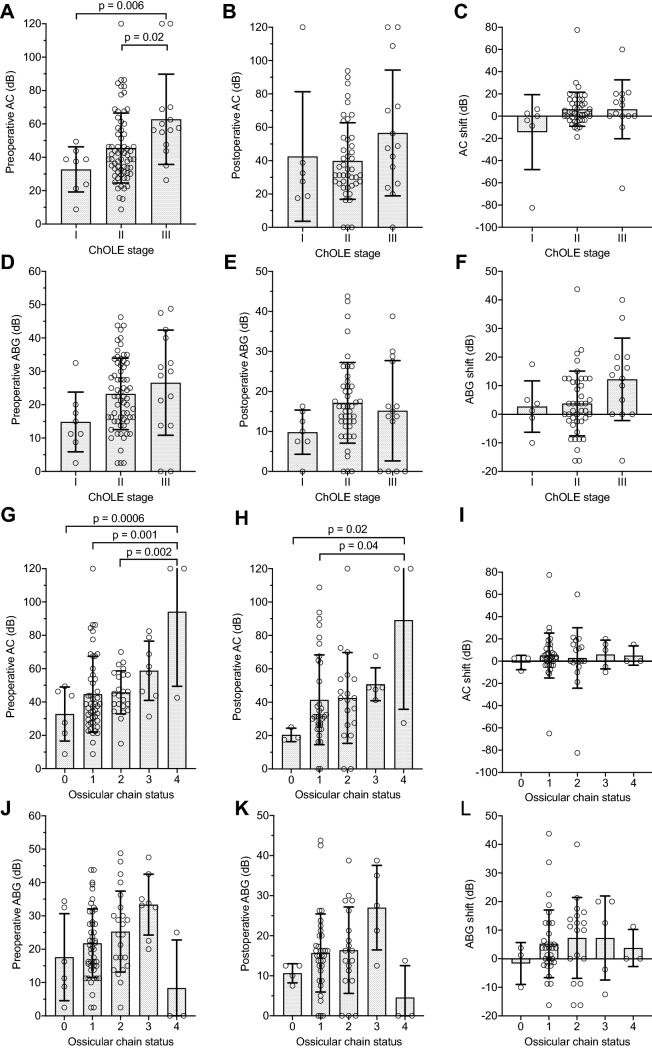
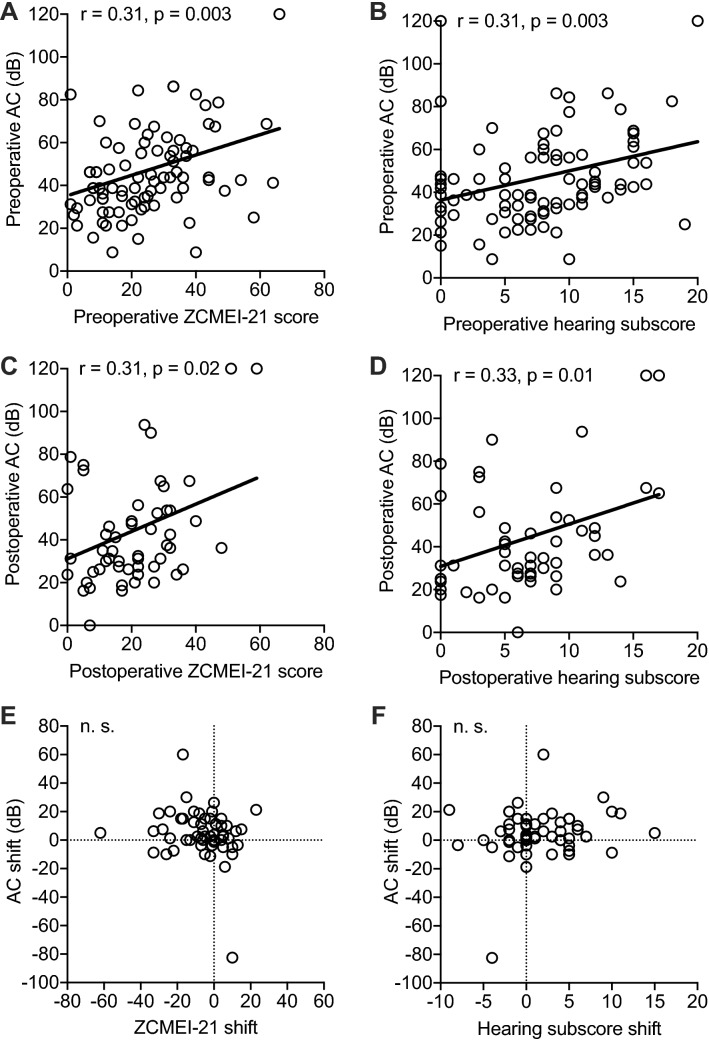
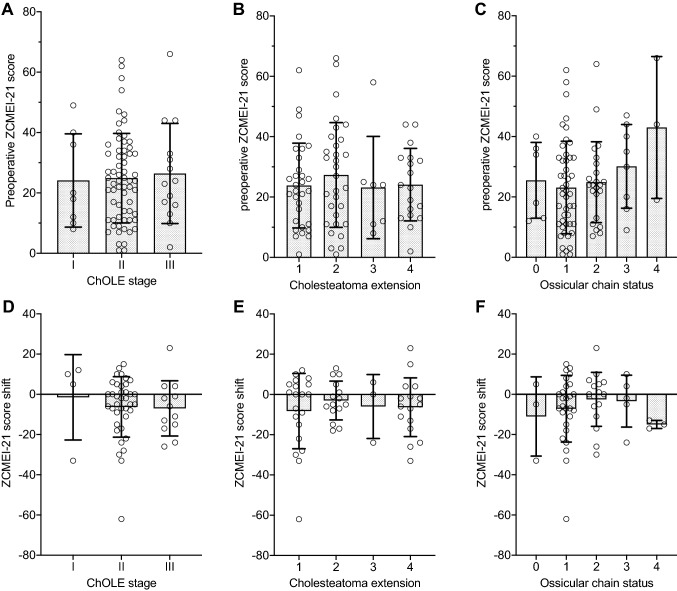
A total of 87 patients (mean age 45.2 years, SD 16.2) were included in this study. ChOLE stage I cholesteatoma was found in 8 (9%), stage II cholesteatoma was found in 65 (75%), and stage III cholesteatoma was found in 14 (16%) patients. Postoperatively, the mean air-bone gap (0.5, 1, 2, 3 kHz) was significantly smaller than before surgery (14.3 dB vs. 23.0 dB; p = 0.0007). The mean ZCMEI-21 total score significantly decreased after surgery (26.8 vs. 20.7, p = 0.004). No correlation between the ZCMEI-21 total score and both the ChOLE stage and the extent of the cholesteatoma (ChOLE subdivision "Ch") was found. A trend towards worse HRQoL associated with a poorer status of the ossicular chain (ChOLE subdivision "O") was observed. The audiometric outcomes were not associated with the extent of the cholesteatoma. The ChOLE subdivision describing the ossicular status showed a strong association with the pre- and postoperative air conduction (AC) thresholds. Further, the ZCMEI-21 total score and its hearing subscore correlated with the AC thresholds.
The ChOLE classification does not show a clear association with HRQoL measured by the ZCMEI-21. The HRQoL neither seems to be associated with the extent of the disease nor with the ossicular chain status. Yet, surgical therapy significantly improved HRQoL by means of reduced ZCMEI-21 total scores, which were strongly associated with the AC thresholds. Intraoperative assessment of a cholesteatoma using the ChOLE classification and HRQoL complement each other and provide useful information.
研究“ChOLE”分类、听力结果与疾病特异性健康相关生活质量(HRQoL)之间的关系。
在两家三级转诊中心,评估符合条件的患者是否需要进行原发性或复发性胆脂瘤手术。术前和术后进行听力评估。术中通过术前 CT 扫描确定 ChOLE 分类。术前和术后使用苏黎世慢性中耳问卷(ZCMEI-21)评估 HRQoL。
本研究共纳入 87 例患者(平均年龄 45.2 岁,标准差 16.2)。Ⅰ期胆脂瘤 8 例(9%),Ⅱ期胆脂瘤 65 例(75%),Ⅲ期胆脂瘤 14 例(16%)。术后,气骨导差(0.5、1、2、3 kHz)平均明显小于术前(14.3 dB 比 23.0 dB;p = 0.0007)。术后 ZCMEI-21 总分明显下降(26.8 比 20.7,p = 0.004)。未发现 ZCMEI-21 总分与 ChOLE 分期和胆脂瘤范围(ChOLE 亚分类“Ch”)之间存在相关性。观察到与听小骨链状态较差(ChOLE 亚分类“O”)相关的 HRQoL 呈下降趋势。听力结果与胆脂瘤范围无关。描述听小骨状态的 ChOLE 亚分类与术前和术后气导阈值有很强的关联。此外,ZCMEI-21 总分及其听力子评分与气导阈值相关。
ChOLE 分类与 ZCMEI-21 测量的 HRQoL 之间没有明显的关联。HRQoL 似乎既与疾病程度无关,也与听小骨链状态无关。然而,手术治疗通过降低 ZCMEI-21 总分显著改善了 HRQoL,而 ZCMEI-21 总分与气导阈值有很强的关联。术中使用 ChOLE 分类评估胆脂瘤和 HRQoL 互为补充,提供有用的信息。