Isaiah Simon, Loots Du Toit, Solomons Regan, van der Kuip Martijn, Tutu Van Furth A Marceline, Mason Shayne
Human Metabolomics, Faculty of Natural and Agricultural Sciences, North-West University, Potchefstroom, South Africa.
Department of Pediatrics and Child Health, Faculty of Medicine and Health Sciences, Stellenbosch University, Tygerberg, South Africa.
Front Neurosci. 2020 Apr 21;14:296. doi: 10.3389/fnins.2020.00296. eCollection 2020.
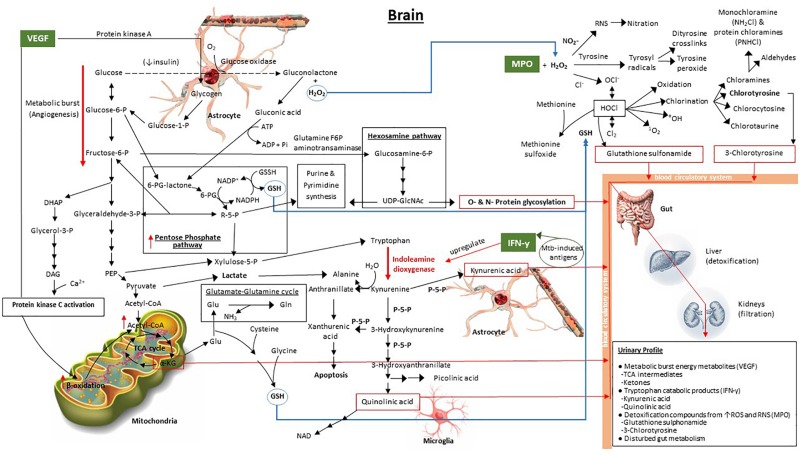
A new paradigm in neuroscience has recently emerged - the brain-gut axis (BGA). The contemporary focus in this paradigm has been gut → brain ("bottom-up"), in which the gut-microbiome, and its perturbations, affects one's psychological state-of-mind and behavior, and is pivotal in neurodegenerative disorders. The emerging brain → gut ("top-down") concept, the subject of this review, proposes that dysfunctional brain health can alter the gut-microbiome. Feedback of this alternative bidirectional highway subsequently aggravates the neurological pathology. This paradigm shift, however, focuses upon non-communicable neurological diseases (progressive neuroinflammation). What of infectious diseases, in which pathogenic bacteria penetrate the blood-brain barrier and interact with the brain, and what is this effect on the BGA in bacterial infection(s) that cause chronic neuroinflammation? Persistent immune activity in the CNS due to chronic neuroinflammation can lead to irreversible neurodegeneration and neuronal death. The properties of cerebrospinal fluid (CSF), such as immunological markers, are used to diagnose brain disorders. But what of metabolic markers for such purposes? If a BGA exists, then chronic CNS bacterial infection(s) should theoretically be reflected in the urine. The premise here is that chronic CNS bacterial infection(s) will affect the gut-microbiome and that perturbed metabolism in both the CNS and gut will release metabolites into the blood that are filtered (kidneys) and excreted in the urine. Here we assess the literature on the effects of chronic neuroinflammatory diseases on the gut-microbiome caused by bacterial infection(s) of the CNS, in the context of information attained via metabolomics-based studies of urine. Furthermore, we take a severe chronic neuroinflammatory infectious disease - tuberculous meningitis (TBM), caused by , and examine three previously validated CSF immunological biomarkers - vascular endothelial growth factor, interferon-gamma and myeloperoxidase - in terms of the expected changes in normal brain metabolism. We then model the downstream metabolic effects expected, predicting pivotal altered metabolic pathways that would be reflected in the urinary profiles of TBM subjects. Our cascading metabolic model should be adjustable to account for other types of CNS bacterial infection(s) associated with chronic neuroinflammation, typically prevalent, and difficult to distinguish from TBM, in the resource-constrained settings of poor communities.
神经科学领域最近出现了一种新范式——脑-肠轴(BGA)。这种范式当前的重点在于肠道→大脑(“自下而上”),即肠道微生物群及其紊乱会影响一个人的心理状态和行为,并且在神经退行性疾病中起关键作用。本文综述的新兴的大脑→肠道(“自上而下”)概念提出,大脑健康功能失调会改变肠道微生物群。这条双向通路的反馈随后会加重神经病理学状况。然而,这种范式转变聚焦于非传染性神经疾病(进行性神经炎症)。那么传染病呢?在传染病中,病原菌会穿透血脑屏障并与大脑相互作用,在引起慢性神经炎症的细菌感染中,这对脑-肠轴有什么影响?由于慢性神经炎症导致的中枢神经系统持续免疫活动会导致不可逆的神经退行性变和神经元死亡。脑脊液(CSF)的特性,如免疫标志物,可用于诊断脑部疾病。但用于此目的的代谢标志物呢?如果存在脑-肠轴,那么理论上慢性中枢神经系统细菌感染应该会在尿液中有所体现。这里的前提是,慢性中枢神经系统细菌感染会影响肠道微生物群,并且中枢神经系统和肠道中受干扰的代谢会将代谢产物释放到血液中,这些代谢产物会被肾脏过滤并随尿液排出。在此,我们结合通过基于代谢组学的尿液研究获得的信息,评估有关中枢神经系统细菌感染引起的慢性神经炎症性疾病对肠道微生物群影响的文献。此外,我们以一种严重的慢性神经炎症性传染病——结核性脑膜炎(TBM)为例,研究三种先前已验证的脑脊液免疫生物标志物——血管内皮生长因子、干扰素-γ和髓过氧化物酶——在正常脑代谢预期变化方面的情况。然后,我们对预期的下游代谢效应进行建模,预测在结核性脑膜炎患者尿液谱中会体现出的关键代谢途径改变。我们的级联代谢模型应可进行调整,以考虑与慢性神经炎症相关的其他类型的中枢神经系统细菌感染,这些感染在资源有限的贫困社区环境中通常很普遍,且难以与结核性脑膜炎区分开来。