Heidari Hamid, Sedigh Ebrahim-Saraie Hadi, Amanati Ali, Motamedifar Mohammad, Hadi Nahal, Bazargani Abdollah
Department of Bacteriology and Virology, School of Medicine, Shiraz University of Medical Sciences, Shiraz, Iran.
Professor Alborzi Clinical Microbiology Research Center, Shiraz University of Medical Sciences, Shiraz, Iran.
Iran J Basic Med Sci. 2019 Jul;22(7):813-819. doi: 10.22038/ijbms.2019.35223.8390.
infection as a healthcare-associated infection can cause life-threatening infectious diarrhea in hospitalized patients. The aim of this study was to investigate the toxin profiles and antimicrobial resistance patterns of isolates obtained from hospitalized patients in Shiraz, Iran.
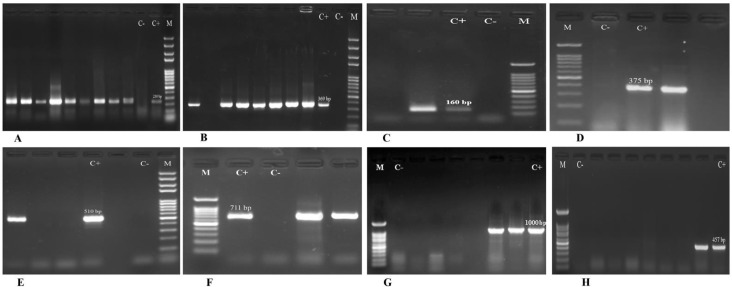
This study was performed on 45 toxigenic isolates. Determination of toxin profiles was done using polymerase chain reaction method. Antimicrobial susceptibility to vancomycin, metronidazole, clindamycin, tetracycline, moxifloxacin, and chloramphenicol was determined by the agar dilution method. The genes encoding antibiotic resistance were detected by the standard procedures.
The most frequent toxin profile was , , , (82.2%), and only one isolate harboured all toxin associated genes (+, , , ) (2.2%). The genes encoding CDT (binary toxin) were also found in six (13.3%) isolates. Resistance to tetracycline, clindamycin and moxifloxacin was observed in 66.7%, 60% and 42.2% of the isolates, respectively. None of the strains showed resistance to other antibiotics. The distribution of the gene (the gene encoding resistance to clindamycin) was 57.8% and the and genes (the genes encoding resistance to tetracycline) were found in 62.2% and 13.3% of the isolates, respectively. The substitutions Thr82 to Ile in GyrA and Asp426 to Asn in GyrB were seen in moxifloxacin resistant isolates.
Our data contributes to the present understanding of virulence and resistance traits amongst the isolates. Infection control strategies should be implemented carefully in order to curb the dissemination of strains in hospital.
作为一种医疗保健相关感染,[病原体名称未明确]感染可导致住院患者出现危及生命的感染性腹泻。本研究旨在调查从伊朗设拉子住院患者中分离出的菌株的毒素谱和抗菌药物耐药模式。
本研究对45株产毒素菌株进行。采用聚合酶链反应法测定毒素谱。通过琼脂稀释法测定对万古霉素、甲硝唑、克林霉素、四环素、莫西沙星和氯霉素的抗菌药敏性。通过标准程序检测编码抗生素耐药性的基因。
最常见的毒素谱是[具体毒素谱未明确](82.2%),只有一株菌株携带所有毒素相关基因([具体基因组合未明确])(2.2%)。编码CDT(二元毒素)的基因也在6株(13.3%)菌株中发现。分别有66.7%、60%和42.2%的菌株对四环素、克林霉素和莫西沙星耐药。没有菌株对其他抗生素耐药。[编码对克林霉素耐药的基因名称未明确]基因的分布为57.8%,编码对四环素耐药的[具体基因名称未明确]和[具体基因名称未明确]基因分别在62.2%和13.3%的菌株中发现。在耐莫西沙星的菌株中观察到GyrA中第82位苏氨酸替换为异亮氨酸以及GyrB中第426位天冬氨酸替换为天冬酰胺。
我们的数据有助于目前对分离株中毒力和耐药特性的理解。应谨慎实施感染控制策略以遏制[病原体名称未明确]菌株在医院的传播。