Department of Medical Microbiology, School of Medicine, University of Nairobi, Nairobi, Kenya.
Department of Pathology, Division of Medical Microbiology, Aga Khan University Hospital, Nairobi, Kenya.
Front Cell Infect Microbiol. 2021 Feb 8;10:604986. doi: 10.3389/fcimb.2020.604986. eCollection 2020.
is a neglected pathogen in many African countries as it is generally not regarded as one of the major contributors toward the diarrheal disease burden in the continent. However, several studies have suggested that infection (CDI) may be underreported in many African settings. The aim of this study was to determine the prevalence of CDI in hospitalized patients, evaluate antimicrobial exposure, and detect toxin and antimicrobial resistance profiles of the isolated strains.
In this cross-sectional study, 333 hospitalized patients with hospital-onset diarrhoea were selected. The stool samples were collected and cultured on cycloserine-cefoxitin egg yolk agar (CCEY). Isolates were presumptively identified by phenotypic characteristics and Gram stain and confirmed by singleplex real-time PCR (qPCR) assays detecting the species-specific gene, toxin A () gene, toxin B () gene, and the binary toxin () genes. Confirmed isolates were tested against a panel of eight antimicrobials (vancomycin, metronidazole, rifampicin, ciprofloxacin, tetracycline, clindamycin, erythromycin, and ceftriaxone) using E-test strips.
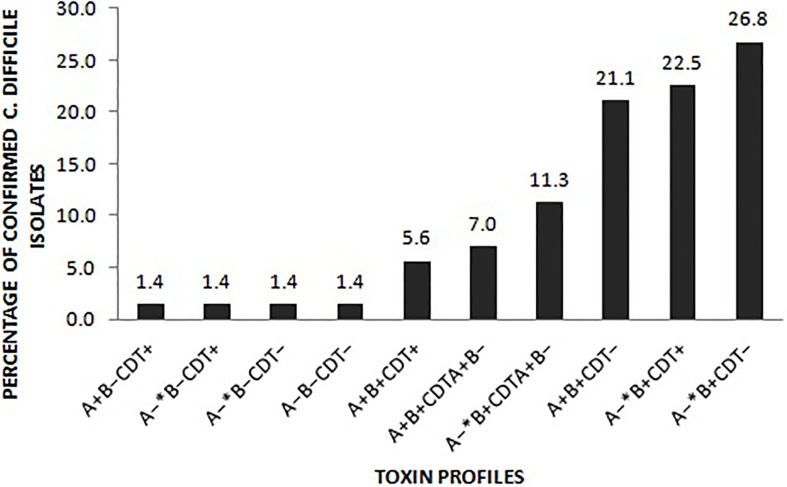
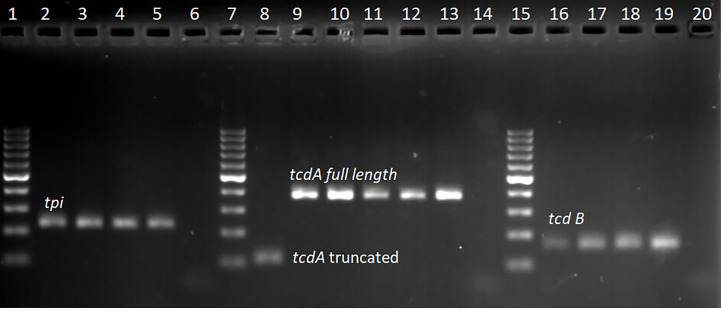
was detected in 57 (25%) of diarrheal patients over the age of two, 56 (98.2%) of whom received antimicrobials before the diarrheal episode. Amongst the 71 confirmed isolates, 69 (97.1%) harbored at least one toxin gene. More than half of the toxigenic isolates harbored a truncated gene. All isolates were sensitive to vancomycin, while three isolates (2.1%) were resistant to metronidazole (MIC >32 mg/L). High levels of resistance were observed to rifampicin (65/71, 91.5%), erythromycin (63/71, 88.7%), ciprofloxacin (59/71, 83.1%), clindamycin (57/71, 80.3%), and ceftriaxone (36/71, 50.7.8%). Among the resistant isolates, 61 (85.9%) were multidrug-resistant.
Multidrug-resistant strains were a significant cause of healthcare facility-onset infections in patients with prior antimicrobial exposure in this Kenyan hospital.
在许多非洲国家, 被忽视为一种病原体,因为它通常不被认为是导致该大陆腹泻疾病负担的主要因素之一。然而,有几项研究表明, 感染(CDI)在许多非洲环境中可能报告不足。本研究旨在确定住院患者中 CDI 的患病率,评估抗菌药物暴露情况,并检测分离 的菌株的毒素和抗菌药物耐药谱。
在这项横断面研究中,选择了 333 例患有医院获得性腹泻的住院患者。采集粪便样本并在环丝氨酸头孢西丁卵黄琼脂(CCEY)上培养。通过表型特征和革兰氏染色对分离株进行初步鉴定,并通过检测种特异性 基因、毒素 A()基因、毒素 B()基因和二元毒素()基因的单重实时 PCR(qPCR)检测进行确认。用 E 试验条对确认的 分离株进行了对抗生素(万古霉素、甲硝唑、利福平、环丙沙星、四环素、克林霉素、红霉素和头孢曲松)的药敏试验。
年龄大于 2 岁的腹泻患者中,有 57 例(25%)检测到 ,其中 56 例(98.2%)在腹泻发作前接受了抗菌药物治疗。在 71 例确认的分离株中,69 例(97.1%)至少携带一种毒素基因。超过一半的产毒分离株携带截短的 基因。所有分离株均对万古霉素敏感,而 3 株(2.1%)对甲硝唑耐药(MIC>32mg/L)。对利福平(65/71,91.5%)、红霉素(63/71,88.7%)、环丙沙星(59/71,83.1%)、克林霉素(57/71,80.3%)和头孢曲松(36/71,50.7.8%)的耐药率较高。在耐药分离株中,61 株(85.9%)为多重耐药株。
在肯尼亚医院,有抗菌药物暴露史的患者中,多药耐药 菌株是医源性 感染的重要原因。