Maalouly Joseph, Tawk Antonios, Ayoubi Rami, Al Rahbani Georges Katoul, Metri Aida, Saidy Elias, El-Hajj Gerard, Nehme Alexandre
Department of Orthopedic Surgery and Traumatology, Saint George Hospital University Medical Center, Balamand University, P.O. Box 166378, Achrafieh, Beirut 1100 2807, Lebanon.
Faculty of Medicine and Medical Sciences, University of Balamand, Aschrafieh, Beirut, Lebanon.
Adv Orthop. 2020 Apr 14;2020:9130462. doi: 10.1155/2020/9130462. eCollection 2020.
Total hip arthroplasty (THA) is associated with substantial blood loss in the postoperative course. Tranexamic acid (TXA) is a potent antifibrinolytic agent, routinely administered by intravenous (IV) and topical (intra-articular, IA) route, which can possibly interrupt the cascade of events due to hemostatic irregularities close to the source of bleeding. However, scientific evidence of combined administration of TXA in THA secondary to a femoral neck fracture is still meagre. The present study aims to compare the patients who were administered combined IV and topical TXA with a control group in terms of blood loss, transfusion rate, and incidence of deep vein thrombosis (DVT) and thromboembolism (TE). . 195 patients with femoral neck fracture underwent THA and were placed into two groups: (1) IV and IA TXA group which had 58 patients and (2) no TXA control group which had 137 patients. In the TXA group, 1 g IV TXA was administered 30 minutes before incision, and 1 g IA TXA was administered intraoperatively after fascia closure. No drains were placed, and soft spica was applied to the hip.
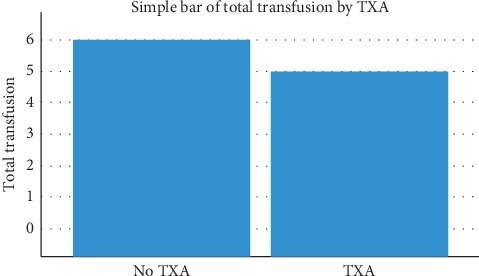
Combined usage of IV and IA TXA showed better results when compared to the control group in terms of blood transfusion rate (31%) and hemoglobin drop (28%). No cases of DVT or TE were noted among the two study groups.
Combined use of IV and IA TXA provided significantly better results compared to no TXA use with respect to all variables related to postoperative blood loss in THA. Moreover, TXA use is safe in terms of incidence of symptomatic DVT and TE.
全髋关节置换术(THA)在术后过程中会导致大量失血。氨甲环酸(TXA)是一种强效抗纤溶药物,通常通过静脉(IV)和局部(关节内,IA)途径给药,它可能会中断因靠近出血源的止血异常而引发的一系列事件。然而,关于在股骨颈骨折继发的THA中联合使用TXA的科学证据仍然不足。本研究旨在比较接受IV和局部TXA联合给药的患者与对照组在失血量、输血率以及深静脉血栓形成(DVT)和血栓栓塞(TE)发生率方面的情况。195例股骨颈骨折患者接受了THA,并被分为两组:(1)IV和IA TXA组,有58例患者;(2)无TXA对照组,有137例患者。在TXA组中,术前30分钟静脉注射1g TXA,筋膜闭合后术中关节内注射1g TXA。未放置引流管,髋部应用软石膏。
与对照组相比,IV和IA TXA联合使用在输血率(31%)和血红蛋白下降(28%)方面显示出更好的结果。两个研究组均未发现DVT或TE病例。
与未使用TXA相比,IV和IA TXA联合使用在与THA术后失血相关的所有变量方面均提供了显著更好的结果。此外,就有症状的DVT和TE发生率而言,使用TXA是安全的。