Moore Justin X, Han Yunan, Appleton Catherine, Colditz Graham, Toriola Adetunji T
Division of Public Health Sciences, Department of Surgery, and Siteman Cancer Center at Washington University School of Medicine, St. Louis, MO, USA.
Division of Epidemiology, Department of Population Health Sciences, Augusta University, Augusta, GA, USA.
JNCI Cancer Spectr. 2020 Feb 26;4(2):pkaa010. doi: 10.1093/jncics/pkaa010. eCollection 2020 Apr.
Because of the mixed reports from smaller studies, we examined associations of race with mammographic breast density and evaluated racial differences in the determinants of breast density.
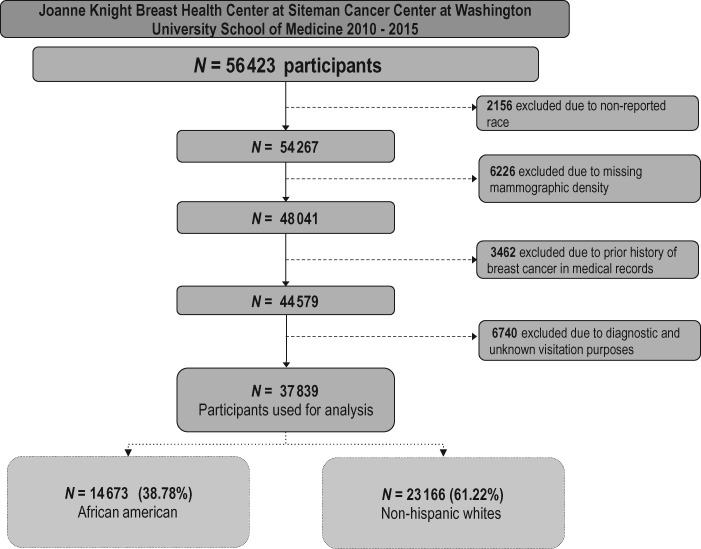
Participants included 37 839 women (23 166 non-Hispanic white and 14 673 African American) receiving screening mammograms at the Joanne Knight Breast Health Center at Washington University School of Medicine from June 2010 to December 2015. Mammographic breast density was assessed using the Breast Imaging Reporting and Data System (5th edition). To determine the association of race and participant characteristics with mammographic breast density, we used multivariable polytomous logistic regression models (reference group: almost entirely fatty).
African American women had increased odds of extremely dense (adjusted odds ratio = 1.31, 95% confidence interval = 1.13 to 1.52) and reduced odds of heterogeneously dense breasts (adjusted odds ratio = 0.91, 95% confidence interval = 0.84 to 0.99) compared with non-Hispanic white women. Altogether, race, parity and age at first birth, current age, current body mass index (BMI), BMI at age 18 years, menarche, family history of breast cancer, oral contraceptive use, alcohol use, and menopausal status explained 33% of the variation in mammographic breast density. Among African American and non-Hispanic white women, these factors explained nearly 28.6% and 33.6% of the variation in mammographic density, respectively. Current BMI provided the greatest explanation of breast density (26.2% overall, 22.2% in African American, and 26.2% in non-Hispanic white women).
The determinants of mammographic breast density were generally similar between African American women and non-Hispanic white women. After adjustments for confounders, African Americans had higher likelihood of extremely dense breasts but lower likelihood of heterogeneously dense breasts. The greatest explanation of breast density was provided by BMI, regardless of race.
由于小型研究的报告结果不一,我们研究了种族与乳腺钼靶密度之间的关联,并评估了乳腺密度决定因素中的种族差异。
研究对象包括2010年6月至2015年12月在华盛顿大学医学院乔安妮·奈特乳腺健康中心接受乳腺钼靶筛查的37839名女性(23166名非西班牙裔白人女性和14673名非裔美国女性)。采用乳腺影像报告和数据系统(第5版)评估乳腺钼靶密度。为了确定种族和参与者特征与乳腺钼靶密度之间的关联,我们使用了多变量多分类逻辑回归模型(参照组:几乎全为脂肪型)。
与非西班牙裔白人女性相比,非裔美国女性乳房极度致密的几率增加(调整后的优势比=1.31,95%置信区间=1.13至1.52),而异质致密型乳房的几率降低(调整后的优势比=0.91,95%置信区间=0.84至0.99)。总体而言,种族、初产时的胎次和年龄、当前年龄、当前体重指数(BMI)、18岁时的BMI、月经初潮、乳腺癌家族史、口服避孕药使用情况、饮酒情况和绝经状态解释了乳腺钼靶密度变化的33%。在非裔美国女性和非西班牙裔白人女性中,这些因素分别解释了乳腺钼靶密度变化的近28.6%和33.6%。当前BMI对乳腺密度的解释力最大(总体为26.2%,非裔美国女性为22.2%,非西班牙裔白人女性为26.2%)。
非裔美国女性和非西班牙裔白人女性乳腺钼靶密度的决定因素总体相似。在对混杂因素进行调整后,非裔美国人乳房极度致密的可能性较高,但异质致密型乳房的可能性较低。无论种族如何,BMI对乳腺密度的解释力最大。