Dardani Christina, Howe Laurence J, Mukhopadhyay Nandita, Stergiakouli Evie, Wren Yvonne, Humphries Kerry, Davies Amy, Ho Karen, Weinberg Seth M, Marazita Mary L, Mangold Elisabeth, Ludwig Kerstin U, Relton Caroline L, Davey Smith George, Lewis Sarah J, Sandy Jonathan, Davies Neil M, Sharp Gemma C
Centre for Academic Mental Health, Population Health Sciences, Bristol Medical School, University of Bristol, Bristol, UK.
MRC Integrative Epidemiology Unit, Population Health Sciences, Bristol Medical School, University of Bristol, Bristol, UK.
Int J Epidemiol. 2020 Aug 1;49(4):1282-1293. doi: 10.1093/ije/dyaa047.
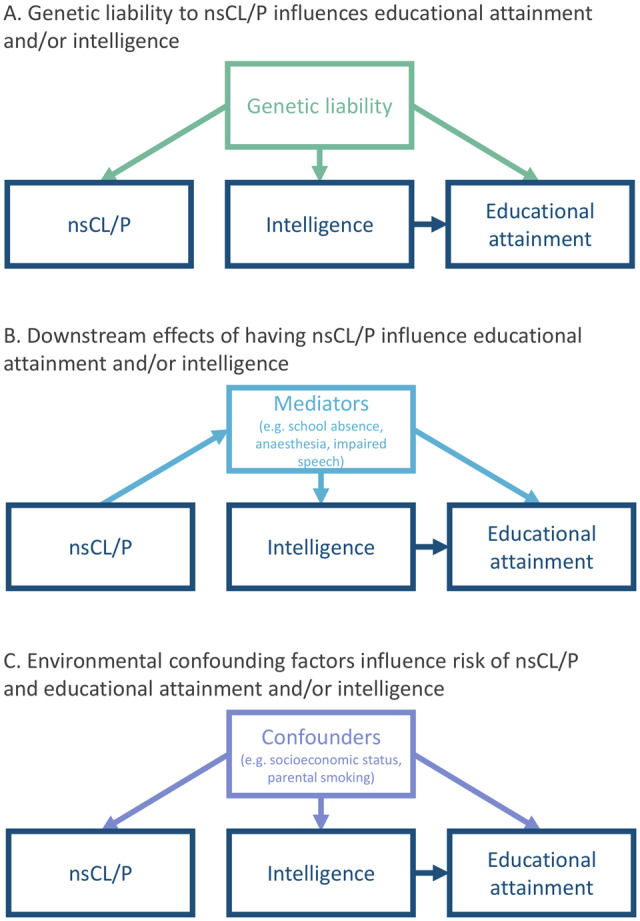
Previous studies have found that children born with a non-syndromic orofacial cleft have lower-than-average educational attainment. Differences could be due to a genetic predisposition to low intelligence and academic performance, factors arising due to the cleft phenotype (such as social stigmatization, impaired speech/language development) or confounding by the prenatal environment. A clearer understanding of this mechanism will inform interventions to improve educational attainment in individuals born with a cleft, which could substantially improve their quality of life. We assessed evidence for the hypothesis that common variant genetic liability to non-syndromic cleft lip with or without cleft palate (nsCL/P) influences educational attainment.
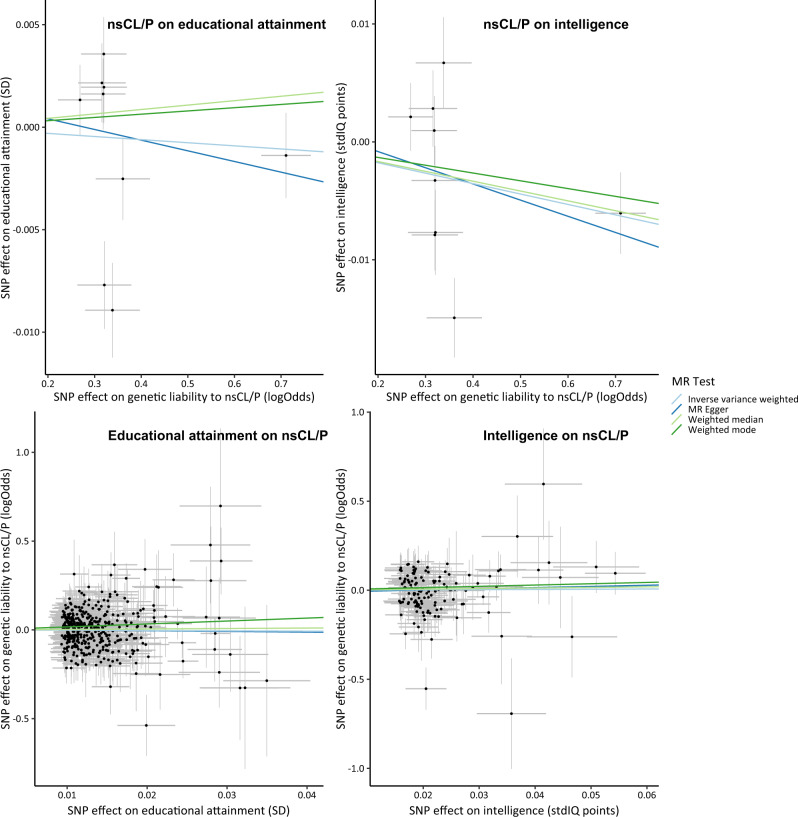
We performed a genome-wide association study (GWAS) meta-analysis of nsCL/P with 1692 nsCL/P cases and 4259 parental and unrelated controls. Using GWAS summary statistics, we performed Linkage Disequilibrium (LD)-score regression to estimate the genetic correlation between nsCL/P, educational attainment (GWAS n = 766 345) and intelligence (GWAS n = 257 828). We used two-sample Mendelian randomization to evaluate the causal effects of genetic liability to nsCL/P on educational attainment and intelligence.
There was limited evidence for shared genetic aetiology or causal relationships between nsCL/P and educational attainment [genetic correlation (rg) -0.05, 95% confidence interval (CI) -0.12 to 0.01, P 0.13; MR estimate (βMR) -0.002, 95% CI -0.009 to 0.006, P 0.679) or intelligence (rg -0.04, 95% CI -0.13 to 0.04, P 0.34; βMR -0.009, 95% CI -0.02 to 0.002, P 0.11).
Common variants are unlikely to predispose individuals born with nsCL/P to low educational attainment or intelligence. This is an important first step towards understanding the aetiology of low educational attainment in this group.
先前的研究发现,患有非综合征性口面部裂隙的儿童教育程度低于平均水平。差异可能归因于低智力和学业表现的遗传易感性、由裂隙表型引起的因素(如社会污名化、言语/语言发育受损)或产前环境的混杂因素。更清楚地了解这一机制将为改善裂隙患儿教育程度的干预措施提供依据,这可能会大幅提高他们的生活质量。我们评估了以下假设的证据:非综合征性唇裂伴或不伴腭裂(nsCL/P)的常见变异基因易感性会影响教育程度。
我们对1692例nsCL/P病例以及4259例父母及无关对照进行了nsCL/P的全基因组关联研究(GWAS)荟萃分析。利用GWAS汇总统计数据,我们进行连锁不平衡(LD)评分回归,以估计nsCL/P、教育程度(GWAS样本量n = 766345)和智力(GWAS样本量n = 257828)之间的遗传相关性。我们使用两样本孟德尔随机化来评估nsCL/P遗传易感性对教育程度和智力的因果效应。
nsCL/P与教育程度之间存在共同遗传病因或因果关系的证据有限[遗传相关性(rg)为-0.05,95%置信区间(CI)为-0.12至0.01,P = 0.13;孟德尔随机化估计值(βMR)为-0.002,95%CI为-0.009至0.006,P = 0.679],与智力之间也是如此(rg为-0.04,95%CI为-0.13至0.04,P = 0.34;βMR为-0.009,95%CI为-0.02至0.002,P = 0.11)。
常见变异不太可能使患有nsCL/P的个体易患低教育程度或低智力。这是了解该群体低教育程度病因的重要第一步。