Department of Population Health Sciences, Duke University School of Medicine, Durham, NC 27710;
Social Science Research Institute, Duke University, Durham, NC 27708.
Proc Natl Acad Sci U S A. 2018 Jul 31;115(31):E7275-E7284. doi: 10.1073/pnas.1801238115. Epub 2018 Jul 9.
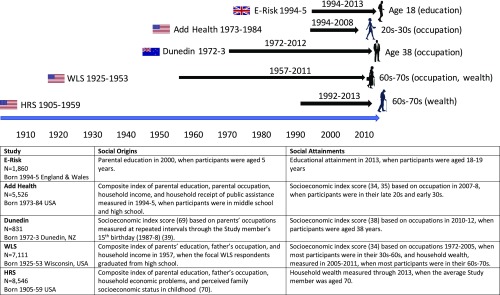
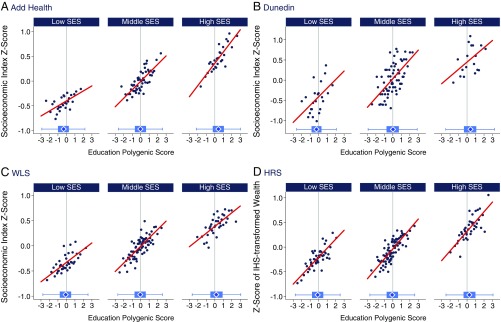
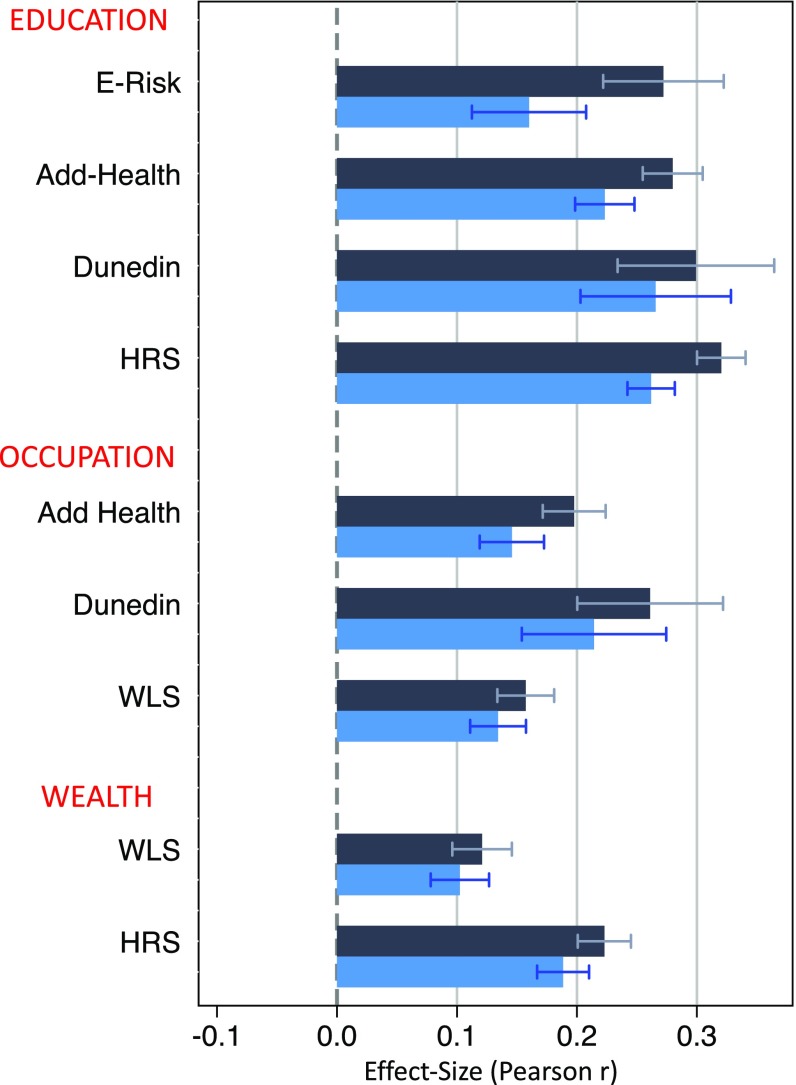
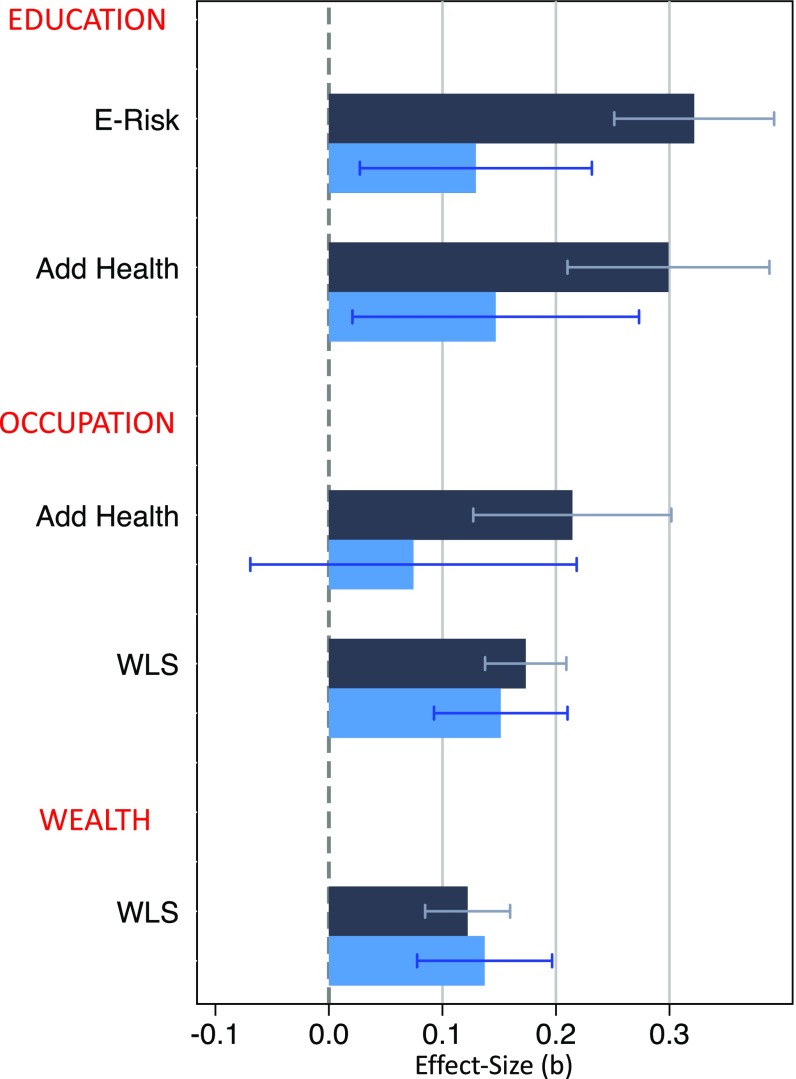
A summary genetic measure, called a "polygenic score," derived from a genome-wide association study (GWAS) of education can modestly predict a person's educational and economic success. This prediction could signal a biological mechanism: Education-linked genetics could encode characteristics that help people get ahead in life. Alternatively, prediction could reflect social history: People from well-off families might stay well-off for social reasons, and these families might also look alike genetically. A key test to distinguish biological mechanism from social history is if people with higher education polygenic scores tend to climb the social ladder beyond their parents' position. Upward mobility would indicate education-linked genetics encodes characteristics that foster success. We tested if education-linked polygenic scores predicted social mobility in >20,000 individuals in five longitudinal studies in the United States, Britain, and New Zealand. Participants with higher polygenic scores achieved more education and career success and accumulated more wealth. However, they also tended to come from better-off families. In the key test, participants with higher polygenic scores tended to be upwardly mobile compared with their parents. Moreover, in sibling-difference analysis, the sibling with the higher polygenic score was more upwardly mobile. Thus, education GWAS discoveries are not mere correlates of privilege; they influence social mobility within a life. Additional analyses revealed that a mother's polygenic score predicted her child's attainment over and above the child's own polygenic score, suggesting parents' genetics can also affect their children's attainment through environmental pathways. Education GWAS discoveries affect socioeconomic attainment through influence on individuals' family-of-origin environments and their social mobility.
一种综合遗传指标,称为“多基因评分”,源于对教育的全基因组关联研究(GWAS),可以适度预测一个人的教育和经济成功。这种预测可能表明存在一种生物学机制:与教育相关的遗传可能编码有助于人们在生活中取得成功的特征。或者,预测可能反映社会历史:来自富裕家庭的人可能因为社会原因而保持富裕,而这些家庭在遗传上也可能相似。区分生物学机制和社会历史的关键测试是,具有较高教育多基因评分的人是否倾向于超越父母的地位攀登社会阶梯。向上流动将表明与教育相关的遗传编码有助于成功的特征。我们在五个美国、英国和新西兰的纵向研究中测试了 20000 多名个体中与教育相关的多基因评分是否可以预测社会流动性。具有较高多基因评分的参与者接受了更多的教育和职业成功,并积累了更多的财富。然而,他们也往往来自条件较好的家庭。在关键测试中,与父母相比,具有较高多基因评分的参与者更倾向于向上流动。此外,在兄弟姐妹差异分析中,具有较高多基因评分的兄弟姐妹更倾向于向上流动。因此,教育 GWAS 发现不仅仅是特权的相关因素;它们在一生中影响社会流动性。进一步的分析表明,母亲的多基因评分可以预测她孩子的成就,超过孩子自身的多基因评分,这表明父母的遗传也可以通过环境途径影响他们孩子的成就。教育 GWAS 发现通过对个体出身环境及其社会流动性的影响,影响社会经济地位。